2026 On-Site Security Checklist: NYC & NJ Properties
The true measure of a property's safety in the New York and New Jersey metropolitan area is no longer found in the complexity of its software, but in the caliber and composure of the professionals who represent its front line. While technology offers a useful lens, it's the human element that provides the judgment and hospitality necessary to manage high-traffic urban environments effectively. You likely recognize the daily challenge of maintaining a secure perimeter without sacrificing the sense of welcome that defines a premium residential or corporate space. Meeting these local safety expectations requires a steady hand and a commitment to high standards that go beyond basic compliance.
This article offers a definitive on-site security checklist designed to help you master the art of property protection in 2026. By following this framework, you'll gain a clear path toward reducing liability and meeting the elevated expectations of the NYC and NJ markets. We'll examine how to conduct a professional security audit, the importance of personnel-focused protocols, and the specific steps required to ensure your residents and employees feel truly protected. Through a commitment to meticulous standards and quiet strength, you can transform your security strategy into a seamless extension of your property's core values.
Table of Contents
The Strategic Importance of a Professional On-Site Security Assessment
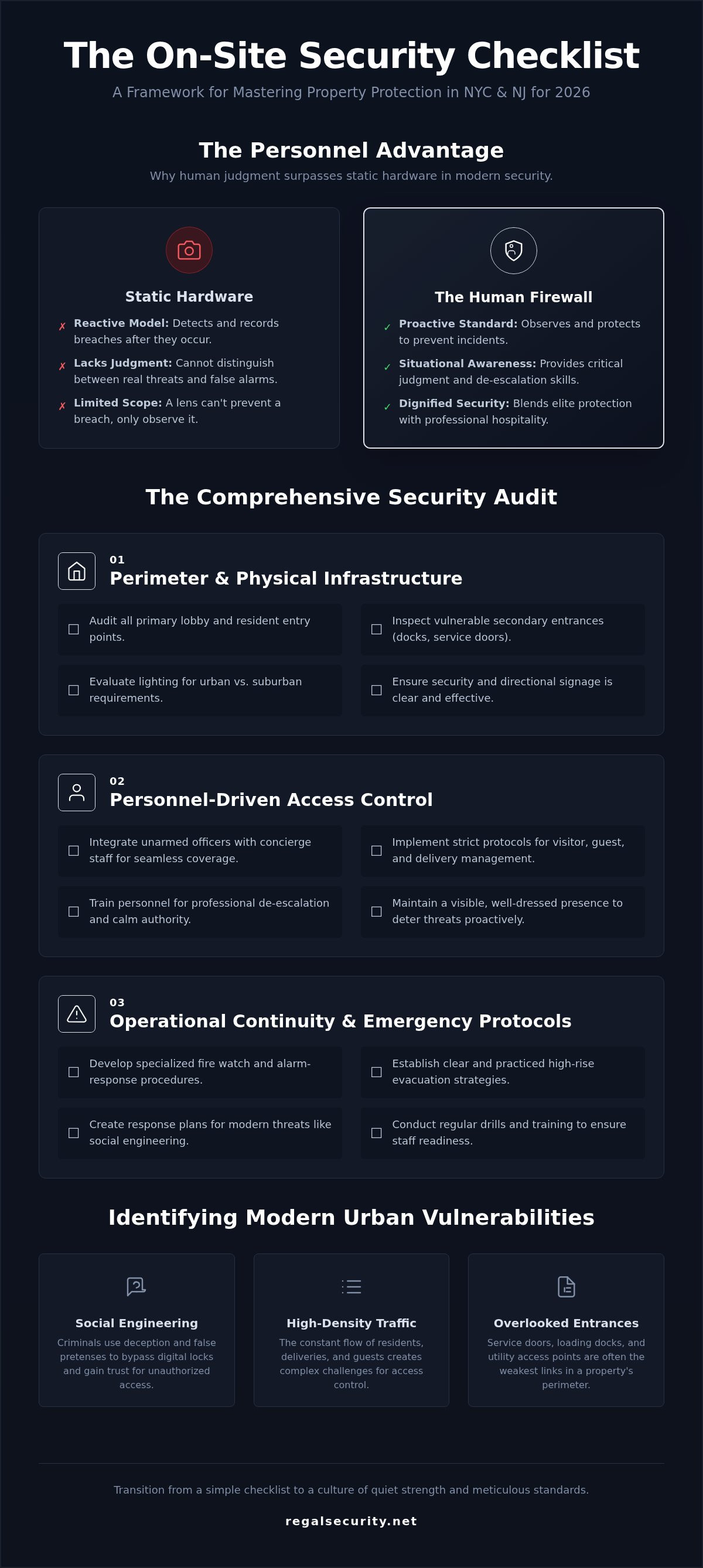
An effective security strategy begins with a deep understanding of the environment it seeks to protect. In the dense, fast-paced corridors of New York and New Jersey, a comprehensive on-site security checklist serves as a vital living document for risk mitigation. It isn't merely a static list of equipment or a set of binary tasks. Instead, it represents a dynamic commitment to safety that adapts as threats evolve. While modern properties often rely heavily on surveillance technology, static security measures like cameras frequently fail when they lack human intervention. A lens can capture a breach, but it cannot exercise the judgment required to prevent one from occurring in the first place.
Professional protection in 2026 emphasizes the concept of "Dignified Security." This approach ensures that safety measures respect the atmosphere of a luxury residence or a corporate headquarters, blending protection with hospitality. For property managers in the NYC and NJ markets, this methodology provides significant liability reduction benefits. By establishing clear, personnel-driven standards, managers demonstrate a meticulous duty of care that meets local safety expectations and legal requirements. It's about providing a stabilizing force that residents and employees can trust.
Identifying Modern Urban Vulnerabilities in 2026
The nature of urban risk has shifted from simple forced entry to sophisticated social engineering. Criminals now use deception to bypass digital locks or gain access to service entrances under false pretenses. In high-density residential areas across Brooklyn and Queens, unique protocols are necessary to manage the constant flow of residents, deliveries, and guests. These environments require a mastery of Physical Security Principles that prioritize de-escalation and precision. Unarmed security officers play a critical role here. They deter threats through their presence alone, managing potential conflicts with a calm authority that prevents situations from escalating needlessly.
The Personnel Advantage: Why Humans Trump Hardware
Technology provides data, but human personnel provide situational awareness. A motion sensor might trigger an alert for a stray cat or a blowing leaf, but a trained professional can distinguish between a routine delivery and a suspicious loitering event. Adopting peace of mind security services transforms the culture of a property. It moves the needle from a reactive "detect and record" model to a proactive "observe and protect" standard. The psychological impact of a visible, professional presence is profound. When residents see a composed, well-dressed officer at the entrance, it fosters a sense of stability and respect. This quiet strength ensures that every item on your on-site security checklist is executed with the elite capability your stakeholders deserve.
Perimeter and Physical Infrastructure: Securing the First Line of Defense
The perimeter of a property is its first opportunity to communicate a standard of order and safety. In the New York and New Jersey metropolitan areas, this boundary often consists of more than just physical barriers; it involves the meticulous management of flow through every available entrance. An effective on-site security checklist must begin with a rigorous audit of all physical entry points. This includes not only the primary lobby doors but also the loading docks and service entrances that are frequently overlooked. In high-density environments like Midtown Manhattan, these secondary points are often the most vulnerable to unauthorized access if they are not properly monitored.
Lighting requirements differ significantly between urban centers and suburban areas such as Westchester or Suffolk County. In the city, lighting must be bright enough to deter loitering without contributing to light pollution that disturbs residents. In suburban New Jersey, lighting standards focus on illuminating sprawling parking lots and perimeters where natural visibility is lower. Signage should be discreet yet authoritative, signaling that the property is under the care of a professional guardian. For larger, more expansive properties in New Jersey, the integration of vehicle patrols provides a mobile layer of protection that static systems cannot match, ensuring that the entire grounds are surveyed regularly.
Lobby and Entryway Integrity
The main entrance serves as the primary "choke point" for any building. It's essential to assess the efficiency of this space to ensure that security personnel can monitor arrivals without creating congestion. Clear sightlines are vital for a concierge security officer to maintain total awareness of the lobby area. Standardizing digital check-in procedures and visitor logs ensures that every individual on the premises is accounted for with precision, providing a reliable record of who has entered and exited the building.
External Property and Parking Security
Managing the safety of secondary structures is just as critical as securing the main building. Bike rooms, storage areas, and mail centers are common targets for theft and require regular inspection as part of your on-site security checklist. For large residential complexes, vehicle patrol routes should prioritize identifying "blind spots" where lighting or camera coverage may be insufficient. These are the areas where a professional presence must be most visible to deter potential incidents. If you are looking to enhance your property's perimeter safety, considering a professional security assessment can provide the clarity needed to address these vulnerabilities effectively.
Personnel-Driven Access Control: Integrating Concierge and Unarmed Officers
Personnel-driven access control represents the sophisticated layer of protection where technology meets human intuition. While a gate or a card reader can verify a credential, it cannot vet the intent of a visitor or the validity of a vendor's presence. This "Human Firewall" is a critical component of any modern on-site security checklist, ensuring that every individual entering the premises is accounted for with precision. High standards of integrity and moral uprightness are non-negotiable. These professionals are entrusted with the safety of high-value assets and the peace of mind of residents, requiring a level of dedication that a camera simply cannot provide.
Every assignment requires a specific set of "Post Orders" that detail the unique duties of the site. These instructions ensure that officers aren't merely present but are actively executing a tailored strategy, a key element of a robust on-site security checklist. This level of meticulousness is what distinguishes a professional security partner from a reactive guard service. In environments where security must coexist with a luxury lifestyle, the hybrid model of protection and hospitality becomes the gold standard for property management. It provides a stabilizing force that is both effective and respectful of the property's atmosphere.
The Unarmed Officer's Daily Checklist
A professional's routine is defined by consistency and sharp observation. For unarmed security officers, the daily protocol includes several key actions:
Executing varied patrol patterns to eliminate predictability and identify vulnerabilities.
Maintaining clear, formal communication with corporate clients and stakeholders.
Utilizing proactive de-escalation techniques in retail or residential settings to resolve conflicts quietly.
Reporting anomalies with precise detail to ensure operational continuity and risk mitigation.
Concierge Security: The Face of Your Building
The concierge serves as a prestigious guardian, bridging the gap between high-tier service and constant vigilance. Their presence must be dignified, reflecting the property's values through a professional appearance and composed conduct. In Manhattan, where courier traffic is constant and high-volume, the concierge manages the intake of packages and the vetting of delivery personnel with seamless efficiency. This role requires a delicate balance. They must offer a warm welcome to residents while maintaining the sharp awareness necessary to identify potential risks before they materialize. This dual focus ensures that the first point of contact is both a service provider and a dedicated protector.
Operational Continuity and Emergency Protocol Checklists
Operational continuity is the hallmark of a well-managed property. When a building’s mechanical systems fail or an emergency occurs, the transition from routine to response must be seamless. A professional on-site security checklist includes dedicated fire watch protocols to be enacted whenever life-safety systems undergo maintenance. This ensures that a human guardian is physically present to detect hazards, providing the protection that a dormant alarm system cannot. In the high-rise environments of Manhattan and Jersey City, these protocols are not just suggestions; they are essential components of a property’s duty of care.
Emergency evacuation for high-density structures requires more than a marked exit. It demands a calm, authoritative leader who can guide residents and employees through complex stairwells and assembly points. Standard Operating Procedures (SOPs) for medical emergencies and power outages must be practiced until they become second nature. When an incident occurs, the precision of the subsequent report is vital. Accurate documentation serves as a moral and legal record, providing the necessary detail for insurance providers and stabilizing the property’s liability profile. Meticulous record-keeping ensures that every action taken during a crisis is defensible and transparent.
NYC and NJ Compliance Standards
Maintaining compliance with local fire and safety ordinances is a foundational requirement for any metropolitan property manager. In 2026, aligning your security protocols with current NYC building codes ensures that your facility remains both safe and lawful. Security personnel play a central role in conducting "Active Threat" drills, fostering a culture of preparedness without creating an atmosphere of fear. Professional security staffing services provide the expertise needed to manage these documentation requirements, ensuring that every shift is logged with meticulous care and meets the expectations of local regulators.
Incident Management and Response
The first five minutes of any crisis are the most critical. Security’s primary role is to stabilize the situation, providing clear direction until emergency services arrive. Established communication chains ensure that stakeholders are notified promptly and accurately, preventing the spread of misinformation during a disruption. Following any event, a post-incident review allows you to turn your on-site security checklist into a tool for continuous improvement. This methodical approach ensures that your strategy evolves alongside the risks you face. If you are ready to elevate your property's emergency readiness, you can consult with a professional security partner to develop a tailored response strategy today.
Implementing Your Security Strategy: From Audit to Professional Staffing
Moving from an internal draft to a formal professional contract represents a significant step in property maturity. While an on-site security checklist provides a necessary foundation, its value is only fully realized when it is executed by personnel who embody a sense of duty and precision. Transitioning from a "DIY" approach to a professional staffing model ensures that your safety protocols are not just written, but lived. This process begins with a meticulous review of your current findings and a commitment to high standards that align with the expectations of a premium metropolitan property.
Vetting a security partner requires a focus on three pillars: precision, morality, and deep local expertise. You should seek a guardian that views protection as a stabilizing force rather than a reactive one. The onboarding process for new personnel at your location must be handled with care, ensuring that every officer is fully integrated into the site-specific culture and "Post Orders" discussed in previous sections. Continuous improvement is maintained through quarterly audits, where the on-site security checklist is updated to reflect new risks, regulatory changes, or shifts in building occupancy.
Choosing the Right Security Partner in NYC/NJ
Local knowledge is indispensable when navigating the unique demands of Manhattan, Brooklyn, and various New Jersey counties. A partner must understand the nuances of local regulations, such as the 2026 requirements for storefront visibility under NYC Local Law 75 or the specific fire watch expectations for high-rise residential towers. When evaluating a firm, prioritize their commitment to "Unarmed Excellence" and sophisticated de-escalation techniques. Ask detailed questions about their officer training programs and how they customize their approach to fit your specific environment. A dignified presence is just as important as technical capability in maintaining the prestige of your property.
Your Next Steps for Peace of Mind
The path to a more secure environment begins with a professional site walkthrough. This risk assessment allows experts to identify vulnerabilities that may not be apparent during a routine internal audit. Whether you manage a corporate headquarters in Midtown or a sprawling residential complex in New Jersey, your protocols must be tailored to the specific needs of your industry. Customizing your checklist ensures that your security strategy is both efficient and effective, providing the stability your stakeholders require. To begin this transition, you can request a professional on-site security consultation from Regal Security to ensure your property is protected with the highest level of care and elite capability.
Securing Your Legacy in the Metropolitan Landscape
True security is a continuous commitment to excellence that evolves alongside the unique challenges of the New York and New Jersey markets. By utilizing a comprehensive on-site security checklist, you establish a foundation of precision that protects both your physical assets and the people who rely on them. We have explored how the integration of elite personnel, meticulous perimeter audits, and robust emergency protocols creates a stabilizing force for any property. It's the combination of human intuition and professional standards that ensures your environment remains safe, dignified, and compliant with modern regulations.
As you look toward the future, the caliber of your security partner becomes the defining factor in your property's resilience. Regal Security offers integrity-driven unarmed security and specialized concierge services tailored for NYC luxury properties and corporate hubs. Our dedicated professionals serve all five NYC boroughs and Northern and Central NJ, bringing a level of quiet strength to every post. Secure Your Property with Regal Security’s Professional On-Site Officers and experience the stability that comes from a partner committed to elite capability. Your dedication to these high standards today ensures a more secure and respected environment for years to come.
Frequently Asked Questions
What is included in a standard on-site security checklist?
A standard checklist covers physical perimeter integrity, access control protocols, visitor management logs, and emergency equipment inspections. It should also include personnel-specific tasks like shift handover reports and de-escalation training reviews. A comprehensive on-site security checklist ensures that every vulnerability, from unlit stairwells to service entrance protocols, is addressed with meticulous precision to maintain a property’s elite standards and operational continuity.
How often should a property manager conduct a security audit in NYC?
Quarterly audits are the industry standard for maintaining high-tier security in high-traffic urban environments. These regular reviews allow managers to adapt to shifting local regulations, such as NYC Local Law 75 or updated fire codes. Frequent assessments ensure that your protocols remain a living document, reflecting the current risk landscape while providing residents and employees with the peace of mind that comes from proactive, professional oversight.
Why is unarmed security preferred for luxury residential buildings?
Unarmed security officers provide a dignified presence that prioritizes de-escalation over confrontation. In luxury environments, the goal is to maintain a welcoming atmosphere while ensuring total protection. These professionals are trained to use situational awareness and verbal communication to resolve conflicts quietly, preventing the unnecessary tension that armed personnel might introduce. This approach aligns with the quiet strength expected in prestigious Manhattan and Brooklyn residences.
What is the difference between a security guard and a concierge security officer?
A security guard typically focuses on monitoring and surveillance, whereas a concierge security officer provides a hybrid of elite protection and high-tier hospitality. The concierge serves as the face of the building, managing visitor arrivals and package deliveries with a refined, professional conduct. They are trained to balance constant vigilance with service-oriented interactions, ensuring that security measures feel like a seamless part of the resident experience.
How do I secure a large property that has multiple entry points?
Securing a large property requires a layered approach that combines stationary personnel at primary choke points with mobile vehicle patrols for the perimeter. By centralizing visitor check-ins at a main desk and utilizing unarmed officers to monitor secondary service entrances, you create a comprehensive human firewall. Regular audits of all access points should be a core component of your on-site security checklist to identify and mitigate any blind spots.
What are the legal requirements for security staffing in New Jersey?
New Jersey requires all security personnel to be registered under the Security Officer Registration Act (SORA). This involves mandatory training, background checks, and fingerprinting through the State Police. Employers must also provide written notice before monitoring employee communications according to N.J.S.A. 34:6B-5. Ensuring your staffing partner adheres to these meticulous standards is essential for reducing liability and maintaining a professional, moral presence on your property.
Can a security checklist help reduce my property insurance premiums?
Many insurance providers offer favorable rates to properties that demonstrate a rigorous, documented approach to risk mitigation. By maintaining a detailed checklist and conducting regular professional audits, you provide verifiable proof of your duty of care. This meticulous documentation shows that you are actively working to reduce incidents, which can lead to lower liability premiums and improved standing with your insurance carrier over the long term.
How does vehicle patrol work with on-site security officers?
Vehicle patrols act as a mobile extension of your on-site team, providing coverage for sprawling perimeters and parking structures that are difficult to monitor on foot. These patrols follow varied routes to eliminate predictability and can respond rapidly to anomalies detected by stationary officers. This coordinated effort ensures that every area of the property is surveyed regularly, reinforcing a sense of stability and elite capability across the entire site.


