25 Essential Questions to Ask a Security Company Before Hiring
Could a single lapse in judgment by an unvetted guard do more damage to your reputation than the very incident they were hired to prevent? Most property managers and corporate executives understand that true safety is built on a foundation of discipline rather than mere presence. It's natural to feel a sense of anxiety regarding the liability and licensing complexities inherent in the NY and NJ markets. Knowing the right questions to ask a security company is the only way to move past the surface level and identify a partner that values precision as much as you do.
You deserve the peace of mind that comes from a team that acts with moral uprightness and quiet strength. We've compiled a list of the 25 essential inquiries that will help you vet an agency's training protocols, concierge standards, and emergency response capabilities. This guide provides a clear framework for your next interview. You'll gain the confidence to select a provider that acts as a seamless extension of your brand while maintaining the highest standards of professional conduct and regulatory compliance. By asking the right questions, you ensure your security partner is a stabilizing force for your organization.
Table of Contents
The Strategic Importance of Vetting Your Security Partner
Engaging a private security company is a decision that extends far beyond a simple line item in an annual budget. It represents a long-term commitment to the stability of your brand and the safety of your occupants. When you view security as a strategic investment rather than a reactive expense, you begin to understand that the caliber of the personnel on your site reflects the caliber of your own organization. A professional guard is not merely a deterrent; they are a stabilizing force that maintains the dignity of your property through quiet strength and professional assurance.
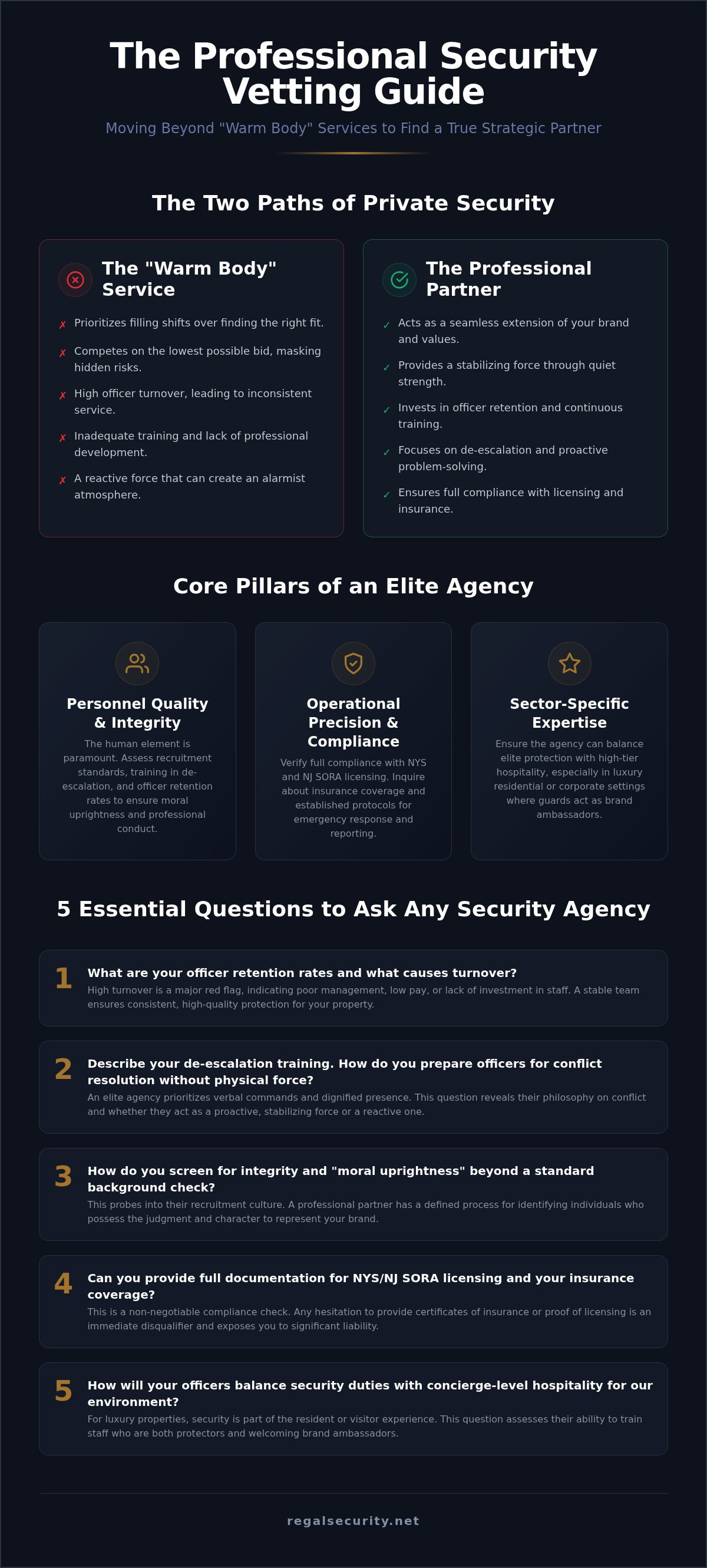
The industry often struggles with "warm body" services, where companies prioritize filling shifts over finding the right fit for a specific environment. This approach carries immense hidden risks, particularly when agencies submit the lowest possible bid to secure a contract. A low price often masks inadequate training, high turnover, and a lack of insurance compliance. By preparing the right questions to ask a security company, you look past the uniform and into the agency’s internal culture. You seek a partner that values precision and moral uprightness, ensuring that every officer acts with the integrity your environment demands.
Defining the Professional Security Partnership
A truly elite partnership moves your organization from a reactive mindset to a proactive, stabilizing presence. In luxury residential or corporate settings, a security officer serves as a brand ambassador, often being the first and last person a visitor encounters. High-tier peace of mind security services create an atmosphere of quiet strength where residents and employees feel both protected and respected. This seamless integration of safety and service ensures that the presence of security enhances the property’s prestige rather than detracting from it through aggressive or alarmist behavior.
Identifying Your Specific Security Objectives
Every facility possesses unique requirements that dictate the necessary level of oversight. You must determine whether your objectives center on asset protection, hospitality-led concierge services, or executive safety. Defining these objectives early helps you refine the specific questions to ask a security company during the procurement process. For larger perimeters or multi-site complexes, you might consider whether a static post is sufficient or if your facility requires the mobility of vehicle patrol security services. Aligning your organizational values with the provider’s mission is essential for a partnership built on mutual trust and elite capability.
Questions Regarding Personnel Quality and Professional Standards
The human element is the most critical component of any security strategy. When you're evaluating a potential partner, the most vital questions to ask a security company revolve around their recruitment standards. You aren't just hiring a uniform; you're hiring an individual who must embody integrity and exercise precise judgment. A professional agency should be able to articulate how they measure moral uprightness in their staff and ensure that every officer acts as a stabilizing force on your property. This level of scrutiny ensures that the personnel representing your brand possess the quiet strength necessary for elite protection.
We believe that unarmed security officers serve as a sophisticated, de-escalating force. Ask the provider about their philosophy on conflict resolution. Do they train their staff to be a reactive force, or a proactive one? True precision in security is found in the ability to neutralize a situation through verbal command and dignified presence rather than physical escalation. This approach maintains a secure environment without creating the alarmist atmosphere often associated with less professional agencies.
Officer retention is another key indicator of quality. Ask about their retention rates and how they foster employee loyalty. High turnover often signals a lack of investment in the staff, which directly impacts the consistency of your protection. Agencies that foster loyalty through professional development and fair treatment provide a more stable, dependable service. If you're ready to partner with a team that prioritizes these elite standards, you can review our professional standards to see the difference.
The Vetting and Recruitment Process
In the NY and NJ markets, basic state compliance is merely the starting point. Inquire about multi-layered background checks that investigate beyond the standard criminal records. Does the agency employ psychological screenings to ensure candidates possess the temperament for high-pressure environments? Understanding the caliber of the person behind the badge provides the assurance that your property is in capable hands. These are the critical questions to ask a security company to ensure they don't simply provide "warm bodies" but rather elite personnel who respect the gravity of their duty.
Training for Precision and Discretion
Training should be an ongoing pursuit rather than a one-time event. Ask how officers are prepared to integrate into luxury residential or corporate cultures where discretion is paramount. For those requiring specialized details, such as those provided by an executive protection agency, the training must be even more meticulous. It's essential to know if officers receive specific instruction in hospitality-led security, ensuring they protect your assets while respecting the privacy and comfort of your guests.
Evaluating Operational Precision and Local Compliance
Operational excellence is built on a foundation of rigorous standards and meticulous oversight. When you consider the safety of your property, you must look beyond the physical presence of an officer and examine the regulatory framework that supports them. One of the most essential questions to ask a security company concerns their unwavering commitment to state-level compliance. In the tri-state area, this isn't merely a suggestion; it's a legal necessity that protects you from significant liability and ensures the personnel on your site have met the gold-standard for training.
A professional agency maintains transparency regarding their insurance coverages and operational protocols. You should verify that their policies specifically cover unarmed security and vehicle patrols in high-density environments. Incident reporting systems are equally vital. Precision in reporting ensures that every observation is documented with clarity, providing you with a logical and steady flow of information. This methodical approach to documentation allows for a seamless transition between shifts. It ensures that no detail is overlooked and that your property remains a stable environment.
Navigating NY and NJ Regulatory Standards
Compliance in New York and New Jersey requires a deep understanding of local mandates. In New York, every officer must complete an 8-hour pre-assignment training course followed by a 16-hour on-the-job training course within 90 days of starting work. Annual 8-hour in-service training is also mandatory to maintain licensure. Similarly, NJ SORA standards require rigorous state-approved training. When interviewing a provider, ask how they stay current with evolving regulations in Manhattan, Westchester, Long Island, and the surrounding boroughs. Verifying these licenses for your specific jurisdiction ensures your partner is fully authorized to operate within the law.
Operational Accountability and Supervision
Accountability is maintained through a clear chain of command and active supervision. You should know exactly who your direct point of contact is and how the agency audits performance. Key indicators of operational precision include:
Frequency of unannounced site visits by mobile supervisors to ensure high standards.
Use of digital patrol tracking to verify officer presence and movement in real-time.
Standardized protocols for shift handovers and detailed briefing logs.
Technology should be used to enhance human oversight rather than replacing the seasoned judgment of a professional. These supervisory layers ensure that the quiet strength promised by the agency is consistently delivered. By asking these targeted questions to ask a security company, you don't just confirm their operational precision; you secure the success and safety of those you serve.
Sector-Specific Inquiries for Residential and Corporate Environments
Security requirements are rarely uniform across different asset classes. A luxury residential lobby demands a vastly different approach than a high-stakes corporate headquarters. When refining your list of questions to ask a security company, it's essential to probe their experience in your specific sector. You need a partner who understands that a security presence shouldn't just be effective; it must be appropriate for the culture of the environment it protects. This is particularly true for properties where the officer acts as the primary point of contact for residents or high-level executives.
The role of a concierge security officer represents a sophisticated hybrid of protection and hospitality. Ask the agency how they train their staff to balance these two seemingly opposing duties. A professional officer must be able to manage high-traffic access control and complex package logistics while maintaining the dignified, welcoming presence expected in a luxury condominium. This "quiet strength" ensures that safety is maintained without making residents feel as though they are entering a fortress. If your property requires this level of meticulous care, contact us to discuss your specific site needs.
The Concierge and Residential Framework
In a residential setting, the officer is a key component of resident retention. You should ask how the agency handles the nuances of front-desk operations. Can the officers manage visitor logs with precision? Do they understand the importance of discretion regarding resident privacy? A welcoming yet firm presence enhances the overall living experience. Inquiring about their specific experience in luxury settings will reveal if they possess the caliber of personnel required to uphold your building’s prestige.
Corporate and Executive Protection Nuances
Corporate environments present a different set of challenges that require specialized security staffing services. For large-scale facilities or leadership details, discretion is the primary objective. These are the specific questions to ask a security company regarding corporate safety:
How do you prepare officers to handle sensitive internal events, such as corporate terminations, with dignity and restraint?
What experience do you have providing a discreet security presence for executive leadership that does not disrupt business operations?
How do your protocols differ when securing a retail environment versus a private corporate headquarters?
A seasoned professional remains calm under pressure and dedicated to the success of those they serve. They act as a stabilizing force during times of transition or heightened sensitivity, ensuring that your organization’s operations remain seamless and secure.
Finalizing the Selection: Red Flags and Green Lights
Selecting a security partner is a meticulous process that culminates in a decision based on trust and verified capability. As you review the responses to the questions to ask a security company, certain indicators will distinguish elite providers from standard agencies. A significant red flag is an agency’s inability to provide specific, local references within the NY/NJ area. Regional expertise is non-negotiable in markets like Manhattan or Jersey City, where local regulations and building cultures are unique. If a provider cannot demonstrate a proven track record in your immediate vicinity, they likely lack the nuance required for your facility.
Another warning sign is a lack of transparency regarding officer compensation or training hours. Quality protection is built on the caliber of the personnel; agencies that underpay their staff often suffer from high turnover and low morale. Conversely, a primary green light is a proposal that feels logical and customized rather than a generic template. You should look for a commitment to dignity and quiet strength in all communications, as these traits reflect the internal culture of the agency. When a provider takes the time to address your specific risks with precision, they demonstrate a dedication to your long-term stability.
The Contract and Service Level Agreement (SLA)
The transition from a proposal to a formal agreement requires a focus on accountability. A professional Service Level Agreement should include clear performance metrics and clauses that allow for scalability as your organizational needs evolve. It's prudent to request a sample incident report during this stage. Evaluating the quality of their documentation reveals the agency’s level of meticulousness. If the reports are vague or poorly structured, it's a sign that their on-site precision may also be lacking. A gold-standard partner provides documentation that is as disciplined as their physical presence.
The Final Walkthrough: Aligning Expectations
Before the first shift begins, a final walkthrough ensures that all expectations are perfectly aligned. This is the time to confirm that the post orders are tailored specifically to your facility’s layout and culture. You should establish a clear frequency for management reviews and site audits to maintain a high level of oversight. Making the final decision involves choosing a partner that acts as a prestigious guardian. Regal Security represents this gold standard in local protection, offering a seamless integration of elite capability and moral uprightness. By following this methodical framework and asking the right questions to ask a security company, you secure a partner dedicated to the success and safety of those you serve.
Securing a Legacy of Professionalism and Precision
Choosing the right partner requires moving beyond the surface of a uniform to examine the moral uprightness and local expertise of the agency. By utilizing a methodical framework of questions to ask a security company, you ensure that your provider is a stabilizing force rather than a reactive one. This vetting process reveals whether an agency possesses the meticulous standards and regulatory depth necessary to protect your specific interests in the NY and NJ markets. It's a strategic investment in your brand's stability and the safety of those you serve.
The right security partner acts as a prestigious guardian, blending elite protection with high-tier hospitality. You deserve the peace of mind that comes from meticulous vetting and deep expertise in local regulations. If you're ready to elevate your property's safety standards, secure your property with Regal Security's professional unarmed officers today. Our team provides a dignified, professional presence that ensures stability and precision across luxury residential and corporate sectors. Your dedication to safety deserves a partner that shares your commitment to excellence. We look forward to helping you establish an environment of quiet strength and absolute security.
Frequently Asked Questions
What is the difference between unarmed and armed security for a corporate office?
Unarmed security officers focus on deterrence through a dignified presence and verbal de-escalation, which is ideal for corporate environments where brand reputation is paramount. Armed personnel are generally reserved for high-risk settings involving volatile threats. For most Manhattan offices, a professional unarmed officer provides a sophisticated, non-confrontational atmosphere. This approach ensures safety without creating the alarmist environment that often accompanies armed details, maintaining a sense of stability and respect.
How do I verify if a security company is licensed in New York and New Jersey?
You can verify an agency’s credentials through the New York State Division of Licensing Services' public database and the New Jersey State Police Private Watchman licensing system. It's essential to confirm that the provider holds an active watch, guard, and patrol license. These are among the most critical questions to ask a security company during your vetting process. Always request current certificates to ensure they're authorized to operate in your specific jurisdiction.
What should be included in a standard security officer's training program?
A standard program must include state-mandated courses such as the New York 8-hour pre-assignment and 16-hour on-the-job training. Beyond these legal requirements, elite training includes conflict resolution, emergency response, and sector-specific hospitality for concierge roles. Professional agencies prioritize ongoing education to ensure officers remain sharp. You should look for a curriculum that emphasizes de-escalation techniques and precise reporting protocols to maintain a high level of operational integrity on your property.
How much liability insurance should a security company carry in NYC?
While specific requirements vary by contract, most professional agencies in New York City carry a minimum of $1 million per occurrence and $2 million in aggregate for general liability. Many high-tier corporate and residential properties require an umbrella policy of $5 million or more to mitigate risks. It's vital to ensure the policy specifically covers the services provided, such as unarmed guarding or vehicle patrols. This coverage protects your organization from potential financial liability.
Can a concierge security officer also handle mail and resident requests?
A concierge security officer is specifically trained to balance protection with high-tier hospitality duties. This includes managing package logistics, handling resident requests, and overseeing front-desk operations in luxury condominiums. Their presence acts as a stabilizing force that enhances resident retention while maintaining strict access control. By integrating these service-oriented tasks, the officer becomes a seamless part of the building's management team without compromising the safety and security of the luxury residential facility.
What is SORA certification, and why is it required for NJ security guards?
The Security Officer Registration Act, known as SORA, is a mandatory certification for all security personnel working in New Jersey. It requires a rigorous process including a 24-hour training course, fingerprinting, and a thorough background check conducted by the New Jersey State Police. This certification ensures that every guard possesses the necessary knowledge and moral character to perform their duties. SORA registration must be renewed every two years to maintain active status and compliance.
How quickly can a security company staff a new location in Long Island or Westchester?
Professional agencies with deep local roots in Long Island and Westchester can typically staff a new location within one to two weeks. This timeline allows for the meticulous selection of personnel who match the specific culture of your facility. While some providers claim same-day availability, a methodical approach ensures that the officers are properly briefed and trained on your site's unique post orders. Precision in staffing is far more valuable than a reactive placement.
Should I choose mobile patrols or a dedicated on-site security officer?
The choice depends on the size of your perimeter and your specific risk profile. A dedicated on-site officer provides a constant, stabilizing presence that is ideal for high-traffic lobbies or corporate headquarters in Manhattan. Mobile patrols are a cost-effective solution for larger perimeters or multi-site complexes in areas like Nassau or Suffolk County. Many clients find that a hybrid approach, combining a static officer with periodic vehicle patrols, offers the most comprehensive protection.


