Strategic Security Patrol Routes and Procedures: A Guide to Professional Asset Protection
Does the presence of a security officer on your property instill a genuine sense of tranquility, or does it merely serve as a reminder of potential risk? For many property managers across New York and New Jersey, the sight of a patrol officer often brings more questions than answers, especially when those rounds feel predictable, uninspired, or poorly documented. You've likely felt the frustration of paying for a service only to wonder if the designated security patrol routes and procedures are actually being followed with the precision your assets deserve.
We agree that true safety isn't found in a simple checklist, but in the meticulous stewardship of a professional who treats your property as a sanctuary. You deserve more than a reactive presence; you deserve a partner who operates with quiet confidence and absolute accountability. This guide will help you master the methodologies of professional patrolling to ensure your property remains a bastion of safety and stability. We'll explore the strategic design of patrol patterns, the latest verification methods for officer accountability, and how to maintain a sophisticated presence that protects residents without causing unnecessary alarm.
Table of Contents
Fundamentals of Security Patrol Routes and Procedures
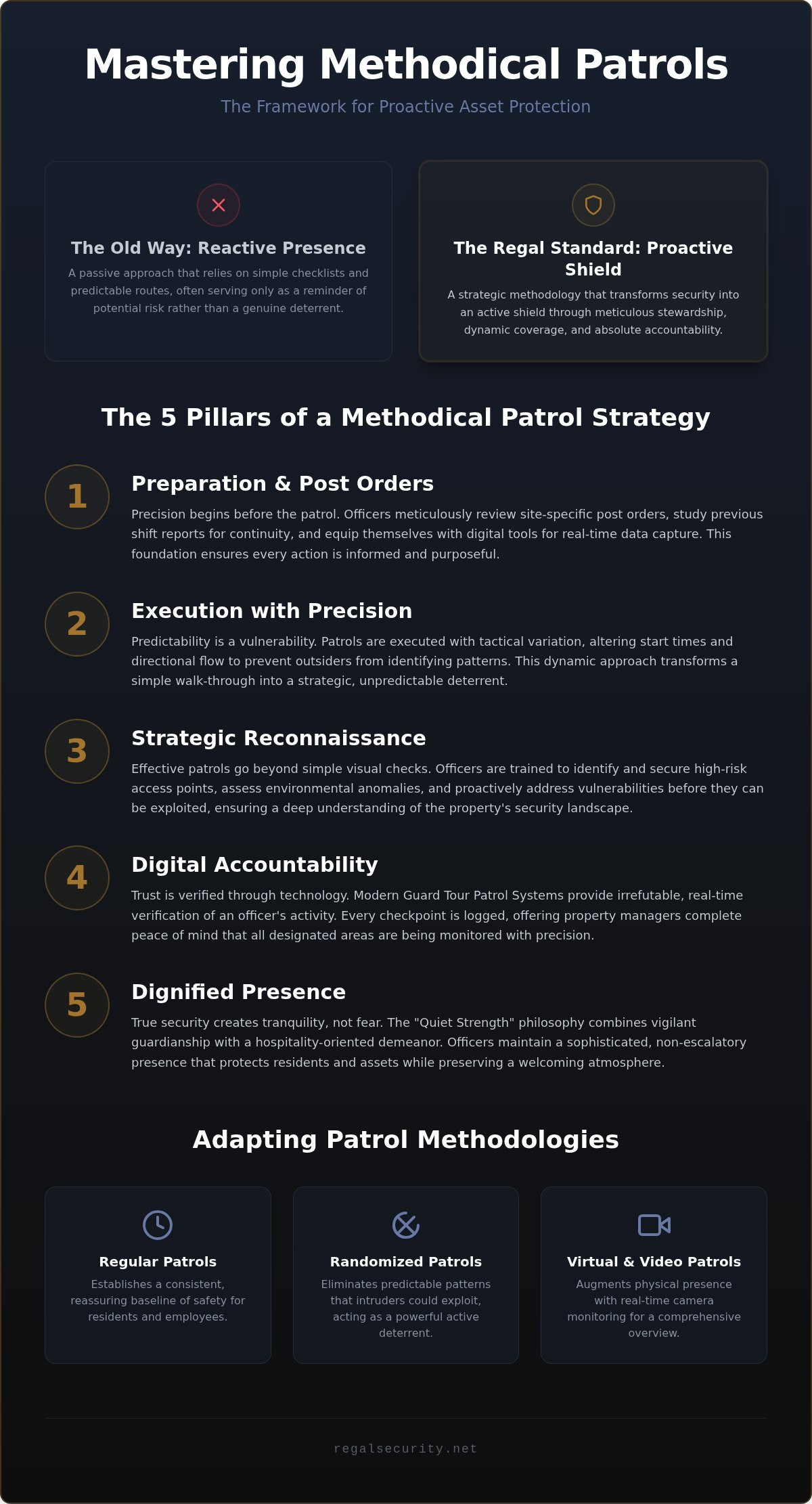
At its core, professional asset protection relies on a systematic movement through a property designed to deter threats and identify vulnerabilities before they escalate. This methodology transforms security from a reactive response into a proactive shield. By establishing comprehensive security patrol routes and procedures, property managers in NYC and NJ ensure their environment remains stable and secure. While a fixed post provides a visible point of contact, a mobile patrol offers the dynamic coverage necessary for larger or more complex environments.
Effective patrolling requires a clear distinction between various operational modes. A fixed post officer focuses on access control at a specific entry point, whereas mobile patrols move through designated areas to monitor the integrity of the entire perimeter. To manage these movements with precision, many professional teams utilize a Guard Tour Patrol System, which logs every checkpoint visited and ensures that no area is overlooked. This data-driven approach allows for a level of accountability that traditional "clock-in" methods simply cannot match.
Common Types of Patrol Methods
The strategy behind a patrol depends on the specific needs of the property. Regular patrols establish a consistent baseline of safety, providing a reassuring presence for residents and employees alike. However, consistency can sometimes lead to predictability. To counter this, randomized patrols are employed to eliminate patterns that potential intruders might exploit. These unpredictable rounds ensure that security remains an active deterrent at all times. Additionally, modern procedures often incorporate video and virtual patrols, where physical presence is augmented by real-time camera monitoring to provide a truly comprehensive view of the premises.
The 'Quiet Strength' Philosophy
A professional unarmed security officer represents a sophisticated alternative to more aggressive security models. This "quiet strength" approach relies on a dignified uniform and professional posture to act as a natural deterrent. It's a philosophy rooted in the belief that a security professional should be both a vigilant guardian and a welcoming presence. This balance is critical for asset protection in environments where hospitality is as important as safety.
In high-tier residential and corporate settings, the goal is to provide elite protection without creating an atmosphere of fear. By balancing meticulous observation with a hospitality-oriented demeanor, officers identify subtle irregularities while remaining approachable to those they serve. This non-escalatory presence is essential for maintaining the sanctuary-like feel of a premium property, proving that precision and morality are the most effective tools for modern security patrol routes and procedures.
The 5 Pillars of a Methodical Patrol Strategy
The execution of professional asset protection is never accidental. It's the result of a disciplined framework that transforms a simple walk-through into a strategic operation. By adhering to the five pillars of a methodical patrol strategy, officers ensure that every action contributes to the property's overall stability. This structured approach to security patrol routes and procedures allows for a seamless transition between observation and intervention, providing a level of care that exceeds standard industry expectations.
Preparation and Post Orders
Precision begins before the officer even steps onto the floor. Reviewing site-specific post orders is essential; these documents serve as the definitive guide for the unique vulnerabilities of a property. Continuity is maintained by studying previous shift reports, ensuring that any unresolved environmental anomalies or maintenance issues are addressed immediately. Equipping officers with digital reporting tools allows for the real-time capture of data, which is foundational to Effective Security Patrol Routes.
Executing the Patrol with Precision
A master of protection understands that predictability is a vulnerability. Officers vary their start times and directional flow to prevent observers from identifying a "pattern." This tactical variation is a hallmark of a high-tier security presence and is a core component of sophisticated security patrol routes and procedures. During the route, officers move beyond mere visual checks. They employ "active listening" to detect unusual mechanical sounds and use sensory observation to identify environmental changes like gas leaks or burning odors.
Checking sensitive areas such as mechanical rooms, stairwells, and roof access requires a specific tactical mindset. An officer must ensure their own safety while securing the perimeter, maintaining a professional posture that communicates readiness. Every observation, regardless of how minor it may seem, is documented with meticulous care. This level of control and reporting creates a transparent record of activity, providing property owners with the professional assurance they require.
Developing a "sixth sense" for situational awareness is the final pillar. It involves recognizing when something "feels" off, such as a propped door that is usually locked or a vehicle parked in a restricted zone. This elite level of awareness is what distinguishes a mere guard from a prestigious guardian. If you are seeking a partner who prioritizes this level of detail, consider how professional security services can elevate your property's safety standards.
Adapting Procedures for NYC and NJ Property Types
Every property possesses a unique rhythm that dictates its specific protective needs. In the vertical landscape of New York City, security patrol routes and procedures focus heavily on internal corridors, elevator banks, and high-traffic lobbies. Conversely, the sprawling corporate campuses and industrial parks of New Jersey require a broader lens that encompasses expansive perimeters and multiple access points. To build these customized plans, we often look to the CISA Security Planning Workbook as a foundational framework, which we then refine with local expertise to address the nuances of Manhattan high-rises or suburban estates.
Luxury Residential and Concierge Protocols
In high-tier residential environments, the patrol officer often serves as the primary point of contact for residents and guests. It's vital to integrate patrol duties with the high-register service expected of a concierge security officer. This dual role requires a delicate balance; an officer must manage package rooms and guest access with hospitality while maintaining the rhythm of their patrol cycle. Handling resident concerns with the dignity and assurance of a protective partner ensures the building remains a sanctuary of stability. Vigilance at the elevator banks and lobby entry points isn't just about security; it's about providing a gold-standard experience for those who call the building home.
Suburban and Industrial Perimeter Security
Managing large perimeters in suburban New Jersey or the gated enclaves of Long Island and Westchester necessitates a more mobile approach. For these expansive sites, we utilize a mix of foot and vehicle patrol security services to maintain a rapid response capability across the entire property. Specialized protocols for gatehouse management and meticulous vehicle logging are essential for residential communities where privacy is paramount. On industrial sites, overnight protocols focus on securing empty or low-occupancy facilities. This includes verifying the integrity of loading docks, mechanical rooms, and perimeter fencing to ensure that no vulnerability is left unaddressed during the quietest hours of the night.
Whether protecting a mixed-use retail space or a private residential enclave, the objective remains the same: balancing asset protection with a seamless experience for those on-site. By adapting procedures to the specific geography and occupancy of the property, a security force becomes a stabilizing force rather than a reactive one.
Accountability and Technology in Modern Patrols
Modern asset protection requires more than just a physical presence; it demands a verifiable record of stewardship. In the past, property managers often had to rely on faith that rounds were completed according to plan. Today, sophisticated digital tools transform security patrol routes and procedures into transparent, data-driven operations. This integration of technology ensures that every movement is purposeful and every observation is recorded with the precision that high-tier properties require.
The Role of Real-Time Data
Digital guard tour systems have replaced traditional paper logs, allowing for the real-time verification of checkpoint visits. When an officer scans a localized tag, the data is instantly uploaded, providing a timestamped record of their presence. This immediacy allows for the immediate correction of security gaps. If a checkpoint is missed or an irregularity is noted, supervisors are notified at once. Over time, this data reveals long-term trends in property vulnerabilities, enabling a more methodical approach to risk management and resource allocation.
Transparency as a Trust Builder
A professional security partner doesn't shy away from scrutiny; rather, they welcome it as a means of building lasting trust. Client portals provide property managers with 24/7 access to patrol data, offering a window into the daily operations of their protective team. This level of transparency is essential for maintaining peace of mind security services. Beyond simply logging arrivals, technology enables "exception reporting," which highlights what didn't occur. Knowing that a shift passed without a single unauthorized entry provides a comprehensive view of a property's stability.
For expansive sites in New Jersey or large estates on Long Island, GPS tracking ensures that mobile patrol units are exactly where they're scheduled to be. This precision isn't about surveillance of the staff, but about the integrity of the service provided to the client. By aligning cutting-edge technology with a culture of moral uprightness, a security force becomes a truly dependable partner. If you're ready to experience this level of professional accountability, contact Regal Security to discuss how we can secure your assets with precision.
The Regal Standard: Elevating Patrol Procedures
Excellence in asset protection is ultimately a human endeavor. While technology provides the necessary framework for accountability, it's the caliber and character of the personnel that define the actual level of safety. The Regal Standard is built on a foundation of meticulous training that emphasizes both tactical security and professional hospitality. We don't believe in a one-size-fits-all approach; instead, we customize security patrol routes and procedures to match the unique rhythm of your specific NYC or NJ property. This ensures our presence acts as a stabilizing force for your residents and employees alike.
Every movement an officer makes is a reflection of our commitment to your property's long-term stability. By conducting a thorough environmental assessment with every round, our team moves beyond simple observation to active stewardship. This methodical rhythm mirrors the operational nature of our service, where every action is planned and executed with care. Our officers are trained to understand the specific needs of the local environment, ensuring that their presence is always purposeful and their documentation is beyond reproach.
Why Dignified Presence Matters
Many security providers rely on an aggressive or alarmist approach that can inadvertently create a sense of anxiety among a property's occupants. Our philosophy is rooted in a different belief. We understand that a security professional should be a source of calm and reassurance. By maintaining a dignified presence and a professional posture, our officers act as a natural deterrent without disrupting the sanctuary of the environment. This "quiet strength" is the hallmark of our brand, providing the psychological benefit of a guardian who is always vigilant but never intrusive. It's about protecting the prestige of your property while ensuring its absolute safety.
Your Partner in Long-Term Safety
Choosing a security provider is about more than fulfilling a contractual obligation; it's about entering into a strategic safety partnership. We move beyond the traditional vendor relationship by prioritizing quality and integrity in every aspect of our operations. This commitment is reflected in our security staffing services, which are designed to ensure that every officer on your site is a seasoned professional capable of handling pressure with grace. By focusing on the caliber of our personnel, we provide a level of care that ensures the long-term safety and stability of your assets. Taking the first step toward a more secure property environment begins with a partner who understands that true protection is a meticulous, ongoing discipline rooted in a sense of duty.
Cultivating a Sanctuary of Safety and Stability
Establishing a sanctuary of safety requires more than a physical presence; it demands a disciplined commitment to excellence. You now understand that effective security patrol routes and procedures are built on a foundation of strategic planning, real-time accountability, and a hospitality-first mindset. By moving from reactive habits to proactive stewardship, you ensure your property remains a stable environment for residents and employees alike.
Serving New York City and New Jersey with a focus on dignified protection, we specialize in providing unarmed concierge and corporate security. We're trusted by luxury residential developments and executive clients to maintain the highest standards of morality and precision. This partnership moves your security from a simple vendor relationship to a strategic safety alliance.
Request a Professional Security Consultation with Regal Security to see how our methodical approach can elevate your property's safety. Your assets deserve the gold standard of care, and we're ready to help you achieve it.
Frequently Asked Questions
What is the difference between a fixed post and a security patrol?
A fixed post officer remains stationed at a specific location, such as a lobby desk in Manhattan or a gatehouse in a gated community, to manage access control and greet visitors. In contrast, a security patrol involves a mobile officer moving through the property to monitor various zones. While the fixed post provides a consistent point of contact, the patrol ensures that every corner of the premises is inspected for vulnerabilities, providing a comprehensive layer of protection.
How often should security patrol routes be changed to remain effective?
To remain effective, security patrol routes and procedures should be randomized on a shift-by-shift basis. Maintaining a rigid schedule allows observers to predict an officer’s location, creating windows of opportunity for unauthorized access. By varying start times, directional flow, and the order of checkpoints, professional guardians eliminate predictability. This methodical approach ensures that security remains an active deterrent rather than a passive routine that potential intruders can easily bypass.
Can unarmed security officers effectively deter criminal activity on my property?
Professional unarmed officers provide a powerful deterrent through "quiet strength" and vigilant observation. Their presence signals that a property is under expert stewardship, which discourages criminal activity without creating an alarmist atmosphere. By maintaining a dignified posture and performing meticulous rounds, these officers identify irregularities before they escalate. This non-escalatory approach is particularly effective in luxury residential and corporate environments across New Jersey and New York where maintaining stability is paramount.
What specific areas are typically included in a commercial property patrol route?
A comprehensive commercial route typically includes all perimeter entry points, loading docks, and parking facilities. Officers also inspect internal high-risk areas such as mechanical rooms, server closets, and stairwells to ensure they remain secure and free of hazards. During these rounds, officers look for signs of tampering, unauthorized vehicles, or environmental anomalies like water leaks. This systematic coverage ensures that the entire facility remains a safe environment for employees and visitors throughout the day.
How does a guard tour system ensure officer accountability during patrols?
A guard tour system utilizes scannable checkpoints, such as QR codes or NFC tags, placed at strategic locations throughout the property. When an officer scans a tag, the system records a precise timestamp and GPS coordinate, which is instantly transmitted to a central database. This technology provides property managers with verifiable proof that every designated area was inspected. It eliminates the guesswork associated with paper logs and ensures absolute accountability for the protective team on-site.
Are security patrol procedures different for residential vs. corporate buildings?
Residential procedures in Manhattan high-rises prioritize hospitality and the resident experience, often integrating patrol duties with concierge services like package management. In contrast, corporate buildings in New Jersey focus on large-scale access control and securing expansive perimeters. While both environments require meticulous observation, the residential officer acts as a protective partner for families, whereas the corporate officer focuses on the stability of business operations and the safety of a high-volume workforce in a professional setting.
What should a property manager look for when auditing a security agency's patrol logs?
When auditing logs, property managers should look for "exception reporting" rather than just a list of completed scans. This includes detailed notes on any anomalies found, such as a propped door or a burnt-out light. Ensure that timestamps show a randomized pattern rather than identical daily times, which suggests a rote routine. A professional agency’s logs should be transparent, verifiable, and provide a clear narrative of the property’s safety throughout every single shift.
How do patrol procedures change during overnight shifts in New York City?
Overnight procedures in New York City focus on the integrity of the building envelope during hours of low occupancy. Officers in Manhattan and Brooklyn perform more frequent checks of secondary exits, roof access, and basement mechanical areas that are often deserted at night. They also monitor for environmental hazards, such as gas leaks or steam pipe issues, which can cause significant damage if left undetected. This vigilant overnight presence provides the peace of mind that the property remains secure.


