Wedding security services in Westchester County
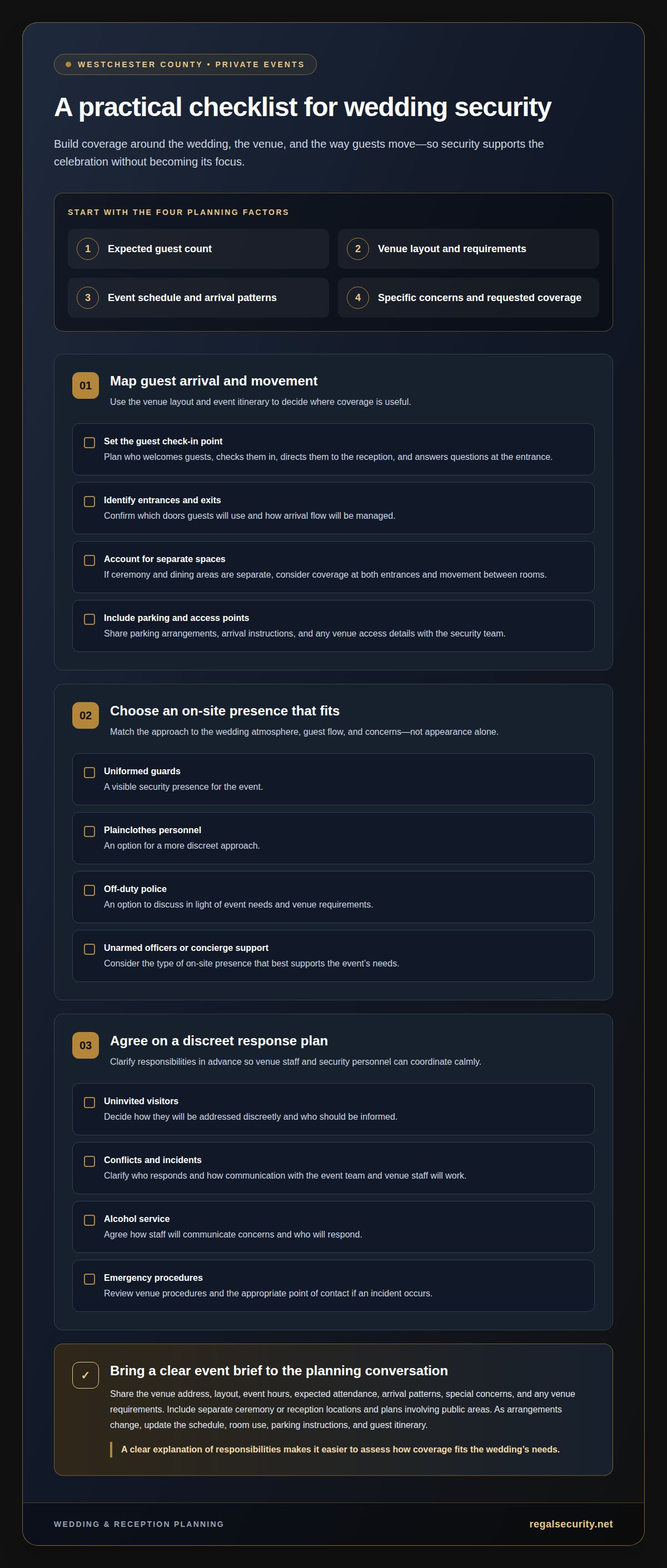
Wedding security services in Westchester County are planned around the guest count, venue, event schedule, and specific concerns. Private-event security may include welcoming and checking in guests, monitoring entrances and exits, managing uninvited visitors, and addressing conflicts discreetly. A clear plan helps keep attention on the celebration while giving the event team a defined point of support.
It’s reasonable to want a welcoming atmosphere without making security the focus. The key is to tailor coverage to the wedding and reception rather than treat every event the same way. Planners can discuss expected attendance, venue details, and security concerns with the security team, so responsibilities and guest flow are considered together.
This guide explains what private-event coverage may involve, how wedding and reception security can be organized, and which factors shape the plan. You’ll also learn what to consider when arranging local coverage and how unarmed officers or concierge services can provide a composed, attentive presence at the venue.
Table of Contents
What does party security typically include for a private event?
Private-event security in Westchester can support guest check-in, monitor entrances and exits, address uninvited visitors, and manage conflicts discreetly. The plan should reflect the event type, venue, schedule, expected attendance, and specific concerns.
Security Staffing and Event Planning
Staffing and planning go hand in hand: the guest count and venue layout help determine where coverage is useful. Discuss event hours, arrival patterns, special concerns, and venue requirements with security personnel. For example, a reception with separate ceremony and dining spaces may need a plan for both entrances and movement between rooms. Clear roles help venue staff and security personnel coordinate.
Wedding Guard Types
Uniformed guards offer a visible presence, while plainclothes personnel can provide a more discreet approach. The best fit depends on the wedding’s atmosphere, guest flow, and concerns identified during planning. Off-duty police are another option to discuss in light of the event’s needs and venue requirements. Ask how each approach would address check-in, entrances, and discreet conflict management, rather than choosing by appearance alone.
Venue Needs and Security Planning
Discuss entrances, parking areas, alcohol service, and emergency procedures with the venue and security team. Identify which doors guests will use, how arrivals will be directed, and who should be notified if an incident occurs. For alcohol service, clarify how staff will communicate concerns and who will respond. The plan should also account for the venue layout, event hours, attendance, and specific requirements.
At private parties and weddings, typical duties may include welcoming guests at check-in, monitoring entry and exit points, and responding discreetly to uninvited visitors or conflicts. The event type, location, schedule, expected attendance, and special concerns shape the coverage. A planner can share those details with security personnel in advance and coordinate responsibilities with venue staff. For example, agree on who directs guests to the reception and who answers questions at the entrance.
Provider listings can offer a sense of the distances involved, but a listing alone doesn’t explain how coverage fits a specific wedding. Featured event-security listings are 19 miles away in Teaneck, New Jersey, and 20 miles away in the Bronx, New York. Another listing in Brooklyn is 32 miles away. Use these examples as geographic context, then focus planning on the Westchester venue, event schedule, attendance, and requested services.
When assessing a provider, look for a practical discussion of guest count, venue details, event hours, and concerns. Ask how the proposed plan covers check-in, entrances, uninvited visitors, and communication with venue staff. A clear explanation of responsibilities helps you compare coverage based on the wedding’s needs, not simply the number of personnel.
Can I book local event security in my city, and how does it work?
Planning wedding security in Westchester starts with the venue address, event schedule, and coverage needs. Local listing locations provide geographic context, but the event plan should be tailored to the specific site.
Discuss permit and police-approval requirements in relation to the venue, event setup, and any planned use of public areas. Include street-side activity, shared parking, and venue-specific conditions in that conversation.
There is no single booking lead time that suits every wedding. Start once the date and venue are set, then share the schedule, expected attendance, location, and requested coverage so the plan can take shape.
Westchester County Service Coverage
For a Westchester wedding, begin with the exact town and venue address rather than relying on a general county label. Share the venue layout, event hours, guest count, and any separate ceremony or reception locations. Those details help determine where personnel should report and which parts of the event need coverage.
Event-security listings provide nearby geographic reference points. Featured waitstaff and event-security listings are 19 miles from Westchester in Teaneck, New Jersey, and 20 miles away in the Bronx, New York. An event-security listing in Brooklyn is 32 miles away. These listing locations don’t establish coverage for a particular Westchester venue; the event’s location and requirements remain central to planning.
When arranging local coverage, provide the venue’s arrival instructions, access points, parking arrangements, and event timeline. If the ceremony and reception are at different locations, describe both stops and the transition between them. A clear itinerary gives the planning conversation practical detail instead of relying on a broad location name.
Booking Lead Time
Begin the booking conversation once the date and venue are set, and share details as the schedule takes shape. The planning window depends on the event date, location, hours, expected attendance, and coverage needs. A wedding with distinct arrival, ceremony, and reception periods may need a different plan from a single-site gathering.
Prepare a concise event brief with the venue address, schedule, expected guest count, special concerns, and areas requiring attention. Include venue requirements and any plans for public spaces, such as activity near a street. This gives the security team a basis for discussing responsibilities and coverage.
For Westchester County events, keep the venue and security team aligned as arrangements change. Share updates to arrival times, room use, parking instructions, or the guest itinerary. These practical changes can affect where coverage is useful and how the event team coordinates on the day.
BEST says event-security planning is informed by event type, location, hours, expected attendance, special concerns, and venue requirements.
New York ranks #2 among U.S. states for Event Security Services requests on GigSalad, a broader demand indicator that does not confirm availability for a particular event.
Guest flow and crowd management
A wedding’s guest flow follows its schedule, from arrival through departure. At a Westchester venue, a plan can distinguish the ceremony entrance, reception entrance, and route between them. The aim is to make each transition clear while keeping access points observed. Security personnel can help monitor entrances and exits and guide guests to the appropriate area.
Start by mapping the guest journey with the venue team. Note where guests arrive, check in, and reach their seats. For example, if the ceremony and reception use separate rooms, establish a clear transition route. Identify who directs guests at each point so visitors receive consistent guidance instead of conflicting instructions.
Arrival is often when several tasks converge: guests seek directions, hosts greet family, and vendors move equipment. Set a check-in point that doesn’t obstruct the main entrance. Decide how staff will handle names or invitations and direct guests who arrive at the wrong door. Assign a clear point of contact to resolve questions without interrupting the receiving line.
Use the venue layout to identify places where guests may pause or cross paths. A narrow hallway between the ceremony room and reception area, for instance, can become confusing if guests leave as others enter. Agree on a direction of movement and share it with the event team. If parking leads to multiple doors, give arriving guests one clear entrance to use.
Before the ceremony: Direct arrivals to the designated entrance and check-in point.
During transitions: Guide guests between ceremony, reception, and dining areas.
At departure: Keep the exit route clear and direct guests toward their intended pickup or parking area.
Timing matters as much as the floor plan. Share the event schedule with the venue and security team, including when doors open, the ceremony begins, and guests move to the reception. If the schedule changes, update the people guiding guests. This simple step prevents directions from being based on an outdated itinerary.
For an orderly plan, identify who will answer operational questions during the event. The planner, venue contact, and security personnel should know who communicates changes and who directs guests. For example, if a room becomes unavailable, one designated contact can share the revised route. Clear communication coordinates guest movement without drawing attention away from the celebration.
Uninvited visitors and incident response
A wedding plan should give the team a calm, consistent way to address an unexpected visitor or disruption. Before the event, agree on who can confirm whether someone is invited, who will speak with that person, and which venue contact supports the response. For example, a guest arriving without an invitation can be directed to a designated host instead of being questioned by several staff members.
Set a discreet check-in procedure with the planner and venue. Decide how staff will handle an unclear invitation, a guest seeking access to a restricted area, or someone who refuses directions. A designated contact can verify the situation while other personnel keep the entrance orderly. Avoid public arguments that could draw attention away from the celebration.
For a wedding reception, discuss practical responses to incidents such as:
An unrecognized visitor: Pause entry and refer the person to the agreed host or venue contact.
A disagreement: Notify the designated lead and move the conversation away from guest areas when appropriate.
A restricted-room entry: Direct the person back to the permitted area and inform the venue contact.
An immediate safety concern: Prioritize people’s safety and contact emergency services when needed.
Define communication roles before guests arrive. The planner, venue representative, and security personnel should know whom to notify first and how to share updates discreetly. For example, the venue representative can handle room-access questions while the planner manages changes to the wedding schedule. Clear roles help prevent duplicate instructions and keep response decisions focused.
Guest conduct concerns may involve alcohol, a heated conversation, or someone disrupting a ceremony. Agree on a respectful approach that begins with calm communication and follows the venue’s procedures. For instance, staff can alert the designated lead when a conversation escalates instead of confronting people in front of guests. The plan should specify when to involve the host or venue contact.
After an incident, record the basic facts for the event lead: what happened, where it occurred, who was notified, and what action followed. Keep the process private and factual. If the event includes separate ceremony and reception spaces, ensure the relevant contacts know where to meet and how to pass along urgent updates. A clear handoff helps the team manage the rest of the celebration without speculation or confusion.
Wedding and reception security
Wedding coverage should reflect the celebration’s schedule, venue layout, and guest needs. In Westchester County, private-event security may include guest check-in, entrance monitoring, managing uninvited visitors, and responding discreetly to conflicts. Unarmed officers or concierge personnel can provide an on-site presence, with roles shaped around the event plan.
A wedding often moves through distinct stages, each with different priorities. Before the ceremony, the focus may be guest arrival and entry. During the reception, attention may shift to access between rooms, vendor movement, and guest departures. Share the schedule with the security team so coverage reflects these transitions rather than treating the event as one continuous, unchanged gathering.
Venue layout matters. A historic property with several entrances presents different planning considerations from a reception in one ballroom. Identify guest entrances, private areas, parking access, and routes between ceremony and reception spaces. Then decide which areas need a visible presence and where a more discreet approach better suits the event’s tone.
Wedding security services in Westchester County can be tailored to event size, location, hours, and coverage needs. Event security costs also vary with event length, location, guest count, and requested services. These factors help define the scope, from a focused entrance presence to support across several event areas. No single arrangement suits every wedding.
Before confirming the plan, align responsibilities with the venue and planner. Specify who will guide guests, answer access questions, and receive updates if the itinerary changes. For example, if the reception moves to another room, a designated contact can communicate the revised arrangement to the relevant team members.
Ceremony: Consider guest entry, arrival questions, and access to private areas.
Reception: Plan coverage around room transitions, vendor access, and the schedule.
Departure: Clarify how guests will leave and whom staff should notify about concerns.
Keep the approach consistent with the atmosphere you want guests to experience. Uniformed officers offer a visible presence; plainclothes personnel provide a more discreet option. Discuss which approach best fits the venue, the couple’s preferences, and the event’s specific concerns. The central question is how personnel can support an orderly celebration without distracting from its purpose.
For a Westchester wedding, begin with the venue address, event timeline, expected attendance, and requested coverage. Those details create a practical basis for planning wedding and reception security. Discuss wedding event coverage for an approach shaped around your celebration.
Regal Security: Unarmed Security Officers
Regal Security provides Unarmed Security Officers for events that call for a composed, attentive on-site presence. At a wedding, their role can match the planned coverage, such as supporting an orderly guest arrival or monitoring an assigned area. Concierge Services may also suit occasions where guest assistance and security presence need to work together.
Share the venue, event schedule, guest count, and areas of concern when discussing your requirements. These details help shape coverage around the celebration rather than applying a generic plan. For a wedding with separate ceremony and reception spaces, explain how guests move between them and where support is needed.
Contact Regal Security to discuss security needs for your wedding or reception.
Put the next step on the calendar
Planning wedding security services in Westchester County is easier when one person owns the next decision. Choose the event lead who will coordinate with the venue, planner, and security team, then authorize that person to share schedule changes and resolve questions. This keeps planning clear as the celebration approaches without adding another task for every member of the wedding party.
Regal Security provides Unarmed Security Officers, Concierge Services, and Vehicle Patrol. Start with a conversation about the kind of presence that suits your event and the responsibilities you want covered. Bring your venue details and priorities, then decide how security fits your plans.
Contact Regal Security about wedding coverage to discuss the next step. With thoughtful coordination in place, you can give your attention to the people and moments that make the celebration meaningful.
Frequently Asked Questions
How do I hire security for an event and what info do you need?
Start by sharing the event date, venue address, schedule, expected attendance, and requested coverage. Include practical details such as separate ceremony and reception locations, vendor access, and the person responsible for event decisions. For example, if guests will use different entrances at different times, explain the arrangement. These details help define coverage and clarify how the event team will coordinate with security personnel.
How do I verify a wedding security company's New York State license and insurance?
Request the company’s legal business name and any relevant license details, then compare them with records from the appropriate New York State authority. For insurance, request a current certificate and confirm its validity with the issuing insurer or agent. Check that the named business matches the company you’re engaging and that the document’s dates cover your event. Keep the records with your venue correspondence.
How many security guards should a wedding hire based on guest count and venue size?
There isn’t a reliable headcount formula based on guest numbers alone. Venue layout, the number of active entrances, event hours, guest movement, and specific concerns all affect staffing needs. For example, a single-room reception with one controlled entrance differs from an event spanning separate buildings. Outline the schedule and locations, then match coverage to assigned responsibilities rather than choosing a staffing level based on attendance alone.
How do wedding security companies compare in Westchester County by services, reviews, and pricing?
Compare providers by the duties their proposed plans cover, how those duties fit your venue, and the clarity of the written scope. Reviews can offer context, but look for details relevant to private events rather than relying on general praise. Regal Security serves Westchester County and nearby areas, including New York City, New Jersey, Long Island, and Rockland County. Compare pricing only for equivalent coverage and terms.
What risks should wedding security address, such as uninvited guests, theft, or crowd incidents?
A wedding plan can address uninvited visitors, restricted-area access, lost-property concerns, and disruptions caused by crowd movement. Identify who receives reports and who can make decisions during the event. For example, assign a venue contact to handle access questions and an event lead to receive incident updates. Clear reporting helps the team respond consistently while reducing confusion for guests and wedding staff.