Access Control Security Guard NYC: Property Guide
What makes an access-control plan work well at a New York City property? Often, it starts with a clear, professional presence where people enter. An access control security guard NYC properties can rely on brings human judgment to the arrival experience, helping people understand where to go while treating residents, visitors, and staff with courtesy.
Choosing an on-site officer is different from choosing access-control technology. It is also worth considering how a visible security presence will fit the property’s character and routines. The approach should reflect the site’s purpose and the people who use it, rather than impose a one-size-fits-all process.
This guide explains how an unarmed security officer can support entry procedures, how Concierge Services combine hospitality and security, and what information helps shape a practical plan. Consider your property type, visitor flow, busy periods, and preferred arrival experience, then see how Regal Security tailors a professional approach for corporate facilities, residential communities, private events, and executive clients. The goal is a composed, respectful presence that supports the people who use your property.
Access Control Security Guard NYC: Table of Contents
What an Access Control Security Guard Does for NYC Properties
An access-control security guard supports a property’s entry process through a professional, human presence. The officer helps arrivals follow the site’s established instructions while maintaining a composed and respectful welcome. For property leaders considering an access control security guard NYC assignment, the central question is whether a staffed presence fits the building’s purpose, visitor flow, and expectations for entry.
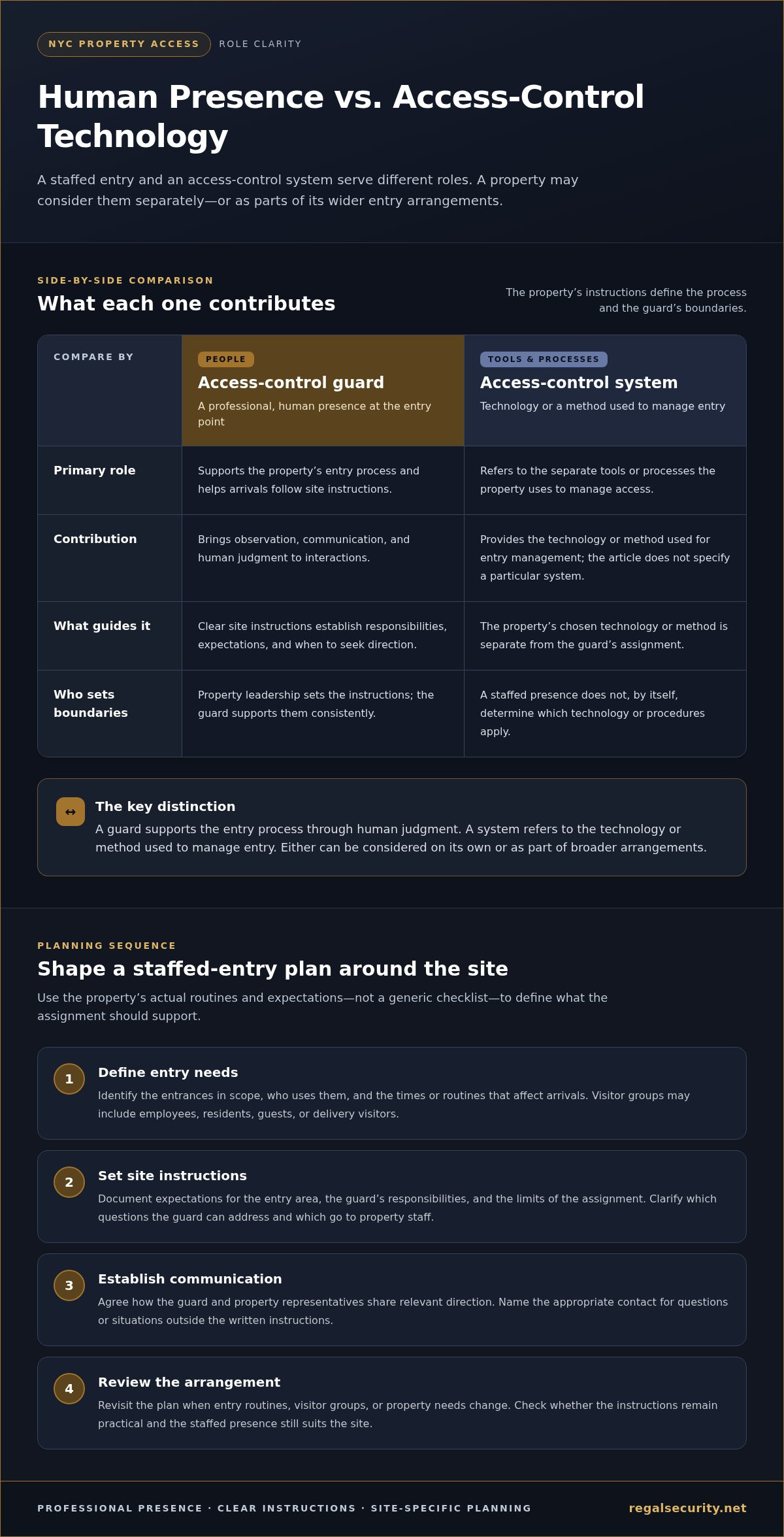
An access-control guard supports a property’s entry process according to site instructions; an access-control system is the technology or method used to manage entry. The distinction matters: a guard brings observation, communication, and judgment to interactions, while technology refers to separate tools or processes used to control access. The broader concept is outlined in What is Access Control?
These approaches can be considered separately or as parts of a property’s wider entry arrangements. A staffed presence does not, by itself, determine what technology a building uses or which procedures apply. Property leadership sets the instructions and boundaries, and the guard supports them consistently. Clear expectations help arrivals understand where to go and whom to approach, making entry more orderly without making it unnecessarily formal.
Which NYC properties may need a staffed entry presence?
Commercial buildings and residential communities may have different reasons to staff an entrance. A Manhattan office may need a clear arrival point for employees and scheduled visitors, while a Brooklyn residential property may prioritize a welcoming, consistent experience for residents and guests. These are examples, not fixed rules. Consider the building’s purpose, who arrives, when they arrive, and how they use the entrance when deciding whether an on-site presence makes sense.
How does an access-control guard differ from general security presence?
An entry-focused assignment centers on the arrival point and the property’s directions for access. A general security presence may have a broader site focus, depending on the assignment. Neither label defines specific screening steps on its own. Site instructions set the guard’s role and boundaries, including how to communicate with visitors and when to refer a question to designated property staff.
For a first-time buyer, the practical distinction is straightforward: identify the entry experience you want supported, then describe it clearly. Consider whether the entrance serves residents, employees, visitors, or a mix, and whether arrivals need directions or a consistent point of contact. Those details help define a suitable role without assuming every property requires the same procedures.
Clarity benefits both arrivals and the staff responsible for the site. Before planning a staffed presence, identify which entrances matter, what routine arrivals should expect, and who provides direction when an unusual request arises. A professional, unarmed officer can then support the property’s stated entry process with a presence tailored to that setting.
How Guard-Supported Access Control Works at a NYC Site
A useful access plan starts with the property’s actual entry needs, not a generic checklist. For an access control security guard NYC assignment, identify where a staffed presence would be useful, who typically arrives, and what the arrival experience should feel like. The guard’s role can then be shaped around site instructions, clear communication, and regular review of whether the arrangement still reflects the building’s routines.
Clear post instructions give the guard and property team a shared understanding of expectations, responsibilities, and when to seek direction. This clarity is especially useful when several visitor groups use the same entrance or when the property’s daily pattern changes. It helps prevent assumptions from replacing the procedures the property has established.
Define entry needs. Identify the entrances in scope, the people who use them, and the times or routines that affect arrivals. An office may have employee and visitor traffic, while a residential property may serve residents, guests, and delivery visitors.
Set site instructions. Document expectations for the entry area, the guard’s responsibilities, and the limits of the assignment. Make clear which questions the guard can address and which should go to designated property staff.
Establish communication. Agree on how the guard and property representatives will share relevant direction. Name the appropriate contact for questions or situations outside the written instructions, so expectations are clear.
Review the arrangement. Revisit the plan when entry routines, visitor groups, or property needs change. A review can show whether the instructions remain practical and whether the staffed presence still suits the site.
What should a site-specific post plan clarify?
A post plan should describe the entry points covered, expected visitor groups, and routines that shape how people arrive. It should also set out responsibilities and escalation paths in plain language. For example, if a visitor asks a question outside the guard’s assigned role, the instructions should identify the appropriate property contact. Keep examples tied to the site’s own procedures rather than assuming particular screening steps.
How can a guard presence remain professional and welcoming?
Professionalism comes through courteous communication, a calm manner, and consistent attention to the property’s directions. A visible presence need not dominate the entrance; it can fit naturally into the everyday atmosphere of a workplace or residential community. Clear guidance on greeting arrivals and directing questions helps maintain a respectful experience without implying any particular verification process.
Before a post begins, property leaders can walk through the arrival experience from a visitor’s perspective: where the entrance is, what guidance is useful, and who can resolve questions. This review can expose gaps in instructions before they affect daily interactions. For NYC organizations seeking a tailored, professional on-site presence, Regal Security’s security services can be aligned with the property’s entry needs.
Access Control Guard, Concierge, or Vehicle Patrol: Which Fits?
These service formats address different property needs. A fixed entry presence focuses on a designated entrance, Concierge Services combine a service-oriented welcome with security support, and Vehicle Patrol provides a mobile presence around a property. The right fit depends on where support is needed, how people use the site, and whether the priority is a staffed entrance, a welcoming arrival, or mobile coverage.
A patrol vehicle and a fixed post aren’t interchangeable. If a property needs an officer consistently positioned at an entrance, a mobile service is not a substitute for that staffed point. A tailored plan can account for distinct needs in different parts of a site without assuming that every property requires the same combination.
When is a fixed on-site officer the clearest fit?
A fixed presence may be appropriate when the entrance is the main focus of the assignment. At a corporate facility, this could mean an unarmed officer in a designated arrival area; at a residential community, it could mean a consistent point of contact near a main entrance. The role should follow site-specific instructions and remain within the agreed scope of service.
When might concierge service or vehicle patrol be more relevant?
Concierge Services suit properties that want a security presence with a service-oriented approach to arrivals. Vehicle Patrol is mobile and is relevant when a property’s needs extend beyond one entrance. It does not provide continuous staffing at a fixed doorway. For more detail on the service-oriented role, see this concierge security officer guide; for mobile coverage, explore the vehicle patrol security services guide.
To choose a direction, consider where support is required, what kind of presence suits the property, and whether the need is concentrated at an entrance or distributed across the site. An access control security guard NYC plan should reflect these practical distinctions. Regal Security provides Unarmed Security Officers, Concierge Services, and Vehicle Patrol, tailoring the service format to the setting and the client’s priorities.
Plan Access Control Security for Your NYC Property
A well-prepared plan starts with the property’s actual arrival patterns. Before selecting a staffed approach, document where people enter, who uses each entrance, and what kind of experience the property wants to provide. This gives property leaders and a security partner a clear basis for shaping an access control security guard NYC plan around the site, rather than relying on assumptions about how every building operates.
What information helps shape an access-control plan?
Begin with a concise site profile. Note whether the setting is commercial, residential, educational, healthcare, or event-based, then identify the entrances relevant to the assignment. Describe broad visitor groups, such as employees, residents, guests, clients, or event attendees, and explain the service outcome you want, such as a consistent point of contact or a courteous arrival experience. Avoid choosing staffing levels or coverage schedules before the property’s needs are understood.
Use a checklist to make the discussion practical:
Property and entry points: Describe the site’s purpose and the entrances where a staffed presence may be relevant.
Visitor patterns: Identify who arrives and note meaningful differences in how residents, employees, visitors, or event guests use the property.
Daily routines: Record the routines that affect entry, including regular busy periods or changes associated with scheduled activities.
Service expectations: State the tone and kind of assistance the property expects, along with the responsibilities that remain with property staff.
Communication: Identify how questions should be directed and who provides guidance when a situation falls outside the site instructions.
Local context can make the description more precise without suggesting every borough or property has identical needs. A Manhattan office may have a different visitor mix from a residential building in Queens; an event venue in the Bronx and a community property on Staten Island may also have distinct arrival routines. Properties in Brooklyn, on Long Island, and in Nassau, Suffolk, Westchester, Rockland, and Orange counties have their own site-specific needs. Describe the property itself, not just its location.
How can site instructions support a consistent experience?
Useful instructions put expectations into plain language. They define the guard’s assigned responsibilities, explain how to communicate with property representatives, and clarify when a question should be referred to someone else. They can also reflect the experience the property wants each group to have, whether that means clear direction for employees, a courteous welcome for visitors, or a composed presence for residents and event guests.
Review the instructions when routines or visitor patterns change. This helps keep the plan aligned with the property’s current priorities and gives everyone a consistent reference point. For guidance on the role and preparation of unarmed officers, consult the professional unarmed security officers guide. Property leaders considering how staffing fits their site can also explore the security staffing services guide.
With clear site details in hand, Regal Security can tailor a professional on-site approach to the property’s access priorities. Explore a tailored security approach for your NYC property.
Regal Security’s Access Control Approach Across NYC
A property’s entry needs are shaped by its people, purpose, and daily routines. Regal Security provides Unarmed Security Officers as a professional on-site presence, tailoring the approach to the setting and client’s priorities. For an access control security guard NYC plan, that means defining how an officer can support the property’s entry experience within clear site expectations, rather than assuming every building needs the same arrangement.
Regal Security serves corporate facilities, residential communities, private events, and executive clients. An office, residential property, and event venue each have different expectations for arrivals and interactions. Recognizing those distinctions helps shape a suitable service approach while keeping the property’s procedures at the center.
Which Regal Security services may support a property’s needs?
Unarmed Security Officers are the most directly relevant offering when a property needs a staffed presence at an entry point. Their role is tailored to the site and guided by the property’s instructions. Concierge Services are a distinct option for settings where hospitality and security presence meet, while Vehicle Patrol provides a separate mobile service. Each serves a different purpose, so the right fit depends on the property’s priorities.
Regal Security brings decades of experience to its work and has a dedicated management team available 24/7. Property leaders can describe their setting and expectations, and the service approach is tailored around those needs. The aim is a composed, professional presence suited to the site, whether the client represents a corporate facility, residential community, private event, or executive client.
Before discussing a plan, gather a few practical details:
Property type: Note whether the site is a workplace, residence, event setting, or another environment.
Access priorities: Describe the entrances and arrival experience that matter most.
Visitor groups: Identify the people who regularly use the property and any differences in their needs.
Service expectations: Explain the kind of presence and communication style that would suit the setting.
These details give the conversation a useful starting point without requiring the property to have every instruction finalized. Regal Security tailors security solutions to client needs, with the site’s priorities informing the approach.
How to take the next step with Regal Security
Share your property type, access priorities, and service expectations to begin a focused discussion about a tailored NYC security solution. Clear context helps align the service with the environment and the people who use it. Discuss a tailored NYC security solution with Regal Security.
Make Your Property’s Next Security Decision with Confidence
A well-considered access plan can also help align the people responsible for a property. Before moving forward, bring together the priorities of building leadership, front-of-house staff, and the people who regularly use the entrance. Their perspectives can clarify what a professional presence should contribute and how it should fit the character of the site.
Use that shared understanding to guide your next conversation about an access control security guard NYC properties can rely on for a composed, site-appropriate presence. Focus on the experience you want people to have, the expectations your team needs supported, and the qualities that matter in a security partner. A thoughtful discussion can turn those priorities into a practical direction for your property.
Discuss a tailored security solution for your NYC property with Regal Security. Share your property’s needs and access priorities to start the conversation.
Frequently Asked Questions
Is an access control security guard the same as a doorman?
Not necessarily. The titles can overlap in practice, but the property’s expectations matter more than the label. A security-focused assignment may center on supporting entry procedures, while a doorman role may place greater emphasis on hospitality and guest interaction. A residential community, for example, might value both a courteous welcome and a defined security presence. Clarifying the expected balance helps define a suitable role.
Can an access control security guard work at a construction site?
Yes. Regal Security serves construction sites, and a staffed security presence can be tailored to the site’s needs. The site’s instructions should set the role’s boundaries and priorities, taking account of its activity and the people expected to arrive. This avoids assuming particular equipment, procedures, schedules, or outcomes.
Can a security guard support access control without access-control technology?
Yes. An access control security guard NYC property leaders consider can provide a person-based presence in support of the property’s entry process. The practical point is to define the process the property wants followed and communicate it clearly. If a building uses separate equipment or procedures, those remain distinct considerations; a guard assignment alone does not include them.
What happens if a visitor does not follow a property’s entry instructions?
The property’s established instructions should determine the response, since expectations can differ between a workplace, residence, and event venue. A useful plan identifies whom the guard should notify when a visitor’s request falls outside the normal directions, and how that communication should be handled. For instance, site staff might be the designated contact for an exception. A calm, consistent response can preserve a respectful atmosphere without improvising a new rule.
How can residents be informed about access-control procedures?
Property managers can use the communication channels residents already rely on, such as building notices or resident updates, to explain the intended entry process. Keep the message concise: describe what residents should expect, how they can share visitor instructions, and where practical questions should go. Adapt the guidance to the community, whether it is in New York City, New Jersey, Manhattan, Brooklyn, Queens, the Bronx, Staten Island, Long Island, Nassau or Suffolk counties, or Westchester, Rockland, or Orange counties.
Can access-control security support a private event in New York City?
Yes. Regal Security serves private events and can provide a professional security presence suited to the event setting and organizer’s priorities. The plan should reflect the venue, audience, and intended arrival experience, with instructions suited to the site rather than assumptions about staffing, duration, or specific entry procedures.