Commercial Property Risk Assessment: Guide for Owners
The most visible threat isn’t always the most urgent one. A risk assessment for commercial property is most useful when it looks beyond obvious hazards and helps owners decide which vulnerabilities deserve attention first.
An inspection can surface concerns involving building conditions, daily operations, and security. To make the findings useful, consider how each risk could affect tenants, employees, and visitors, then turn the observations into practical next steps.
This guide explains the main categories of commercial property risk, a repeatable process for assessing vulnerabilities, and ways to prioritize actions according to potential impact. You’ll also learn how to connect security findings to proportionate protective measures. Depending on a property’s needs, Unarmed Security Officers, Concierge Services, or Vehicle Patrol can complement a broader protection plan with a tailored on-site presence. The goal is a clear, site-specific approach that supports the people who use and manage your property.
Table of Contents
What a Commercial Property Risk Assessment Reveals About Your Building
How to Conduct a Commercial Property Risk Assessment Step by Step
How to Prioritize Commercial Property Risks and Compare Assessment Types
Commercial Property Risk Assessment Checklist for NY, NJ, and PA Sites
Turn Assessment Findings Into a Tailored Commercial Property Security Plan
What a Commercial Property Risk Assessment Reveals About Your Building
A risk assessment for commercial property is a structured review of conditions that could harm a building, disrupt its operations, or affect the people who use it. It helps owners understand where vulnerabilities exist and make informed decisions about what to address.
Consider more than the building’s physical condition. Its use, occupancy patterns, operating procedures, visitors, and surrounding context all shape exposure. A lobby serving frequent visitors presents different operational questions from a restricted service area. A property’s location may also affect the environmental conditions owners need to consider. Property Condition Assessments (PCAs) offer useful background on evaluating a commercial building’s physical condition, but owners may also need to consider operational and security concerns.
Identifying risks is only the first step. An assessment records and examines them; owners then decide how to manage them through maintenance, procedural changes, safeguards, risk transfer such as insurance, or a combination of measures. Set priorities according to the property’s circumstances rather than treating every finding as equally urgent.
Which risks belong in a commercial property assessment?
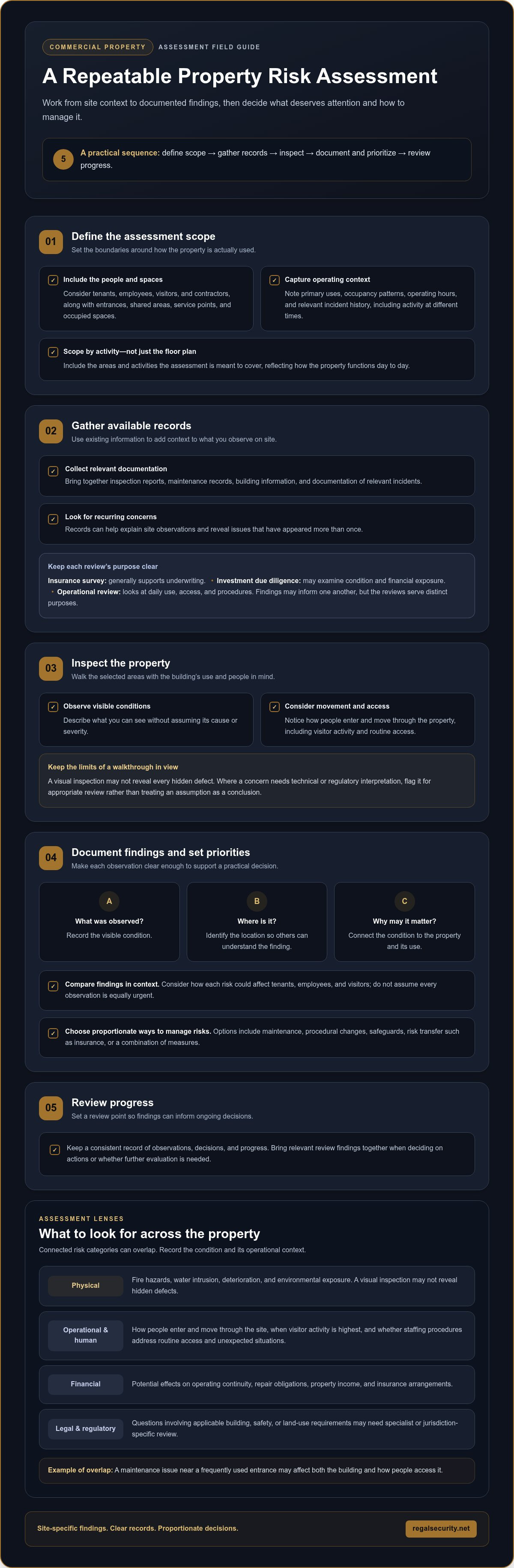
A well-rounded review considers several connected categories. Physical concerns may include fire hazards, water intrusion, deterioration, and environmental exposure. The goal is to identify conditions that could affect the building or interrupt its use, not to assume a visual inspection will reveal every hidden defect.
Operational and human factors: Consider how people enter and move through the property, when visitor activity is highest, and whether staffing procedures address routine access and unexpected situations.
Financial considerations: Review potential effects on operating continuity, repair obligations, property income, and insurance arrangements.
Legal and regulatory considerations: Note matters that may require specialist or jurisdiction-specific review, such as applicable building, safety, or land-use requirements. An assessment can flag questions, but it should not be treated as a property-specific legal opinion.
These categories can overlap. A maintenance issue near a frequently used entrance, for example, may affect the building and how people access it. Recording both the condition and its operational context gives decision-makers a more useful picture.
Why an insurance survey may not answer every operational question
An insurance survey generally supports underwriting by examining information relevant to an insurer’s evaluation of a property. Day-to-day protection planning has a different focus: how the site functions, where people interact, and whether current procedures fit actual access and occupancy patterns.
Survey findings can inform broader planning, but they don’t automatically resolve operational vulnerabilities. A report might note a building condition without detailing visitor flow or staffing practices. Use each review for its intended purpose, then bring relevant findings together to determine appropriate actions, responsibilities, or further evaluation. No single assessment format covers every risk or guarantees that incidents will be prevented.
How to Conduct a Commercial Property Risk Assessment Step by Step
A practical risk assessment for commercial property moves from defining the review to gathering evidence, inspecting, recording findings, prioritizing action, and reviewing progress. This sequence helps property teams create a consistent record instead of relying on memory or isolated observations. For a general framework on identifying hazards and vulnerabilities, consult Ready.gov's guide to risk assessment, then tailor the review to the site.
Prepare the property information and assessment scope
First decide which areas, activities, and people the assessment will cover. Include tenant and employee spaces, entrances, shared areas, service points, and locations used by visitors or contractors. The scope should reflect how the property actually operates, not just its floor plan. Note its primary uses, occupancy patterns, operating hours, and relevant incident history so the review accounts for activity at different times.
Gather available inspection reports, maintenance records, building information, and documentation of relevant incidents. These records provide context for observations and can reveal recurring concerns. An insurance survey may focus on underwriting considerations, while investment due diligence may examine condition and financial exposure. An operational review looks at how daily use, access, and procedures affect the property. The findings may inform one another, but each review serves a distinct purpose.
Inspect, document, and assign ownership to findings
During the walkthrough, describe visible conditions rather than assuming their cause or severity. Record enough detail for someone who wasn’t present to understand what was observed, where it occurred, and why it may matter. If a concern requires technical or regulatory interpretation, flag it for appropriate review instead of presenting an assumption as a conclusion.
Define the scope. Identify the building areas, activities, occupants, and visitors included in the review.
Gather records. Assemble relevant inspection and maintenance information alongside incident documentation.
Inspect the property. Walk the selected areas with the property’s use and operating conditions in mind.
Document observations. Record each finding’s location, observable condition, operating context, and possible consequence. For example, note a poorly lit entrance, when it is used, and how that condition could affect safe access.
Prioritize and assign. Compare findings according to their relevance and potential impact, then identify a responsible role and follow-up status for each action.
Review progress. Revisit open findings and update the assessment when property use, occupancy, procedures, or incident history changes.
Clear ownership turns observations into trackable work. Depending on the finding, assign it to facilities, property management, or an operations lead. Keep the status straightforward, such as open, under review, or addressed, and preserve notes on any remaining concern. This creates accountability without implying that every issue can be resolved on the same schedule.
If findings point to a need for a more consistent on-site presence, Regal Security’s tailored on-site security services can complement the property team’s broader response. Choose an approach that fits the site’s operations and the responsibilities identified through the review.
How to Prioritize Commercial Property Risks and Compare Assessment Types
A useful ranking helps property teams decide what deserves attention first without overstating what an assessment can tell them. For each finding, consider how likely the condition is to affect the site, its potential impact, who or what is exposed, and which safeguards are already in place. Use this as a planning aid, not a prediction or guarantee that an incident will or won’t occur.
Use likelihood and impact to create a practical priority list
Base ratings on documented conditions and operating context, including how often an area is used, who relies on it, and whether the condition has appeared before. Use simple terms such as low, moderate, or high, and record the reason for each rating. Separate urgent life-safety concerns that need prompt attention from maintenance observations or longer-term planning needs. A serious immediate concern should not be obscured by a scoring total.
Existing safeguards matter, but they don’t erase an underlying risk. A controlled entrance may reduce exposure, for example, while a concern about the entrance’s physical condition remains. Record the control, whether it addresses the finding, and any limitations observed. The matrix below supports consistent comparison rather than precise calculation.
Choose the assessment lens that matches the decision
Different reviews answer different questions. An insurance survey supports underwriting; a building inspection examines physical condition; an operational security review considers how access, people, and procedures interact in daily use. A risk assessment for commercial property may draw on findings from each, but these approaches are complementary, not interchangeable. None replaces qualified local professional advice where specialized interpretation is needed.
Start with the decision at hand, then select the review that can inform it. Bringing relevant findings together gives owners a more balanced basis for action while preserving the purpose and limits of each assessment.
Commercial Property Risk Assessment Checklist for NY, NJ, and PA Sites
A useful walkthrough checks how people actually enter, move through, and use a property, not just whether each space appears orderly. Use this checklist to guide observations, then record concerns with their location and context. A risk assessment for commercial property should reflect the site’s activities and the people who depend on it.
Review access, public-facing areas, and daily operations
Consider the experience of tenants, employees, visitors, contractors, and service personnel from arrival through departure. Where practical, observe the property during representative operating periods, since activity and staffing can change throughout the day. Note gaps or unclear procedures without assuming that every site needs the same security measures.
Entrances and approaches: Are entry points easy to identify and in suitable physical condition? Can visitors find reception or the intended check-in point without entering staff-only areas?
Shared areas: Review lobbies, corridors, elevators, stairwells, and other common spaces. Note congestion, access patterns, visibility, and whether intended routes are clear.
Service points: Observe loading areas, delivery handoffs, maintenance access, and other back-of-house locations. Record how staff distinguish routine service activity from unexpected access.
Visitor-facing spaces: Consider reception, waiting areas, public counters, and event spaces. Note how visitors are directed, where staff are positioned, and how concerns are communicated.
Property perimeter and vehicle areas: Review parking, service roads, and other relevant exterior spaces for activity patterns or operational concerns that merit follow-up.
Adapt the checklist to the property’s use and location
Site-specific prompts make the review more meaningful. At a health care facility, consider how patient, visitor, and service activity intersect. At a construction site, account for changing work areas and contractor access. Retail teams can review customer circulation and delivery operations; educational facilities can consider how students, staff, and visitors use the grounds. For commercial buildings, assess tenant access and shared services. At event sites, account for changing visitor flow and temporary operating arrangements.
Local requirements can differ across New York and New Jersey, and may depend on the property and its activities. Treat code, safety, and other regulatory questions as location-specific matters to address through appropriate local sources or qualified professionals. This checklist supports observation and planning; it isn’t a substitute for a formal compliance review.
Repeat the walkthrough when property use, occupancy, staffing, or operating procedures materially change, and revisit recorded findings as conditions evolve. If site operations indicate that mobile coverage may be relevant, review this vehicle patrol security guide as one input to a broader plan.
For a tailored on-site security presence that reflects your property’s operational needs, review security support for commercial properties by Regal Security.
Turn Assessment Findings Into a Tailored Commercial Property Security Plan
Assessment findings become useful when each priority leads to a proportionate action, a responsible person, and a way to review progress. A risk assessment for commercial property may identify concerns that call for maintenance, updated procedures, clearer communication, or a more visible on-site presence. Security staffing is one part of a broader plan, not a substitute for addressing building, safety, or compliance concerns through appropriate channels.
Match on-site security approaches to the property’s needs
Choose an approach according to the operational need identified, the people using the property, and how the site functions. Different services can support different responsibilities:
Unarmed Security Officers can provide an on-site presence where property operations call for personnel focused on security responsibilities. Findings about access patterns or areas needing a consistent security presence can help determine whether this approach fits.
Concierge Services can suit properties where security and guest-facing service intersect. In a building with regular visitors, for example, the property team may need to balance a welcoming experience with the site’s security requirements.
Vehicle Patrol provides a mobile patrol approach that may be relevant to operations involving exterior areas or vehicle spaces. Its role should reflect the property’s needs, without assuming specific coverage or results.
Regal Security tailors its services to commercial facilities and other property settings, drawing on decades of experience. A dedicated management team is available 24/7. Property teams can consider Unarmed Security Officers, Concierge Services, and Vehicle Patrol as part of a tailored approach to on-site security.
Build a measured follow-through process
Translate each prioritized finding into a manageable action. Record what needs to change, who is responsible for coordinating it, and how the team will track its status. For example, an access-related concern might call for reviewing a procedure, clarifying staff responsibilities, or considering whether an on-site security presence fits the operating environment. Keep the response aligned with the finding rather than applying the same measure everywhere.
Property managers, facilities teams, and operations leads can each take responsibility for findings within their remit. Where a concern spans several functions, identify who will coordinate the response so ownership remains clear. Keep a record of open items and decisions, including concerns that require further review.
Revisit the plan when property use, occupancy, staffing, or operating conditions change, and use new observations or relevant incidents to refine priorities. A measured review helps the plan remain useful as the site evolves. To explore an approach tailored to your property’s operational needs, explore Regal Security’s tailored protection services.
Make Your Next Review a Practical Step Forward
A risk assessment for commercial property is most valuable when it becomes part of how you manage the site, not a document that sits untouched after the walkthrough. Choose one or two priority findings, confirm who will take responsibility, and set a point to review progress. This measured approach helps property teams build momentum while keeping attention on the people who rely on the building each day.
Security needs can shift as tenants, visitor patterns, and operations change. If your findings suggest that a tailored on-site presence could support your property’s routines, consider how that support would fit alongside existing responsibilities and the broader protection plan.
Regal Security brings decades of experience, a dedicated management team available 24/7, and tailored services including Unarmed Security Officers, Concierge Services, and Vehicle Patrol. Explore Regal Security’s tailored protection services to discuss a suitable next step for your property.
With clear priorities and steady follow-through, you can strengthen your plan with care and confidence.
Frequently Asked Questions
What is a commercial property risk assessment?
It’s a structured way to understand conditions that could affect a commercial building, the people using it, or the work carried out there. For example, a property team might document a recurring delivery-area concern and consider how it affects staff routines. The review helps decision-makers see where closer attention may be useful, but it doesn’t predict exactly what will happen or guarantee that a loss can be prevented.
What should a commercial property risk assessment include?
Include the building’s condition, how spaces are used, who enters them, and how daily work is organized. Useful inputs might include maintenance logs, inspection records, visitor procedures, delivery routines, and notes about previous disruptions. A small office and a busy retail site won’t need identical prompts. Tailoring the review to the property’s actual activities helps keep attention on relevant exposures instead of producing a generic inventory.
How often should a commercial property risk assessment be reviewed?
Review it whenever a meaningful change could alter how the property is used or who is exposed to a concern. Examples include a new tenant, renovation, change in access arrangements, expanded operating hours, or a shift in delivery activity. A reported incident can also signal that an earlier assumption needs reconsideration. Property teams can set a routine review point that fits their operations, then update sooner if conditions change.
Is a commercial property risk assessment the same as an insurance inspection?
No. An insurance inspection generally supports an insurer’s evaluation of the property, while an owner’s operational review asks how the site functions and where everyday practices may create vulnerabilities. For instance, an inspection may document a building feature, while a property manager considers how staff handle access to that area. Findings can be useful together, but one review may not answer the other’s questions.
Can a property manager conduct a commercial property risk assessment?
Yes. A property manager can lead a practical review by organizing records, walking accessible areas, speaking with relevant staff, and documenting observations. The manager should distinguish visible facts from conclusions that require technical expertise. If a concern involves structural integrity, specialized safety matters, or interpretation of local requirements, involve an appropriately qualified professional. This division of responsibilities helps the assessment remain useful without overstating what an internal walkthrough can establish.
How do you prioritize risks found during a property assessment?
First identify concerns that may present immediate danger to people, then compare other findings by plausible likelihood, potential impact, exposure, and relevant safeguards. Consider who uses the affected area and whether the concern occurs during normal operations. A blocked route used by staff may call for different attention than a cosmetic maintenance issue. Record why an item received its priority, and assign an owner to coordinate appropriate follow-up.
What security risks should commercial property owners consider?
Review how unauthorized access could occur, whether visitor and delivery procedures are clear, and whether shared or less-used spaces create overlooked vulnerabilities. Consider tailgating through an entrance, unattended deliveries, unclear staff escalation steps, or limited awareness of activity around parking and service areas. For properties in New York City, Manhattan, Brooklyn, Queens, the Bronx, Staten Island, Long Island, Nassau County, Suffolk County, Westchester County, Rockland County, Orange County, and New Jersey, assess each site according to its own layout and operating patterns.