Common security guard problems, from training to service quality
Annual turnover in the U.S. security industry reached 89% in 2024, and frequent staff changes can make consistent service harder to sustain. The most common security guard reliability issues include gaps in training, unclear emergency coordination, uneven service quality, and working conditions that contribute to fatigue or turnover. The problem is often broader than one guard’s performance: preparation, communication, and job quality all shape what clients experience.
It’s reasonable to expect security personnel to be alert, professional, and prepared to respond. When that standard slips, safety and confidence in the operation can suffer. This article explains how training, response coordination, liability, customer feedback, and job quality influence security guard reliability issues, and what practical signs can help you assess a security operation.
You’ll see why clear procedures and role-specific preparation matter, how workplace conditions affect consistency, and how feedback can reveal recurring strengths or gaps. Together, these factors offer a fuller picture of security service quality than judging a single shift in isolation.
Table of Contents
1. Training standards and crisis-response preparation
About 1.3 million people work as security guards in the United States, according to the U.S. Bureau of Labor Statistics. At that scale, preparation and supervision influence whether a post is covered consistently. The U.S. Bureau of Labor Statistics reported an hourly wage of $17.82 per hour in May 2023. Pay alone doesn't establish performance, but staffing stability, training, and clear expectations all affect the work a guard can deliver.
Turnover can make experience uneven across shifts. A newly assigned guard may know general procedures but not a building’s entrances, parking areas, stairwells, or evacuation routes. For each post, supervisors should explain site hazards, patrol expectations, reporting lines, and the emergency plan. A handover should also flag unresolved incidents and equipment problems, giving the next guard the context needed to follow procedures.
In-house and contracted guards can both be reliable when duties, supervision, and site procedures are clear. About 60% of U.S. security guards work for contract security firms rather than the establishments they protect. The employment arrangement alone doesn't determine reliability; continuity of assignment, communication with site management, and familiarity with the property matter.
State and local licensing rules vary across the United States, so no single national requirement applies uniformly to every guard. A business should identify the rules for its jurisdiction and the specific role, then ensure assignments meet those requirements. Licensing is separate from site preparation: a credential does not teach a guard how to respond to an evacuation at a particular property.
Useful preparation combines appropriate screening with role-specific instruction. Employers can review identity and work history, document screening consistently, and train guards in communication, conflict resolution, first aid, and emergency response. Practical exercises should use the actual site plan. For example, guards can rehearse reporting a hazard, directing occupants toward an exit, and relaying updates to the designated contact. Supervisors can record completion and address gaps before assigning independent duties.
Safety equipment also requires instruction. Guards need to know what equipment their role requires, how to use it, and how to report a defect before it affects a shift. An inspection at handover can reveal a damaged flashlight or unusable radio. Training should cover what to do when equipment fails, including whom to notify and how to maintain communication through an approved alternative.
After a reliability failure, address any immediate safety concern first and follow the site’s emergency plan. Then document what happened, preserve relevant records, notify the responsible supervisor, and review whether training, instructions, staffing, or equipment contributed. Corrective action should state what will change and who will verify that guards understand the revised procedure.
2. Emergency response delays and coordination
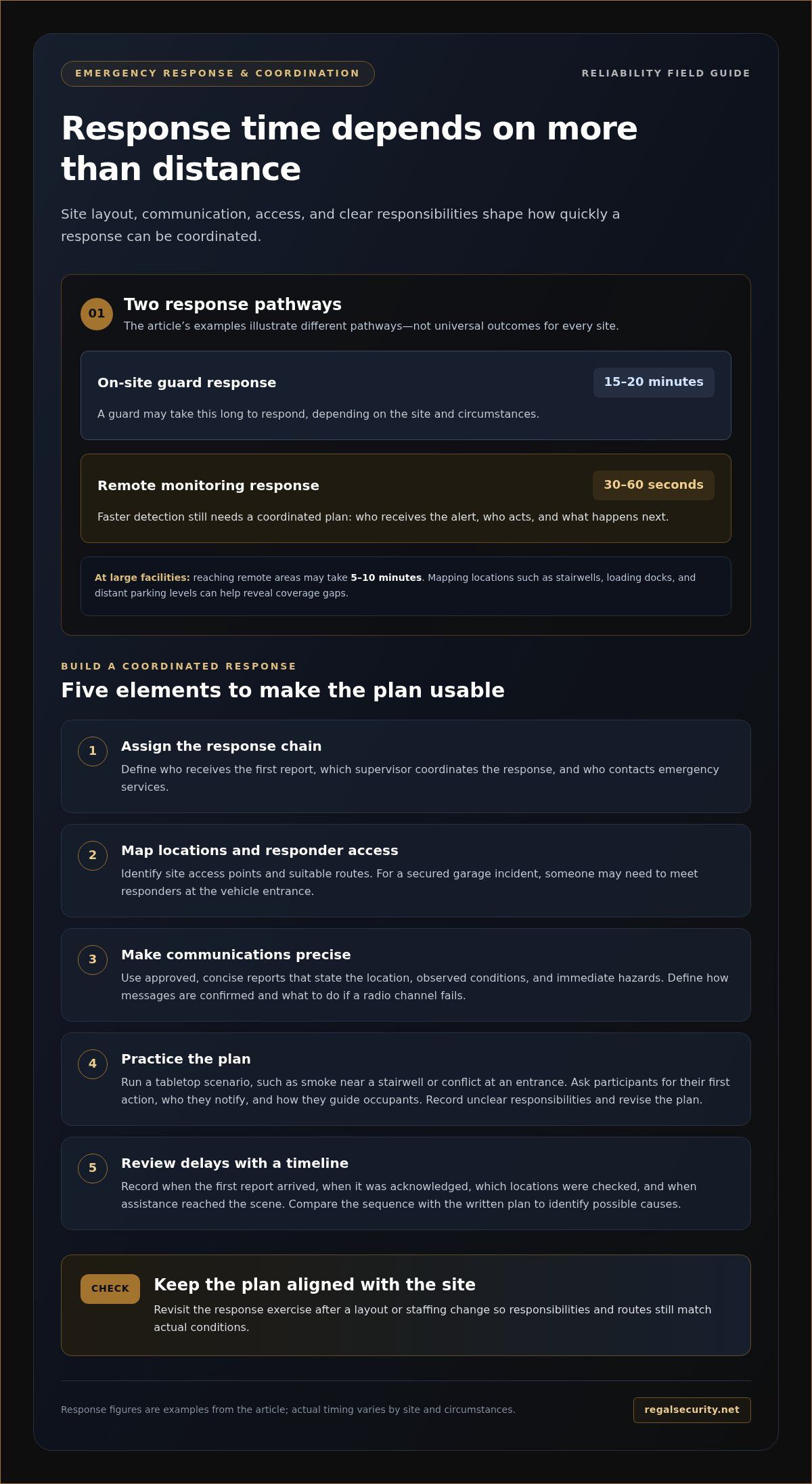
Response time depends on distance, site layout, communication, and the procedures guards follow. At large facilities, guards may need 5-10 minutes to reach remote areas. A stairwell, loading dock, or distant parking level can add travel time before an officer reaches an incident. Mapping these locations helps managers identify coverage gaps and place patrols more effectively.
Distance is only one factor. A guard may take 15-20 minutes to respond, compared with 30-60 seconds for remote monitoring. These figures illustrate different response pathways, not a universal outcome for every site. A coordinated plan defines what monitoring personnel report, who receives the alert, and what action follows. Without those steps, faster detection may still lead to confusion.
Written procedures should turn site risks into clear assignments. Identify who receives the initial report, which supervisor coordinates the response, and who contacts emergency services. Include each location’s access points and a suitable route for responders. For example, an incident in a secured garage may require someone to meet responders at the vehicle entrance.
Communication matters during conflict, medical emergencies, and evacuations. Guards need concise, approved language for reporting a location, observed conditions, and immediate hazards. Radio protocols should explain how to confirm a message and what to do if a channel fails. A missed call or unclear location description can delay support, even when a guard recognizes the problem promptly.
Practice makes procedures easier to use under pressure. A site manager can run a tabletop exercise based on a scenario, such as smoke near a stairwell or conflict at an entrance. Ask each participant to describe their first action, whom they notify, and how they guide occupants. Record unclear responsibilities and revise the plan. Repeating the exercise after a layout or staffing change keeps the response aligned with actual conditions.
After an incident or delayed response, preserve the timeline while details remain clear. Record when the first report arrived, when it was acknowledged, which locations were checked, and when assistance reached the scene. Compare those steps with the written plan to identify whether distance, communication, access, or unclear authority caused delay. Where a consistent on-site presence is part of the response plan, consider on-site security support suited to the property’s needs.
3. Liability, injuries, and insurance exposure
Security work carries physical risks for guards, occupants, and property owners. U.S. security guards die on the job at more than twice the rate of the average worker. Nearly two-thirds of fatal injuries among U.S. security guards result from assaults and other violent acts. These figures underscore the importance of incident prevention, clear boundaries, and careful reporting.
Liability concerns can arise when an incident involves injury, property damage, or an alleged failure to follow assigned procedures. If a visitor falls near an entrance, for example, a timeline may help clarify what happened. Record when the hazard was first observed, who received the report, what action followed, and when the area was checked again. Avoid assumptions and distinguish direct observations from information reported by others.
A sound incident record should identify the location, time, people involved, observed conditions, and actions taken. If a guard responds to a conflict in a lobby, document the sequence rather than relying on broad phrases such as “handled appropriately.” Preserve relevant shift records and communications through established channels. Consistent reporting helps managers assess whether instructions were clear and the response followed site procedures.
Insurance exposure depends on the work, the setting, and the policy terms. A business can review coverage limits, exclusions, reporting obligations, and each party’s responsibilities. The written agreement should explain who manages incident reporting and how records are shared. Compare those provisions with actual post duties, since a mismatch can complicate a later claim.
Prevention takes more than constant observation by one guard. Managers can identify recurring hazards, assign responsibility for corrective action, and document when a remedy is completed. For example, a report about a poorly lit walkway should prompt a recorded inspection and follow-up. Clear patrol instructions also help guards know when to observe, report, request assistance, or avoid actions outside their assigned role.
After an injury or allegation, follow a defined sequence: secure the immediate area, arrange appropriate assistance, notify the designated supervisor, and preserve relevant records. Then review the incident against the site plan and the guard’s assigned duties. Note whether training, communication, equipment, or staffing affected events. Corrective actions should name a responsible person and a completion step, so the review leads to a practical change rather than an unfinished report.
4. Customer feedback
Customer feedback can reveal strengths and weaknesses in a security operation. A visitor may describe a courteous greeting, while an employee may report that an entrance was unattended. Treat each comment as a useful signal, not a complete assessment. Compare it with shift records, incident reports, and assigned post duties before deciding whether it reflects an isolated event or a recurring service gap.
Make feedback specific enough to support action. Ask what happened, where it occurred, and which part of the service was affected. For example, “the lobby felt poorly monitored” needs follow-up: Was the desk unattended, was a visitor left waiting, or was an access concern missed? Clarifying the details helps managers distinguish a communication lapse from a coverage or procedure problem.
Group comments by operational theme, such as attendance, communication, patrol coverage, professionalism, or response to a reported concern. If several employees mention that deliveries wait at the same entrance, review that location’s visitor procedures and post instructions. A consistent review process helps identify patterns across shifts. A single complaint can prompt a focused review without being treated as proof of widespread failure.
Define how concerns should be escalated. A routine service comment can go to the site supervisor for review; an immediate safety concern should follow the site’s emergency reporting procedures. The contract and post orders should clarify who receives feedback, who investigates it, and who communicates the outcome. Clear ownership prevents a concern from sitting in an inbox without an assigned response.
Use a repeatable review process. Record the date, location, issue, source category, and action taken. Compare the account with relevant shift documentation, then speak with the personnel involved when appropriate. If the review identifies an unclear instruction, revise it and explain the change in a briefing. If a patrol route appears to be the concern, observe it and compare its coverage with site needs.
When appropriate, close the loop with the person who raised the concern. Explain that the feedback was reviewed and describe any operational adjustment without disclosing confidential personnel details. Then monitor whether the same concern appears in later reports or routine site reviews. This shows that feedback informs decisions and helps managers assess whether the response addressed the underlying issue.
Job quality and reliability of security services
Reliable coverage depends on more than the guard assigned to a post. Scheduling, supervision, compensation, and clear procedures shape whether service remains consistent across shifts. The U.S. security industry generates about 162,300 job openings annually, almost all to replace workers who leave. Frequent departures can disrupt site familiarity and make dependable staffing harder to maintain.
Job quality matters because demanding work can affect attention and retention. Seventy-one percent of U.S. security officers earn less than the MIT living wage for a single adult, and 43% lack health insurance through an employer or union. Competitive wages, fair schedules, and opportunities for advancement can support retention and help preserve consistent service. Working conditions are therefore an operational concern, not simply an employment issue.
To measure performance, track whether assigned posts are covered, patrols follow their routes, reports are completed, and incidents are escalated through the proper channels. Review records alongside supervisor observations and customer feedback. For a vehicle patrol, compare planned checkpoints with documented visits and investigate repeated omissions.
A contract should define required coverage, how a no-show is reported, who arranges replacement coverage, and how poor performance is documented and addressed. These reported figures underline why clear attendance and coverage procedures matter. Continuous coverage requires a staffing plan that accounts for relief and shift continuity.
To assess staffing, supervision, and incident reporting, review completed schedules, post orders, patrol records, and sample incident reports. Ask managers to explain how a call-off is logged, how an uncovered post is escalated, and how supervisors review records. A consistent process should clarify responsibilities, from the officer on site to the manager overseeing operations.
When assessing service quality, distinguish a one-time lapse from a recurring pattern. A missed patrol, delayed report, or unattended entrance should prompt a documented review of the assignment, instructions, and supervision. Record the corrective action and monitor subsequent shifts for the same issue. This makes improvement observable without relying on impressions alone.
For coverage needs that include a visible on-site presence or vehicle patrols, discuss security coverage options suited to your property and operating requirements.
Regal Security: Unarmed Security Officers
Regal Security provides Unarmed Security Officers for organizations seeking a professional on-site presence. This can suit a property where visible personnel, attentive observation, and clear communication are part of its security approach. Where visitor interaction is central, Concierge Services combine a welcoming point of contact with a security presence. Vehicle Patrol supports properties that need patrol coverage, while Executive Protection serves executive clients.
The right service depends on the setting, required duties, and how security personnel fit into existing site procedures. Discussing these needs helps align coverage with the property’s priorities.
Contact Regal Security to discuss your security requirements, or visit regalsecurity.net.
Make reliability part of your next decision
Make reliability an explicit part of your next security review. Set clear expectations for coverage, communication, and follow-through, then decide how you’ll assess them over time. This gives your team a practical way to identify security guard reliability issues and improve how protection supports daily operations.
The right support reflects the environment and the role security plays in it. For a staffed post, a welcoming entrance, or property patrols, Regal Security offers Unarmed Security Officers, Concierge Services, and Vehicle Patrol. Consider which needs matter most and how those duties should fit your existing procedures.
A thoughtful conversation can help turn those priorities into a suitable service plan. Contact Regal Security to discuss your needs, and take a considered next step toward a more dependable security presence.
Frequently Asked Questions
What are the most common problems of security guards?
Common problems include missed duties, weak communication, poor customer interactions, and inconsistent knowledge of site procedures. A guard might complete a building tour but fail to secure a particular access point, or respond to a visitor without following entry instructions. Businesses can identify these patterns by comparing post expectations with shift records and observations, then addressing specific conduct instead of relying on general impressions.
How can security companies improve business continuity and guard retention?
Security companies can support continuity through fair scheduling, competitive compensation, consistent supervision, and clear opportunities for development. For operations in Manhattan, Brooklyn, Queens, or New Jersey, reliable shift handovers also help preserve local site knowledge when personnel change. Managers can review exit feedback and absence patterns, then adjust scheduling practices or workplace support when recurring concerns appear.
What technology reduces security guard no-shows most effectively?
No single technology replaces sound staffing procedures. Scheduling and attendance systems can make open shifts visible, record acknowledgments, and alert supervisors when a guard has not checked in. A practical workflow assigns a manager to respond to an alert, arrange coverage, and document the resolution. Technology is useful when it gives a named person clear responsibility, rather than merely recording an uncovered post.
Why Some Security Guard Services Fail at Effective Patrols?
Patrols can fail when routes are unclear, priorities change without communication, or guards do not understand the purpose of each checkpoint. For example, a route through a residential property may overlook a service entrance if instructions focus only on the main lobby. Managers can assess patrol quality by comparing route expectations with recorded observations and correcting instructions that leave important areas unattended.
What are the most common reliability issues with security guards?
Recurring security guard reliability issues often involve attendance, incomplete patrols, inconsistent reporting, and unfamiliarity with a site. The key distinction is between a single lapse and a repeated pattern. Review the duty involved, shift circumstances, and available records together. For instance, repeated missed checks at the same entrance could point to a route-design problem, not simply an individual performance concern.
How often do security guards miss shifts or arrive late?
Missed-shift and late-arrival rates vary with scheduling practices, site conditions, staffing stability, and how attendance is recorded. A business can measure its own pattern by tracking scheduled starts, actual arrivals, call-offs, and uncovered posts over consistent reporting periods. Separate late arrivals from absences, then compare patterns by site and shift to identify where coverage planning needs attention.
What factors contribute to security guard turnover and absenteeism?
Turnover and absenteeism can reflect demanding schedules, limited advancement, inadequate support, workplace risks, or compensation that does not match the responsibilities. Commute demands can also affect attendance across a wide service area, including Long Island, Westchester County, and New Jersey. Employers can review departure feedback alongside attendance records to distinguish a scheduling issue from concerns about supervision or job conditions.
What are the legal risks when security guards are negligent or fail to respond?
Negligence allegations can arise when an assigned duty is missed and someone claims the failure contributed to injury or loss. Relevant considerations include the guard’s defined responsibilities, the site’s instructions, the incident record, and the connection between the alleged lapse and claimed harm. Clear contracts and accurate records help establish what duties were assigned and how the organization addressed reported concerns.