Corporate Event Security in Manhattan: A Practical Guide to Choosing the Right Team
A discreet security plan does more than place an officer at the entrance. It helps an event run with quiet confidence. If you’re evaluating corporate event security Manhattan options, you may be weighing how many officers you need, where to position them, and how to keep their presence welcoming. Venue access, deliveries, and guest arrivals add practical coordination needs.
The strongest approach makes security part of the event operating plan, not a visible layer added at the last moment. This guide explains how to align on-site coverage with your venue, schedule, guest experience, and leadership requirements. You’ll learn how to plan officer positions, coordinate arrivals and access, and set a clear process for communicating concerns. With clear roles and a calm, professional presence, unarmed security officers can support orderly operations while guests, staff, and executives focus on the event.
Table of Contents
Why Corporate Event Security in Manhattan Starts with the Guest Experience
Corporate event security is planned, on-site coverage that supports people, manages access, and helps an event proceed in an orderly manner. In Manhattan, the goal isn’t simply to station an officer at the door. Consider how guests, staff, and authorized visitors will move through the venue, and how a professional presence can support a composed experience.
Security has a distinct role. Event producers manage the program and its logistics; venue teams oversee the building and its operations; public emergency services respond to emergencies within their remit. On-site security officers carry out agreed event responsibilities, such as access awareness, guest direction, and communicating concerns to the appropriate contacts. These roles work together, but they aren’t interchangeable. A plan can apply the basic principles of Physical security measures, including controlling access and protecting people and property, while remaining specific to the event.
Manhattan’s setting also matters. Guests may arrive amid busy street activity, deliveries may need coordination, and the venue’s entrances, reception areas, elevators, and interior layout can shape movement. Review these details in advance so the plan fits the location instead of relying on a single post to address every need.
Which Manhattan corporate events may need on-site security?
Conferences, product launches, receptions, and leadership gatherings may all benefit from on-site coverage, depending on their circumstances. Attendance is one consideration, but access requirements, the schedule, venue layout, and guest profile also affect the plan. A reception with a defined guest list and one arrival period may call for a different arrangement from a conference with several arrival periods. Match coverage to the event’s actual setting and operational needs.
How can security support a welcoming event atmosphere?
A calm, professional officer can help guests find their way, while an attentive presence supports awareness and discourages unauthorized access without making security the focus. Clear directions and orderly entry contribute to a considered welcome. Define the guest-facing role in advance, including officer positions and when to direct questions to event or venue staff.
The right balance is deliberate: officers are accessible and observant, while the event remains centered on its purpose. Clear roles can support a smooth arrival and a reassuring experience for guests, staff, and leadership.
What a Manhattan Corporate Event Security Plan Should Cover
A useful plan turns event details into clear assignments. Document the schedule, venue layout, expected attendance, access arrangements, and key contacts, then use that information to align officer roles with the event’s needs. FEMA’s guidance on contingency planning for special events also emphasizes deliberate pre-event planning and coordination.
Keep the brief practical and share it with relevant venue stakeholders. Specify how organizers will communicate changes, who should receive updates, and how to raise concerns with the appropriate event or venue contact. Agree on handoff expectations at the start and end of coverage so responsibilities stay clear throughout the schedule.
What information should organizers include in the event brief?
Record event timings, expected attendance, guest categories, and access arrangements. Mark entrances, registration areas, restricted spaces, and relevant venue contacts on a layout when possible. Add event-specific priorities, such as keeping an area limited to authorized guests, and identify who will communicate changes. A concise, shared brief reduces uncertainty before staff and guests arrive.
How should staffing and officer roles be matched to the plan?
Officer positions and responsibilities should reflect the venue layout and the key points in the schedule. An officer assigned to an entrance may focus on access awareness and guest direction, while another agreed role may support movement through a designated area. Specific assignments help organizers, venue staff, and officers understand who is responsible for each task and where questions should go. For broader context, see this guide to professional unarmed security officers.
Planning checklist to share with venue stakeholders:
Event schedule, arrival periods, and closing time
Venue layout, entrances, registration points, and restricted spaces
Expected attendance, guest categories, and access arrangements
Officer locations, assigned responsibilities, and guest-assistance expectations
Key organizer and venue contacts, communication method, escalation contacts, and handoff expectations
When details change, circulate the updated brief to everyone whose responsibilities are affected. This keeps coverage aligned with the event instead of relying on assumptions. Regal Security provides tailored on-site event coverage shaped around the venue, schedule, and coverage priorities.
How to Compare Corporate Event Security Providers in Manhattan
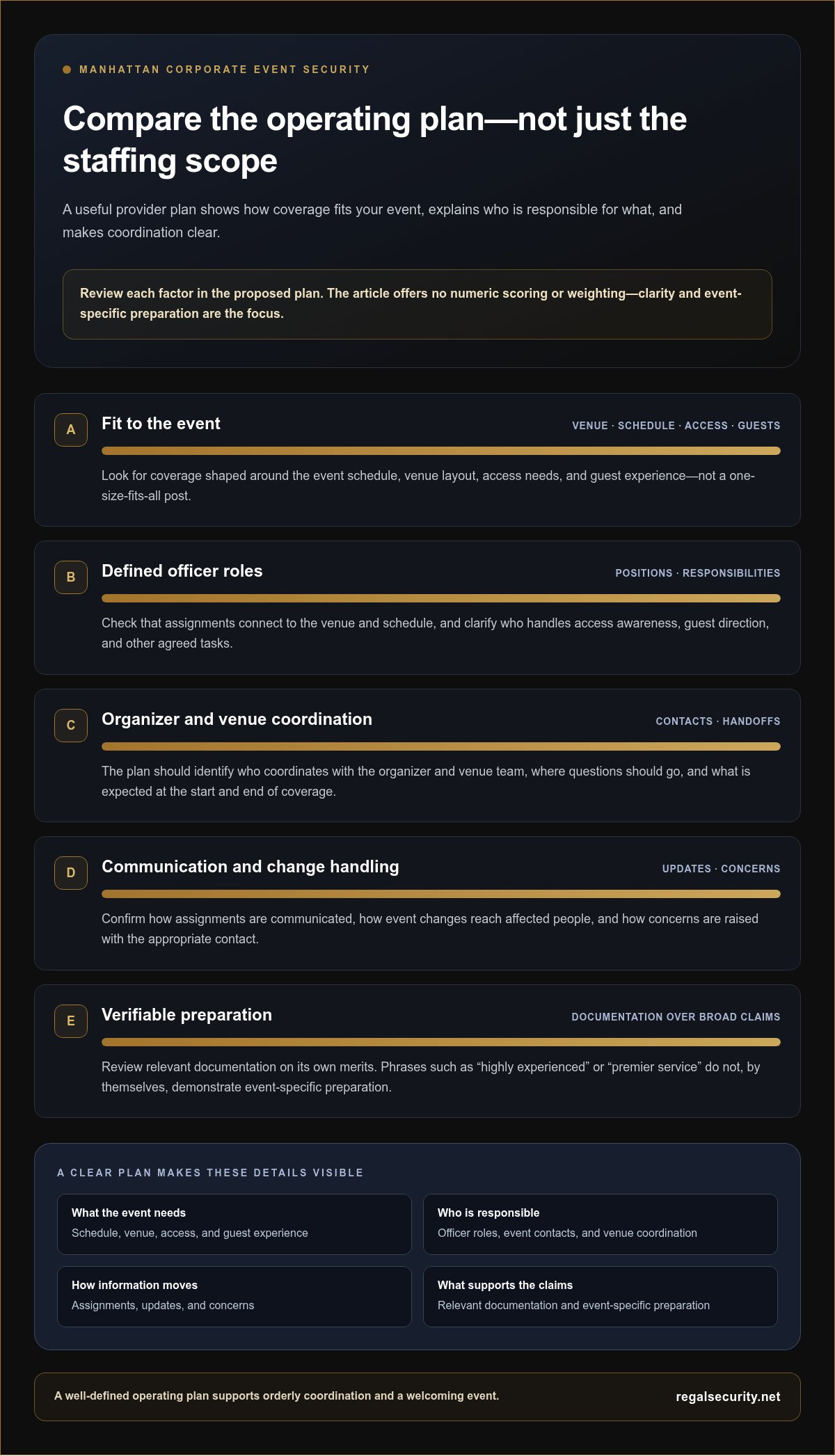
Compare the operating plan, not just the proposed staffing scope. A useful plan explains how coverage reflects your event schedule, venue, access needs, and guest experience. It also clarifies who coordinates with the organizer and venue team, how assignments are communicated, and how changes will be handled.
Separate verifiable qualifications from broad claims. Review relevant documentation on its own merits; phrases such as “highly experienced” or “premier service” don’t, by themselves, show event-specific preparation. The U.S. Department of Justice’s Guidelines for Law Enforcement discuss planning and coordination for major events, offering useful context for the importance of defined responsibilities and communication.
Which questions reveal whether the plan fits your event?
Use practical questions to determine whether the plan is specific to your event:
How does the proposed coverage reflect the event schedule, venue layout, and access arrangements?
Who will coordinate with the organizer and venue team during planning?
How will assigned roles and plan updates be communicated?
Which guest-facing responsibilities are included, and which remain with event or venue staff?
Event details can change, so clear communication during planning matters. A focused discussion should translate those details into defined coverage and points of contact. Regal Security provides corporate clients with tailored on-site unarmed officer coverage, shaped around the venue and event requirements.
What does discreet, professional event security look like?
It is composed, attentive, and respectful. Officers can support orderly access and offer clear directions without dominating the room or making guests feel unwelcome. The aim is a visible, professional presence that supports awareness while keeping the event itself in focus.
Use this comparison framework to assess the proposed plan:
Planning: Does it reflect the schedule, layout, and access needs?
Communication: Are planning contacts and update methods clear?
Role clarity: Are officer responsibilities distinct from venue and event duties?
Guest interaction: Does the approach support calm, courteous assistance?
Manhattan familiarity: Does the plan account for the specific venue and arrival conditions?
If leadership has separate protection needs, consider how those responsibilities relate to the event’s general coverage and explore this executive protection agency guide. To arrange tailored corporate event security in Manhattan, start with the venue, schedule, and coverage priorities.
Manhattan Event-Day Logistics: Entrances, Arrivals, and Coordination
Event-day coverage works best when responsibilities are clear before the first guest arrives. Coordinate the officer plan with the venue’s access points, registration setup, delivery schedule, and event timetable. A Midtown office venue and an event near the Javits Center may have different arrival patterns and layouts, so plan for the specific location rather than assuming every venue uses the same entrance arrangement.
An arrival plan should match the venue’s access points and event schedule so guests, deliveries, and staff know where to go and when. Confirm the designated entrance with venue personnel, identify the registration location, and agree how officers will direct guests while maintaining a composed, service-minded presence.
How should organizers plan guest arrivals and event access?
Map expected arrival periods, registration locations, and designated entrances with the venue team. Consider how pedestrian movement may affect the approach and whether vehicle drop-off requires coordination at that location. For a Midtown event, for example, distinguish the guest entrance from a scheduled delivery point. For an event near the Javits Center, use the selected venue’s entrances and guest route to guide the plan.
Officers can help guests orient themselves and proceed to the correct registration area, following their agreed responsibilities. Give event staff who greet attendees the same access instructions so directions stay consistent. If timing or entrance arrangements change, share the update with the relevant venue and event contacts.
What should happen before doors open and after the event?
Before opening, hold a concise briefing to review assigned roles, key contacts, timing, entrance arrangements, and the agreed process for communicating concerns. Include setup activity and scheduled deliveries, particularly if they overlap with guest arrivals. If the program changes, make sure the people affected receive the revised information.
During coverage, officers carry out their assigned responsibilities and coordinate with venue personnel as agreed. At closing, complete a handoff that notes unresolved matters and confirms the end of assigned coverage. This gives the organizer and venue team a clear transition instead of leaving responsibilities implicit.
Make coordination easier by including the event schedule, venue access details, delivery timing, and arrival priorities in the planning brief. Arrange tailored Manhattan event security with coverage shaped around your venue and event-day logistics.
Arrange Corporate Event Security in Manhattan with Regal Security
Regal Security provides professional unarmed officers for corporate event coverage in Manhattan, with a reliable on-site presence tailored to the venue and event requirements. Planning starts with practical details and connects them to clear officer roles and the guest experience you want to create. This makes coverage a considered part of event operations, aligned with the schedule and setting.
You don’t need every operational detail finalized to start planning. An initial brief can describe the event, access needs, and the priorities that matter most. The clearer those details are, the more directly the discussion can address suitable on-site coverage.
What information helps start an event security discussion?
Prepare the event date, venue, schedule, expected attendance, and available access information. Note arrival patterns, registration arrangements, and areas with restricted access. Include key organizer and venue contacts, along with leadership considerations if separate executive protection is relevant. Describing the atmosphere you want, such as formal, welcoming, or discreet, helps define the guest-facing role.
Event date, venue, and schedule
Expected attendance and guest arrival needs
Entrances, registration points, and access priorities
Organizer and venue contacts
Desired atmosphere and coverage priorities
How can Regal Security support a composed event environment?
Professional unarmed officers provide a visible, service-minded presence suited to a corporate setting. Their roles can align with the venue, schedule, access requirements, and agreed coordination with event personnel. Whether the priority is orderly guest entry or attentive support at a designated location, a tailored plan defines responsibilities while keeping the event’s tone in mind.
Regal Security helps corporate event organizers shape coverage around their requirements. Share your event details and coverage priorities, and discuss corporate security services to begin planning on-site coverage suited to your venue, schedule, and guests.
Make Your Manhattan Event Feel Prepared and Welcoming
Effective corporate event security Manhattan planning starts with the event itself: the venue, schedule, access points, guest arrivals, and experience organizers want to create. Clear officer roles and agreed communication align coverage with venue and event operations. A calm, professional presence can support orderly access without taking attention away from the occasion.
Regal Security provides professional security services tailored to corporate clients, with unarmed security officers as its primary service. On-site coverage can be shaped around your event requirements to support a composed environment for guests, staff, and leadership. Regal Security serves Manhattan and the wider New York City area.
Share your event date, venue, schedule, expected attendance, and coverage priorities to start planning. Discuss corporate event security in Manhattan with Regal Security and take the next step toward a well-coordinated event. Thoughtful planning and a professional presence can help guests feel at ease from arrival through closing.
Frequently Asked Questions
How much does corporate event security cost in Manhattan?
Fees depend on the coverage plan developed for your event. Factors include the schedule, venue layout, attendance, access requirements, and the number and placement of officers needed for assigned responsibilities. Security personnel fees are typically structured as hourly rates or long-term service contracts. A reception with one guest entrance may need a different arrangement from a multi-area program with staggered arrivals. Share your event details and priorities to discuss coverage tailored to your requirements.
How many security officers does a corporate event in Manhattan need?
There’s no single officer count that suits every corporate event. The staffing plan depends on the venue’s access points, event schedule, expected attendance, guest movement, and responsibilities assigned to officers. Identify each location where coverage is needed, such as an entrance or registration area, and consider how those needs change during the event. A clear brief helps align staffing with the actual layout and operations.
What does corporate event security include?
Corporate event security is planned, on-site coverage that supports people, access, and orderly event operations. Depending on the agreed plan, unarmed officers may be assigned to designated entrances, direct guests, and communicate concerns to event or venue contacts. Coverage should remain distinct from event production and venue management, with responsibilities shaped around the schedule, layout, and access arrangements rather than assumed to cover every event function.
Can unarmed security officers provide security at a corporate event?
Yes. Professional unarmed security officers can provide on-site corporate event coverage, with assigned responsibilities aligned to the venue and event plan. Their role may include supporting orderly access, offering directions, and maintaining an attentive presence at agreed locations. Regal Security’s primary service is unarmed security officers, and its corporate coverage is tailored to the client’s setting and operational priorities. Clear role definitions help event teams coordinate effectively.
How far in advance should I arrange event security in Manhattan?
Begin planning as early as practical, especially if the venue has multiple access points, scheduled deliveries, or a detailed event program. Allow time to discuss the schedule, attendance, layout, and coverage priorities before event day. Regal Security serves Manhattan and the wider New York City area, as well as New Jersey, Brooklyn, Queens, the Bronx, Staten Island, Long Island, Nassau County, Suffolk County, Westchester County, Rockland County, and Orange County.
What should I include in a corporate event security plan?
Include the event schedule, expected attendance, venue layout, entrances, registration area, access arrangements, and key organizer and venue contacts. Identify restricted spaces, officer assignments, guest-assistance responsibilities, and how plan changes or concerns should be communicated. Note scheduled deliveries and any leadership-specific considerations as well. Sharing a concise, current brief with relevant stakeholders clarifies responsibilities before guests arrive and supports coordinated event operations.
Can event security help manage guest arrivals and access?
Yes. With responsibilities agreed in advance, officers can help direct guests to designated entrances and registration areas and support orderly access. Organizers should coordinate arrival periods, pedestrian routes, and relevant vehicle drop-off arrangements with venue personnel. Consistent directions from event staff help guests know where to go. Coverage should reflect the venue’s access points and schedule, particularly when deliveries or setup activity overlap with guest arrivals.
How does event security support a discreet, professional guest experience?
Professional event security supports a composed atmosphere through an attentive presence, respectful communication, and clear guest direction. Officers can be visible without dominating the event environment, helping guests find the right entrance or registration area while carrying out their agreed responsibilities. Organizers can shape this guest-facing approach by discussing the desired atmosphere, officer placement, and coordination with venue staff. The aim is a considered experience, not unnecessary disruption.