Corporate shuttle security in NJ for employee travel
A shuttle is only as dependable as the safety plan around each ride. Corporate shuttle security in NJ means planning for pickup and drop-off, maintaining an attentive presence during passenger movement, and coordinating support for the route and setting.
A consistent process helps employees travel with greater confidence and gives businesses a practical way to address security concerns without disrupting daily operations. The right approach depends on where people board, how they travel between locations, and what support the setting calls for.
This guide explains how to plan shuttle security for campuses, business parks, corporate events, and airport transfers in New Jersey and New York City. It also describes how on-site officers, vehicle patrol, concierge services, and executive protection can support different employee travel needs.
Table of Contents
Campus and business park shuttles
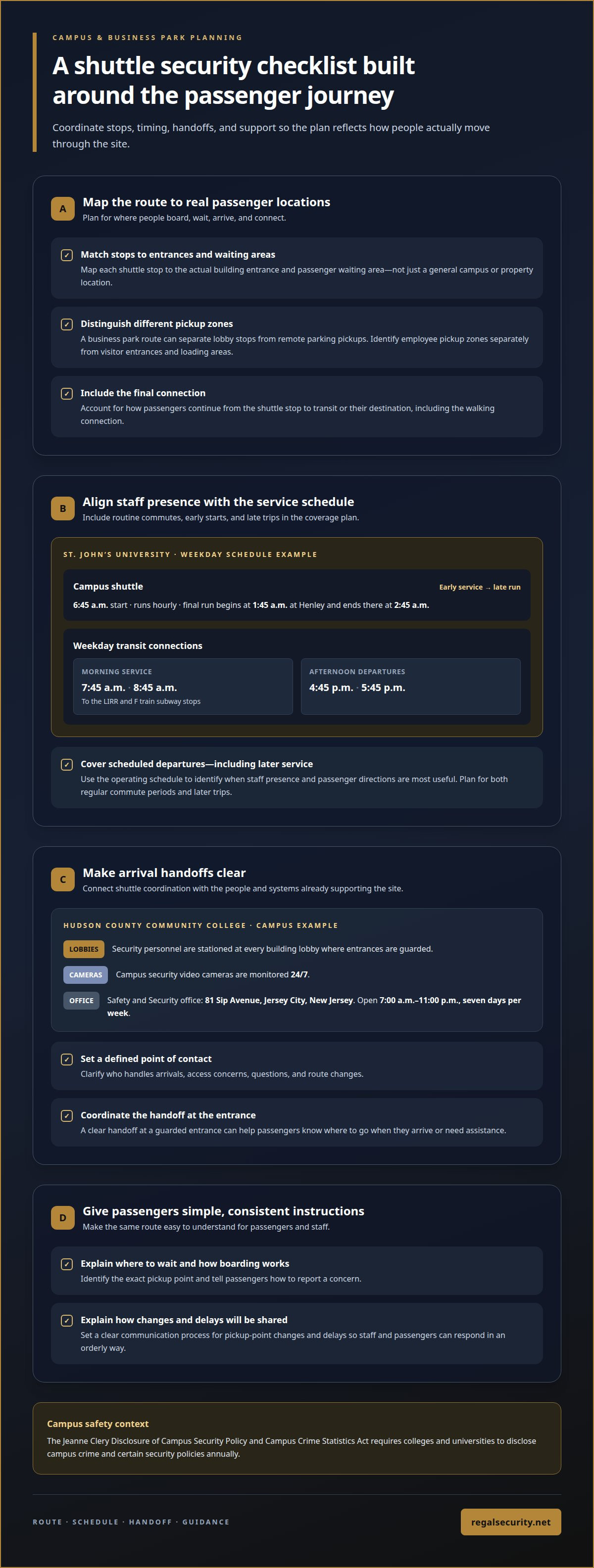
Campus and business park transportation works best when security planning follows the passenger journey. A shuttle may connect parking areas, office buildings, residence halls, and transit stops, each with different needs for coordinating arrivals, departures, and assistance. For example, a business park route can distinguish lobby stops from remote parking pickup points. That helps clarify where staff presence and directions are most useful.
St. John’s University provides a concrete weekday schedule example. Its campus shuttle starts at 6:45 a.m. and runs hourly. The final run begins at 1:45 a.m. at Henley and ends there at 2:45 a.m. Weekday morning service to the LIRR and F train subway stops repeats at 7:45 a.m. and 8:45 a.m. Afternoon departures repeat at 4:45 p.m. and 5:45 p.m. These specific intervals show why a security plan should account for both routine commutes and later trips.
Campus security personnel also shape how shuttle passengers move between buildings. Hudson County Community College staffs security personnel at every building lobby where entrances are guarded. Its campus security video cameras are monitored 24/7. For transportation planning, those measures illustrate how lobby awareness and shuttle coordination can complement one another. A defined handoff at a guarded entrance can help passengers know where to go when they arrive or need assistance.
For campus safety contact information, Hudson County Community College’s Safety and Security office is at 81 Sip Avenue in Jersey City, New Jersey. The office is open from 7:00 a.m. to 11:00 p.m., seven days per week. Naming a specific contact point and operating hours gives campus transportation teams a clear reference for routine coordination. The Jeanne Clery Disclosure of Campus Security Policy and Campus Crime Statistics Act requires colleges and universities to disclose campus crime and certain security policies annually.
Business parks can use the same planning principles without assuming every site follows a university-style schedule. A route plan should identify building entrances, passenger waiting areas, and connections to parking or transit. It should also explain how staff communicate delays or changes to pickup points. These details align transportation with the property’s daily flow.
Map the shuttle’s stops to the actual entrances and passenger waiting areas.
Align security coverage with scheduled departures, including early and late service.
Set a clear point of contact for arrivals, access concerns, and route changes.
On campuses with multiple destinations, such as St. John’s University’s transit connections, timing and handoffs need particular attention. A consistent process helps passengers identify the correct stop and campus personnel respond to questions. At a business park, the same approach can distinguish employee pickup zones from visitor entrances and loading areas.
New Jersey and New York City service areas
Employee transportation between New Jersey and New York City needs a route plan that accounts for state boundaries, pickup locations, and passenger handoffs. For example, a shuttle between a Jersey City office and a Manhattan destination should specify boarding and transfer points, along with who coordinates changes. This structure helps with both recurring commutes and one-time corporate trips. The route shapes timing, access arrangements, and coordination at each stop.
Applicable New Jersey and federal requirements depend on the shuttle’s vehicle, route, and operating arrangement. Treat transportation compliance and security coverage as separate considerations, since they address different parts of the service.
For service between New Jersey and New York City, define the trip by its actual endpoints rather than a broad regional label. A route from a New Jersey business park to a Midtown office involves different passenger movements from a campus loop or airport transfer. Record departure and arrival points, expected handoffs, and planned transit connections. These details help determine where staff presence is useful and how to communicate a route change.
St. John’s University offers a specific example of a weekend connection. Its final weekend shuttle run starts at 2 a.m. Saturdays and Sundays at Gate 6, then ends at 3 a.m. at Gate 6. Students can reach Jamaica LIRR station by taking the Q30 or Q31 bus. Those bus options are approximately two blocks from Henley Road Residence. This illustrates why a route plan should account for the final walking connection, not only the shuttle’s stop.
One-time and recurring shuttle services need different coordination. A corporate event may call for a schedule built around arrival and departure windows, while a regular employee shuttle benefits from a stable route and clear procedures for routine changes. In either case, specify pickup points, passenger instructions, and how delays will be communicated. For weekend service, make operating days and the final departure clear before travel begins.
Shuttle rules should be simple and consistent across the route. Explain where passengers wait, how boarding works, and how to report a concern. At a New York City stop, identify the exact pickup location; at a New Jersey campus, distinguish the shuttle area from other building entrances. Clear directions reduce confusion during handoffs and help staff respond in an orderly way.
Map each New Jersey and New York City stop to a defined passenger handoff.
Separate event-specific instructions from procedures used for recurring service.
Include weekend departure details and the final connection in passenger guidance.
For a route that needs coordinated security presence across employee pickup points, professional shuttle security planning can be considered alongside transportation arrangements.
Corporate event and airport shuttles
Corporate events concentrate passenger movement around a venue and schedule. For a conference at a Newark office, the shuttle plan can identify the arrival entrance, employee waiting area, and person coordinating boarding. That clarity separates arriving guests from event staff and other building visitors. It also gives passengers a consistent place to go when vehicles arrive at different times.
Before an event, organize the route around the itinerary. Record each pickup location, destination, planned departure window, and passenger handoff. A shuttle serving a hotel and corporate venue, for example, needs separate instructions for both stops. Make the boarding point easy to distinguish from nearby public entrances. If the schedule changes, designate one contact to communicate revised pickup details.
Airport transfers also need a deliberate plan, especially when employees arrive on different flights. For travel involving Newark Liberty International Airport, explain how passengers can identify the meeting point and communicate a change in arrival plans. Keep destination and transfer instructions consistent across messages. Clear directions help prevent confusion about pickup, drop-off, and onward travel.
Security planning should cover activity around each vehicle as well as the journey itself. At a corporate venue, key moments may include boarding after a reception, loading luggage, and leaving a busy entrance. At an airport, attention may shift to the meeting point and the transition from terminal to shuttle. Assigning clear responsibilities for these moments helps staff handle questions and changes calmly.
For employees traveling in several vehicles, establish a shared route plan and a clear departure sequence. Each vehicle should follow the same destination and passenger instructions, while the event coordinator has a reliable way to communicate changes. This is useful when a corporate program has several pickup points or employees arrive separately. Do not expect passengers to guess where a vehicle will stop.
Set a recognizable pickup point at the venue or airport.
Keep itinerary changes and passenger instructions consistent.
Assign responsibility for boarding, questions, and departure coordination.
For airport travel, a defined meeting point reduces uncertainty after employees leave the terminal. For event travel, a designated departure area helps attendees leave without interrupting venue access. In both cases, explain what to do if an employee is delayed or arrives at the wrong pickup point. A designated coordinator can relay agreed instructions without making informal route changes.
Corporate shuttle security in NJ should reflect the event’s actual passenger flow. Focus planning on the itinerary, pickup locations, vehicle sequence, and communication responsibilities. Matching these details to a Newark event or airport transfer gives employees a clear journey from boarding to arrival and keeps handoffs orderly.
Corporate shuttle security and safety
A dependable plan connects oversight of the vehicle with passenger protection at every stage. Employers should assess route-specific risks, staff responsibilities, and incident procedures.
Provider Security Features
Choose a security plan suited to the route, passenger profile, and operating environment. Clarify how personnel coordinate with shuttle operations, respond to concerns, and document incidents. Discreet Executive Protection may suit executive travel, while a larger employee route may need a visible presence at boarding points. Clear responsibilities are more useful than broad claims about safety.
Pickup and Drop-Off Security
At each pickup and drop-off, define the vehicle’s position, passenger waiting area, and staff role. An office lobby and curbside stop, for example, may call for different approaches to access and passenger movement. Security personnel can direct passengers, observe the immediate area, and communicate changes to the designated coordinator. Instructions should identify the correct stop and a contact for route updates.
Emergency Response and Incident Reporting
Set out how personnel alert appropriate responders, address immediate hazards to passengers, and notify the employer’s designated contact. An incident report should record the location, time, people involved, actions taken, and follow-up needs. A missed pickup and a medical emergency, for example, require different responses. A written escalation path helps staff act consistently and creates a clear record for review.
Look for route-specific planning, defined staff duties, and orderly communication with drivers and passengers. A security plan should explain how the pickup environment is assessed and concerns are documented, rather than relying on a generic description.
Commercial vehicle inspection and safety certification requirements depend on the vehicle and how it operates. Security coverage does not replace vehicle maintenance or applicable transportation compliance.
Handle passenger data deliberately. The shuttle operator should explain what information it collects, who can access it, and how it is protected and retained. For example, share an employee roster only with personnel who need it for transportation coordination. Avoid collecting information unnecessary for the trip.
Start a risk assessment with the route: identify stops, visibility, access, passenger volume, and points where a delay could create exposure. Then match controls to those risks, such as staff presence, clearer boarding instructions, or a designated escalation contact. Review incident reports and route changes to see whether procedures need adjustment.
For New Jersey employers, effective shuttle security brings transportation, personnel, and communication together in one operating plan. Regular reviews keep the response aligned with the route and the people using it.
Are New Jersey corporate shuttle drivers required to undergo background checks and drug testing?
For a New Jersey corporate shuttle, the vehicle classification and operating arrangement shape which screening requirements apply. The label “corporate shuttle” alone doesn’t establish whether a driver must undergo a background check or drug testing. Those are separate considerations, and employers should assess each against the service’s actual requirements.
Start with the vehicle and route. A shuttle between a company campus and transit station may operate differently from one serving a wider area. Before setting a screening policy, identify the vehicle type, service arrangement, and applicable transportation rules. These details help establish which requirements apply to the driver’s role.
Background screening and drug testing serve different purposes. A background check reviews relevant information about an individual; a drug-testing policy addresses substance testing under applicable requirements and employer procedures. One does not replace the other. Completing a background check, for example, does not by itself establish that a separate testing requirement has been met.
Employers can make the decision process clearer by documenting the factors considered. A practical review can include:
The shuttle vehicle and the way the service operates.
The driver’s role and responsibilities on the route.
Any transportation rules applicable to that vehicle or operation.
The employer’s written screening and testing policies.
How screening decisions and required records are handled.
Consistency matters for recurring service. If one driver serves a weekday campus loop and another covers an event route, apply the requirements relevant to each position. A written procedure can explain who determines the applicable screening steps, how decisions are recorded, and when a vehicle or duty change triggers a review. Do not treat company policy as a substitute for applicable transportation requirements.
Communication matters, too. Identify the responsible transportation contact and establish how screening status is handled before assigning a driver. A new route or changed vehicle, for example, should prompt a review of relevant requirements. This keeps decisions tied to actual operating conditions rather than assumptions based on the word “shuttle.”
For security planning, distinguish driver qualifications from passenger-facing security. Driver screening concerns eligibility for the driving role; security personnel may support passenger movement, access, and incident response. Clear job boundaries help employers coordinate transportation responsibilities without confusing screening procedures with on-site security duties.
Because vehicle classification and operation determine the relevant review, New Jersey employers should establish those details first, then document their screening process. Discuss shuttle security planning as part of a coordinated employee travel plan.
Regal Security
Regal Security supports employers with security needs around employee shuttle travel. Its services include Unarmed Security Officers, Concierge Services, Vehicle Patrol, and Executive Protection. The right support depends on the setting, passenger movement, and risks identified in the travel plan.
For campus routes, business parks, events, and airport transfers, consider how professional security can complement transportation procedures. Unarmed Security Officers and Concierge Services can support passenger-facing operations, while Vehicle Patrol can address mobile security needs. Executive Protection can support travel involving executives. These services offer a practical next step for companies seeking security coordination around employee travel.
Contact Regal Security to discuss your corporate shuttle security needs.
Set a Clear Standard for Employee Travel
Turn your corporate shuttle security plan in New Jersey into clear operating expectations. Define who coordinates security, how route changes are communicated, and how concerns are recorded. Revisit these responsibilities when schedules, destinations, or passenger needs change, so the plan stays aligned with the service employees use.
This preparation gives your organization a practical basis for defining security coverage around its transportation program. Share the routes and travel settings that matter, then determine what support fits those needs. A clear scope keeps security arrangements connected to passenger movement and the workplace.
Contact Regal Security about shuttle safety to discuss your employee travel needs. A considered plan can help your team approach each journey with greater clarity and confidence.
Frequently Asked Questions
What do you do to ensure safety while people use the shuttle?
Regal Security provides a professional security presence tailored to the setting and travel needs. Security personnel can maintain an attentive presence around passenger activity, while Concierge Services can support an orderly, service-oriented environment. The appropriate arrangement depends on the route and location. This complements transportation procedures, but does not replace the employer’s responsibility for schedules and driver qualifications.
What security measures do corporate shuttle services in New Jersey provide?
Security support can include on-site personnel, Concierge Services, or Vehicle Patrol, selected for the travel setting. A company coordinating employee movement between New Jersey and New York City may have routes involving Manhattan, Brooklyn, Queens, the Bronx, Staten Island, Long Island, Nassau County, Suffolk County, Westchester County, Rockland County, or Orange County. Regal Security tailors corporate security services across these locations, with a focus on a reliable, appropriate presence.