Reducing Insurance Premiums With Security Patrols: How Much Can You Save
Security patrols can strengthen a business’s risk profile, but they do not guarantee an insurance discount. The effect of reducing insurance premiums with security patrols depends on the business, its location, its security needs, and the insurer’s underwriting criteria. There is no single savings figure for every business. Patrols may also provide value by helping prevent losses.
A visible security measure may seem likely to lower insurance costs, but insurers assess the wider picture: the risks a business faces, the safeguards in place, and how well those measures are documented. Understanding this process helps set realistic expectations and present security arrangements clearly.
This article explains what insurers may consider, how patrols can affect premiums and incident losses, and which records can support a request for a discount. It also covers how to match patrol coverage to business needs, so you can weigh potential insurance benefits against the practical value of a dependable security presence.
Table of Contents
Factors insurers evaluate when underwriting security systems
Insurers assess security in the context of a property’s risks, not as an isolated feature. Business type, location, security measures, and the insurer’s underwriting criteria all shape how patrols and other safeguards may affect coverage and costs.
Discounts Across Security Systems and Policies
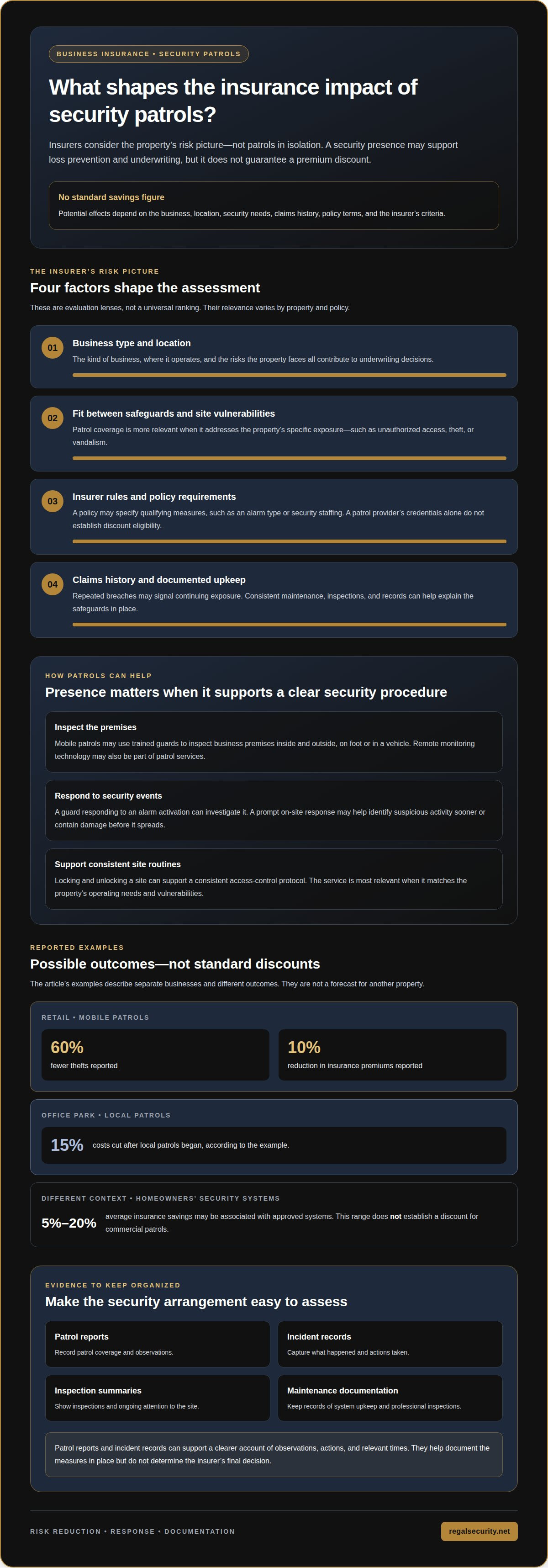
A security discount is a possible premium adjustment for measures that address an insurer’s assessment of risk. For homeowners, approved security systems may be associated with average insurance savings of 5% to 20%; that range does not establish a discount for commercial patrols.
For businesses, commercial property coverage is the clearest place to discuss protection against property loss. Insurers may also consider security when reviewing other business coverage, but policy terms and qualifying measures vary. Cameras may inform the overall risk assessment rather than earn a separate discount.
Patrol Licensing and Discount Variation
Whether patrols qualify for a discount depends on the insurer’s criteria and the security measures required by the policy. An insurer may specify an alarm type or security staffing requirements. A patrol company’s credentials alone do not establish that a discount applies.
Discounts differ by insurer, while business location and security needs also affect underwriting. There is no single savings figure for every state or policy. The relevant comparison is the insurer’s criteria for the specific property and coverage.
Monitoring can influence how insurers assess an alarm system. Professionally monitored systems connected to a central monitoring station typically receive the most meaningful commercial discounts, while self-monitored systems generally receive little or no credit. A UL-listed monitoring center indicates that the center meets industry standards for staffing, response times, and infrastructure redundancy.
Patrols provide a different kind of security evidence. They may be conducted on foot, in a vehicle or through remote monitoring technology; mobile patrols involve trained guards inspecting business premises inside and outside. Insurers may recognize these measures as part of a broader risk assessment, especially when guard duties support consistent site procedures.
For example, guards who respond to alarm activations can investigate them, while guards who lock and unlock a site can support a consistent security protocol. These services do not guarantee a premium credit, but they can show how a business manages access and responds to security events.
Maintenance and documentation matter alongside security equipment and patrols. Properly installed, consistently maintained systems can strengthen an insurer’s assessment, and regular professional inspections create a record of upkeep. Businesses can assess patrol value by weighing documented prevention measures and incident response against their own loss exposure, rather than assuming a premium reduction will cover service costs.
How security measures may affect insurance premiums and losses
Security measures shape an insurer’s view of a business’s exposure and may affect premiums, coverage terms, and claims outcomes.
The financial effect depends on whether safeguards address the incidents most relevant to the property and are reflected in the insurer’s risk assessment.
Security Measures, Risk, and Premiums
Security measures affect the likelihood and potential severity of losses, which insurers consider when assessing business risk. A site with repeated theft or vandalism presents a different exposure from one with controls that deter unauthorized access and support a timely response.
Insurers may charge higher premiums or limit coverage when a business has inadequate security or a history of security breaches. Patrols can form part of a broader prevention plan by providing regular inspections and a visible security presence. Their value depends on whether the coverage addresses the property’s specific vulnerabilities.
Examples illustrate possible outcomes, not standard discounts. In one retail example, mobile patrols were followed by 60% fewer thefts and a 10% reduction in insurance premiums. A separate office park example reported costs cut by 15% after starting local patrols. These results show why businesses should consider incident prevention and premium effects together.
Security and Insurance Claims
Security measures can affect claims by helping prevent an incident, limit damage, or establish what happened. For example, a guard who investigates an alarm activation may identify suspicious activity sooner than a response based only on later discovery.
During an emergency, a prompt on-site response can help contain damage before it spreads. Patrol reports and incident records can also give a business a clearer account of observations, actions taken, and relevant times. That documentation supports a more complete claims file, although it does not determine the insurer’s final decision.
Claims history matters to future underwriting. Insurers may treat repeated breaches as evidence of continuing exposure, while documented loss-control measures can help explain how the business has addressed known vulnerabilities. Patrol activity should therefore address specific site risks, not simply create a record of presence.
Limits on Patrol Savings
Patrols do not prevent every loss, and their effect depends on the insurer’s criteria, the business type and location, and existing claims history. A service that does not address the cause of previous incidents may be less relevant to underwriting than measures aimed directly at that exposure.
Discounts also vary by carrier, and an insurer may assess patrols within the property’s overall risk rather than as a separate credit. Businesses investing in risk prevention and loss control can see premiums drop by up to 15-20%, but this broad figure does not define an individual patrol discount.
To assess return on investment, compare the patrol’s documented role in preventing or limiting losses with the business’s exposure and insurance outcomes. Include avoided disruption and reduced damage in that assessment, not just premium changes. A clear professional patrol plan can connect coverage to the risks the insurer evaluates.
Choosing professional security patrols based on business needs and budget
A suitable patrol plan starts with the property’s actual exposure, not a standard package. Businesses can weigh patrol coverage against risks such as theft, employee safety, and unauthorized access.
A provider can shape coverage around a business risk assessment that considers physical security, data protection, employee safety, theft, cyberattacks, and natural disasters. For a warehouse, the assessment may focus on perimeter access and vulnerable storage areas. An office property may prioritize visitor movement, shared entrances, and after-hours access.
Coverage is most useful when patrol duties correspond to identified risks. A vehicle patrol can inspect exterior areas and business premises, while on-site unarmed officers can provide a consistent presence at a location. The right approach depends on site layout, operating patterns, and existing security measures. Patrols should complement those measures rather than duplicate them.
Existing cameras, alarms, and access control can help identify where professional attention is most relevant. Access control systems can record who entered restricted areas and when. Intrusion detection systems may use door and window sensors, glass-break detectors, and motion sensors. A patrol plan can account for these systems by specifying which areas to inspect and how to report suspicious activity.
Remote monitoring and physical patrols serve different roles. Remote monitoring can support observation of live footage, while a patrol provides a physical presence on the premises. A business with cameras covering key areas may use patrols to address spaces or access points those cameras do not adequately cover. The aim is a coordinated set of security measures, not the assumption that one replaces another.
Budget decisions should compare coverage with the risks and likely consequences of an incident, rather than rely on an assumed insurance discount. Savings vary by insurer, and commercial insurers may consider cameras within an overall risk assessment instead of granting a separate discount. Weigh potential premium effects alongside loss prevention, property protection, and operational disruption.
For an exposed perimeter: Consider vehicle patrol coverage focused on exterior inspections and access points.
For controlled entrances: Align patrol duties with access control records and established entry procedures.
For camera-covered areas: Identify gaps where a physical inspection adds a distinct security measure.
Defining the scope before service begins helps clarify responsibilities. A patrol provider can tailor coverage to the premises and stated priorities, while the business identifies operational constraints and areas of concern. Clear responsibilities support a proactive response and make the selected security measures easier to explain during an insurance review.
How a security provider can document patrol coverage for an insurance discount
Insurance documentation should show what a patrol covers, when it operates, and how staff record activity. At policy renewal, a clear evidence package helps connect security measures to the property’s risks without promising savings or a particular underwriting result.
Build a clear record of patrol activity
A security provider can prepare patrol reports that identify the site, patrol date, areas inspected, and notable observations. A report might record an exterior check, a secured entrance, or suspicious activity and the response taken. Consistent entries show the service’s scope over time more clearly than a general description of coverage.
When an incident occurs, an incident report should describe what was observed, when it was reported, and what action followed. An inspection summary can capture recurring concerns, such as a damaged gate or obstructed exit. Together, these records distinguish routine patrol activity from event-specific response and give the insurer information about the protection of business assets.
Organize evidence for renewal
Businesses can share patrol reports, incident reports, inspection summaries, and risk assessment reports with insurers at policy renewal. A provider can organize these documents by site and reporting period, then summarize the patrol’s assigned areas and duties. For a multi-building property, for example, separate inspection summaries can cover parking areas and entrances.
Useful records are specific and consistent. Each entry should identify the property and describe the activity. If a patrol detects suspicious conditions, the documentation should distinguish the observation, the response, and any follow-up inspection. This structure helps an insurer assess the measures in place without treating a single report as proof of a broader result.
Match documents to the carrier’s requirements
Discount eligibility and documentation requirements vary by insurer, so the business should confirm them directly with its commercial insurance carrier. Commercial insurers typically require a certificate of alarm installation or a monitoring certificate to apply a security-related premium discount. Those documents relate to alarms and monitoring, while patrol records describe physical security activity.
Keeping these types of evidence distinct prevents confusion. A patrol report does not replace an alarm installation certificate or monitoring certificate when the insurer requires one. The patrol provider can supply patrol documentation, while the business gathers relevant security-system records for its renewal submission.
For a focused review, group patrol records with the property’s current risk assessment and inspection summaries. This makes it easier to explain how coverage addresses identified exposures, such as unsecured access points or recurring perimeter concerns. Complete records can make the submission clearer, but they do not establish that an insurer will grant a discount or a particular amount of savings.
How patrols can influence insurance premiums
Patrols can influence insurance premiums by changing how insurance companies assess a property’s exposure to theft, vandalism, and unauthorized entry. The central issue is not simply whether guards are present, but whether their duties address the risks relevant to the insurance provider’s underwriting review.
A patrol can contribute to prevention through a visible presence, site inspections, and timely attention to security concerns. For example, a vehicle patrol inspecting a business perimeter may identify an unsecured entrance before it creates an opportunity for unauthorized access. That intervention can help limit potential losses, while recorded patrol activity gives the business concrete evidence of its security measures.
Premium decisions still depend on the insurer’s assessment of the business, its location, its claims history, and its overall safeguards. An insurer may consider patrol coverage alongside alarms, access control, and surveillance rather than treating guards as a separate discount category. Stronger risk controls may affect the overall assessment without appearing as a distinct line-item credit.
Patrols can affect the scale of a claim, not only the possibility of one. If guards identify damage or suspicious activity during an inspection, a prompt report can help the business respond and preserve a clearer account of events. For example, noting an unsecured gate and its subsequent inspection creates a useful record of the issue and response.
To assess the potential financial value, consider three outcomes separately: fewer incidents, less severe property damage, and any premium adjustment. A lower premium is only one possible result. Reduced disruption or a smaller loss can matter to a business even when the insurer assigns no specific credit for patrols.
Insurers may also reassess security-related discounts annually, particularly after a business expands or upgrades its security system. If new coverage or monitoring changes the property’s risk controls, patrol documentation can help explain how physical security fits the wider plan. The insurer’s criteria determine whether that change affects premiums.
For underwriting: Show how patrol coverage addresses identified property risks.
For loss control: Connect inspections and reported concerns to the business’s response.
For renewal: Present updated security measures when the property or its protections change.
When considering lower premiums, businesses should weigh insurer recognition alongside the patrol’s role in preventing loss and limiting disruption. A focused review of your site’s patrol needs can help clarify how coverage fits your security priorities.
Regal Security: Vehicle Patrol
Regal Security provides Vehicle Patrol for businesses seeking a visible, mobile security presence across their premises. It can suit properties with exterior areas, access points, or multiple buildings that benefit from patrol inspections as part of a wider risk-management plan.
For insurance discussions, clear records help explain the service’s role. Patrol reports can document inspected areas, observed concerns, and responses, giving the business useful material to organize with renewal documents. This evidence supports a clear account of security activity, while the insurer determines how it weighs that information.
Vehicle Patrol may suit a business seeking professional attention to its grounds and perimeter. When a site needs a different on-site presence, Unarmed Security Officers or Concierge Services may be relevant options.
To discuss patrol coverage for your property, contact Regal Security and share your security priorities.
Set a Clear Direction for Your Next Renewal
Use the next policy review to align security priorities with business plans. A new site layout, changed operating patterns, or updated risk assessment can alter which areas need attention. Treat patrol coverage as part of ongoing planning, rather than a one-time effort tied only to a discount request.
A measured approach to reducing insurance premiums with security patrols starts by defining what effective coverage should accomplish for your property. Consider the concerns it should address, the records that will demonstrate activity, and how the service fits wider risk-management decisions. Any premium effect depends on the insurer’s assessment and policy criteria, so weigh loss prevention and operational continuity alongside possible savings.
When you are ready to discuss a patrol plan for your property, contact Regal Security about patrols. A clear conversation about your priorities can help establish a practical next step and support a more considered renewal.
Frequently Asked Questions
How Much Can You Save?
There is no single savings amount for reducing insurance premiums with security patrols. Commercial insurers assess the business, its location, security measures, and underwriting criteria. For a useful estimate, separate possible premium changes from losses a patrol may help prevent. Then compare the insurer’s stated discount criteria with the property’s incident history and risk priorities, rather than relying on a general savings claim.
What Are Security Patrols and How Do They Work?
Security patrols are professional inspections of a property, conducted on foot, in a vehicle, or through remote monitoring technology. Mobile patrols involve trained guards inspecting business premises inside and outside. For example, a commercial property may have exterior areas and entrances included in patrol coverage, while its own operating procedures determine which locations need attention. Patrols are one physical security measure within a broader risk plan.
What documentation does my insurance company need to apply a security discount?
Commercial insurers typically require a certificate of alarm installation or a monitoring certificate for a security-related premium discount. For patrol activity, businesses can also share patrol reports, incident reports, inspection summaries, and risk assessment reports during policy renewal. These records serve different purposes: a patrol report describes security activity, while an alarm or monitoring certificate documents a system. The insurer’s documentation criteria determine which materials support its review.
Do security patrols lower commercial property insurance premiums?
Security patrols may influence a commercial property insurer’s overall risk assessment, which can affect premiums or coverage terms. Physical inspections and attention to site conditions can contribute to loss prevention, but a patrol’s presence alone does not establish a separate premium credit. An insurer may consider patrol activity alongside the property’s location, business type, claims history, and other safeguards when reviewing its exposure.
How much can security patrols reduce insurance premiums?
No standard percentage applies to patrols across commercial policies. The insurer’s underwriting rules, the business’s risk profile, location, and existing security measures all influence any premium adjustment. Businesses investing in risk prevention and loss control can see premiums drop by up to 15-20%, but that figure is not a patrol-specific discount. Treat the carrier’s stated eligibility criteria as the relevant basis for estimating a possible premium change.
How do insurers verify security patrol coverage and documentation?
Insurers review materials submitted for a property and compare them with their requirements for security-related credits. Patrol reports can identify inspected areas and recorded activity, while incident reports describe specific events. Risk assessments and inspection summaries provide additional context about the site’s safeguards. Organize documents by property and reporting period, and distinguish patrol records from certificates for alarms or monitoring systems.
What is the cost of hiring security patrols compared with potential insurance savings?
The cost depends on the patrol plan and is provided after a quote request. Relevant factors include patrol frequency, property scope, and assessed risk. Compare the cost with possible insurance savings, but also consider loss prevention and reduced disruption. A premium adjustment may not represent the full business benefit. For a fair assessment, use the insurer’s discount criteria and the property’s security priorities.
How can a business request an insurance premium discount after hiring security patrols?
At policy renewal, submit patrol reports and related security records with a direct request for review of available security-related discounts. Include relevant incident reports, inspection summaries, and risk assessment documents, then follow the commercial insurer’s submission requirements. For businesses in New York City and New Jersey, this may include properties in Manhattan, Brooklyn, Queens, the Bronx, Staten Island, Long Island, Nassau, Suffolk, Westchester, Rockland, and Orange counties. Present records for each insured property clearly.