Cost of In-House vs. Contract Security in NYC: A 2026 Guide
The lower hourly figure may not be the lower-cost choice. For organizations weighing the cost of in-house vs contract security NYC, wages and provider rates are only the starting point; recruiting, training, scheduling, supervision, benefits, insurance, and coverage gaps all affect the total.
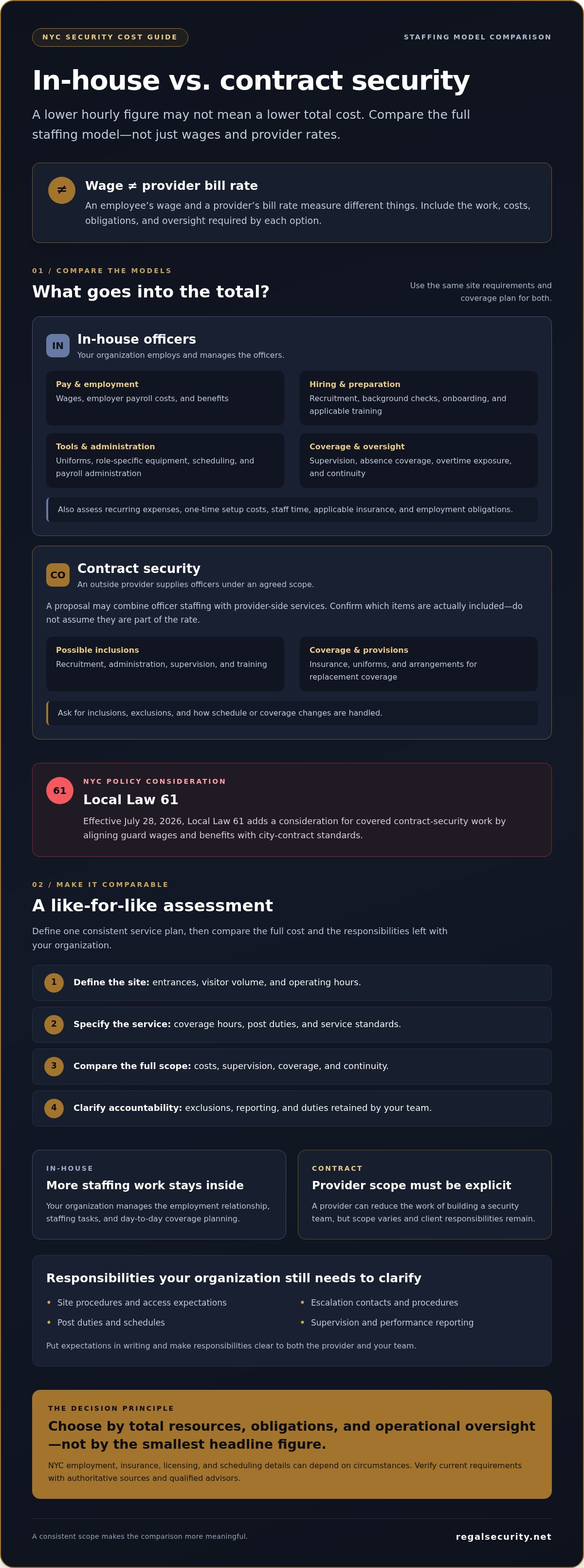
It’s reasonable to expect that hiring officers directly offers more control, while contracting a provider reduces the work of building a security team. But neither comparison is complete without accounting for the responsibilities and resources each model requires. NYC’s Local Law 61, effective July 28, 2026, also adds a new consideration for covered contract-security work by aligning guard wages and benefits with city-contract standards.
This guide compares both approaches using consistent cost categories, from hiring and payroll obligations to management, absences, and service oversight. You’ll also see which responsibilities remain with your organization when you contract a provider, and how to assess proposals by their scope and accountability, not simply their price. The goal is a clear, practical comparison that helps you choose a staffing structure suited to your site’s needs and your team’s capacity.
Table of Contents
Comparing In-House and Contract Security Costs in NYC
In-house security means your organization directly employs its security officers and manages the employment relationship. Contract security means engaging an outside provider to supply officers under an agreed service scope. These are distinct in-house vs. contract security models, and their headline figures measure different things: an employee’s wage is not equivalent to a provider’s bill rate.
For a useful comparison of the cost of in-house vs contract security NYC, define the same requirements for both options. Specify the site, coverage hours, post duties, supervision, and expected service standards. Then compare the full cost and the work each arrangement leaves with your organization. NYC employment, insurance, licensing, and scheduling details can change or depend on circumstances, so verify current requirements with authoritative sources and qualified advisors before making a decision.
What does the in-house security cost include?
Direct employment involves more than wages. Build a complete estimate that accounts for recurring expenses and the work required to recruit, prepare, and manage officers. Depending on your organization and the role, categories to assess include:
Wages, employer payroll costs, and benefits
Recruitment, background checks, onboarding, and applicable training
Uniforms and any equipment the role requires
Scheduling, supervision, payroll administration, and absence coverage
Also review how shift patterns affect overtime exposure and continuity. An absence may require another officer, a schedule adjustment, or a gap in planned coverage; account for how your organization would respond. Confirm applicable insurance and employment obligations with qualified advisors rather than assuming a standard approach applies to every site.
What does a contract security bill rate represent?
A provider’s proposal may combine officer staffing with provider-side recruitment, administration, supervision, training, insurance, uniforms, or arrangements for replacement coverage. Don’t assume any item is included simply because it is common in the industry. Ask the provider to identify each inclusion, explain any exclusions, and clarify how coverage changes are handled.
Contract scope varies. Compare written proposals line by line, including the duties officers will perform, the scheduled coverage, who supervises the post, and how performance or concerns are reported. Clarify the client’s responsibilities as well: contracting a provider doesn’t automatically transfer decisions about site procedures, access expectations, or escalation contacts. A clearly defined scope helps you assess what the bill rate covers and where your own team must remain involved.
Once both estimates use the same coverage plan and service expectations, the comparison becomes more meaningful. The aim isn’t simply to identify the smaller number; it’s to understand the total resources, obligations, and operational oversight required for each model.
Which Costs Change When You Employ NYC Security Officers Directly?
Direct employment shifts more of the staffing work inside your organization. To estimate the cost of in-house vs contract security NYC, separate recurring expenses from one-time setup costs, then account for the staff time needed to keep each post covered and properly managed.
How do payroll, benefits, and coverage affect the total?
Start with wages, then add applicable employer-side payroll costs and benefits. The U.S. Bureau of Labor Statistics provides national average security guard wages as a reference point, but national figures aren’t a substitute for current NYC compensation planning. Confirm applicable employment, tax, leave, and insurance requirements with authoritative sources and qualified advisors; distinguish mandatory obligations from benefits or coverage choices specific to your organization.
Scheduled hours don’t tell the whole story. Leave, vacancies, turnover, and unexpected absences may require replacement coverage, schedule changes, or overtime, depending on your staffing plan and applicable rules. A small team may have little flexibility when an officer is unavailable, so include a realistic method for maintaining coverage rather than assuming every planned shift will be filled as scheduled.
In-house cost worksheet
Recurring: wages, applicable payroll costs and benefits, training or refresher needs, uniforms, supervision, payroll administration, and recordkeeping.
One-time or as needed: recruiting, vetting, onboarding, initial training, and equipment purchases or replacement.
Coverage and management: time spent filling schedules, addressing absences, managing performance, documenting incidents, and arranging backup staffing.
For each item, record the expected frequency, responsible team, and source of your estimate. This makes assumptions visible without relying on unverified NYC wage, tax, or cost figures.
What management capacity does an in-house team require?
Employment also requires an internal owner for recruitment, vetting, training, supervision, scheduling, payroll coordination, performance concerns, and incident documentation. These duties take time even when there are no vacancies or schedule changes. Review the guide to professional unarmed security officers for role and service context as you define the post and the qualities your organization expects.
Before choosing direct employment, identify who will respond when staffing needs change and who maintains the records and procedures your organization requires. Organizations considering contracted unarmed officers can also review Regal Security’s unarmed security services as one option for on-site coverage, while defining the client’s responsibilities clearly.
How Do Contract Security Costs Compare Beyond the Bill Rate?
A contract bill rate may include more than an officer’s scheduled time, but the exact scope depends on the written proposal. To compare the cost of in-house vs contract security NYC fairly, request proposals based on identical duties, coverage hours, site conditions, and reporting expectations. A lobby post with frequent visitor interactions, for example, may require different service expectations from a post focused on monitoring a controlled entrance.
Use the comparison below to identify what the provider will handle and what remains with your organization. Treat each item as a question for the proposal, not an assumed inclusion.
Area
Confirm with the provider
Client consideration
Responsibility
Which post duties and service standards are included?
Who sets site procedures and makes site-specific decisions?
Administration
Who recruits, schedules, and communicates staffing changes?
Who provides site information and approves changes to the scope?
Schedule coverage
What is the written process for absences and replacements?
Who coordinates access and responds to coverage concerns?
Supervision
Who supervises officers and conducts service reviews?
Who is the client contact for feedback or escalation?
Continuity
How are incidents documented and communicated?
What site knowledge and reporting does your team need maintained?
Which provider responsibilities should a proposal spell out?
Ask for clear, written procedures covering recruitment, scheduling, supervision, staffing changes, absences, replacements, incident escalation, and service reviews. Verify claimed insurance, licensing, training, and other qualifications through appropriate documentation, and confirm which party is responsible for each item. New York State publishes New York State training requirements; ask how relevant training is addressed and reflected in the proposal rather than assuming it is included in the rate.
How should NYC buyers compare coverage and service quality?
Assess building access patterns, operating hours, visitor needs, and the actual duties assigned to the post. For a role combining a lobby presence with visitor-facing responsibilities, consult the concierge security officer guide to help clarify the service context.
Evaluate communication, professional conduct, and reporting alongside commercial terms. Contracting can shift selected staffing functions to a provider, but your organization still defines site priorities, shares relevant procedures, and makes site-specific decisions. A precise scope makes those boundaries easier to assess before you compare proposals.
How Can You Calculate the Better-Fit Security Model for Your NYC Site?
A sound comparison begins with the post, not a price. Use the same site requirements for both models, then record what’s verified, estimated, or still unknown. This makes the cost of in-house vs contract security NYC easier to assess without treating unlike figures as equivalent.
Define the post. Write down duties, required experience, visitor-facing expectations, and reporting needs.
Map coverage. Document entrances, visitor volume, operating schedule, shift changes, and how absences or schedule changes would be addressed.
List responsibilities. Identify who handles hiring, training, scheduling, supervision, payroll or provider administration, incident documentation, and escalation.
Gather comparable proposals. Give providers the same post description and coverage requirements. Ask for written inclusions, exclusions, and service assumptions.
Review trade-offs. Compare verified costs alongside management time, backup plans, continuity, and the responsibilities your organization retains.
Site comparison worksheet
Requirement: post duties, entrances, visitor needs, hours, supervision, and escalation procedure.
In-house: recurring expenses, setup needs, internal hours, and backup plan.
Contract: written rate and scope, included functions, exclusions, and client responsibilities.
Status: mark each entry as verified, estimate, assumption, or unknown, and note its source or who must confirm it.
For organizations evaluating professional unarmed coverage, discuss your NYC site’s security needs with Regal Security and clarify the proposed scope and responsibilities.
When may direct employment fit the organization’s operations?
Direct employment may suit an organization that values managing its officers internally and already has the capacity to recruit, vet, schedule, supervise, and arrange backup coverage. Consider whether those functions can be sustained through absences, vacancies, or changing site needs. In-house staffing isn’t automatically less expensive or more controllable; the fit depends on your resources and operating practices.
When may contract security be the more practical choice?
A provider may be practical when your organization prefers to assign defined staffing functions externally rather than build each function internally. That choice still requires a clear scope, accountable communication, and a continuity plan. Review the guide to security staffing services for broader considerations, then confirm proposal details against your site’s actual needs.
Choosing Contract Security in NYC: Set Clear Expectations Before You Decide
The right choice depends on the full operating picture, not a comparison between an employee’s wage and a provider’s bill rate. Consider total responsibilities, the coverage your site requires, and the time your team can devote to managing the arrangement. Contracting may shift defined staffing functions to a provider, but your organization still sets site priorities and retains site-specific decision-making.
Before selecting a provider, put the service expectations in writing. A clear scope should identify:
Post duties, entrances, and any visitor-facing expectations
Coverage schedule and the process for communicating staffing changes
Supervision arrangements and how the client can raise concerns
Reporting expectations, including how incidents are documented and escalated
Each party’s responsibilities for site procedures and service reviews
This shared record gives your team a consistent basis for comparing proposals and assessing whether the arrangement can support the site over time.
What should NYC buyers verify before signing?
Request current documentation for applicable licensing, insurance, training, and other qualifications, then confirm details with the relevant issuing bodies or qualified advisors. Ask how the proposed coverage assumptions work in practice: who communicates an absence, what replacement process applies, and how supervisors can be reached. Clarify how service performance will be reviewed and how concerns move from the site contact to the provider. For New York requirements that affect your organization, consult counsel or the appropriate authority rather than relying on a proposal alone.
Read the scope alongside the commercial terms. Note any exclusions, assumptions, or responsibilities assigned to your team, and resolve unclear language before approval. Precise expectations support accountability on both sides.
How can Regal Security support a site-specific evaluation?
Regal Security provides professional unarmed security officers and tailored security services for corporate and residential clients. Organizations considering contracted on-site coverage can use a discussion about their site, duties, and expectations to clarify what a proposed scope should address. The cost of in-house vs contract security NYC is ultimately a site-specific decision, shaped by the coverage required and the staffing responsibilities your organization is prepared to manage.
To discuss your security needs with Regal Security, share details about your site and coverage requirements. You can use that conversation to explore fit and clarify scope without assuming a particular rate, availability, or outcome.
Make Your Next Security Decision with Clarity
The right staffing model is the one that fits your site’s coverage needs and your organization’s capacity to manage the work. A meaningful assessment of the cost of in-house vs contract security NYC looks beyond wages and bill rates to include administration, scheduling, supervision, absence planning, and the responsibilities your team retains.
Before deciding, define the post and coverage requirements, compare costs using consistent categories, and review every proposal’s written inclusions and exclusions. Clear expectations for duties, schedules, reporting, supervision, and escalation help establish accountability from the outset.
For organizations considering contracted on-site coverage, Regal Security provides professional unarmed security officers and serves New York City and nearby New York and New Jersey communities. A site-specific conversation can help clarify needs and the scope to evaluate, without assuming a particular price or outcome.
Discuss your NYC site's unarmed security needs with Regal Security, and take the next step with a clearer understanding of what your site requires. With careful planning, you can choose a model that supports dependable coverage and your team’s operational priorities.
Frequently Asked Questions
Is in-house security cheaper than contract security in NYC?
Not necessarily; the lower hourly wage or bill rate doesn’t establish the lower total cost. Direct employment can involve recruiting, payroll administration, benefits, training, scheduling, supervision, and backup coverage. A provider’s rate may include some staffing functions, but inclusions vary. Compare both models using the same post duties, coverage hours, supervision expectations, and reporting requirements to see which better fits your budget and operational capacity.
What costs should I include when comparing in-house and contract security?
Include wages and applicable employer costs, benefits, recruiting, vetting, onboarding, training, uniforms, equipment, scheduling, supervision, payroll administration, and absence coverage for an in-house team. For contracted service, review the written rate alongside included staffing functions, administration, supervision, training, insurance, and replacement procedures. Mark each worksheet entry as verified, estimated, assumed, or unknown. This helps expose gaps and supports a more consistent comparison of the cost of in-house vs contract security NYC.
How much does contract security cost in NYC?
There isn’t one dependable figure for every NYC site. The proposal depends on the requested duties, schedule, site conditions, staffing requirements, and what the provider includes. Requirements may differ between a Manhattan office, a Brooklyn residential property, or a site in Queens, the Bronx, or Staten Island. For coverage in New York City or nearby New Jersey, Long Island, Nassau, Suffolk, Westchester, Rockland, or Orange County, request a written, site-specific scope and confirm its assumptions before comparing proposals.
What does a security company’s bill rate include?
A bill rate may cover officer staffing and provider-side functions such as recruitment, scheduling, administration, supervision, training, uniforms, or insurance. The exact inclusions depend on the agreement, so don’t assume a particular service is bundled. Ask for an itemized explanation of what the rate covers, what is excluded, how absences and replacements are handled, and whether any additional charges may apply under the proposed scope.
Can a contract security provider handle officer absences and scheduling?
A provider may coordinate scheduling and absence coverage if those duties are included in the agreed service scope. Confirm who receives absence notices, communicates staffing changes, arranges replacements, and informs your site contact. Ask how continuity is managed and what happens if planned coverage changes. Put the process in writing, including escalation contacts, so your organization understands what the provider handles and what actions remain its responsibility.
Do NYC businesses still have responsibilities when they contract security?
Yes. Contracting can shift specified staffing functions to a provider, but it doesn’t remove every client responsibility. Your organization still needs to define post duties, share relevant site procedures, identify decision-makers, and establish reporting and escalation expectations. Review the written scope to clarify each party’s role. Verify applicable New York requirements with qualified counsel or the appropriate authority, and request current documentation for any provider qualifications you rely on.
When should a NYC property consider contract security instead of hiring officers directly?
Consider contract security when your organization wants an outside provider to coordinate defined staffing functions and prefers not to build every hiring, scheduling, and supervision process internally. The arrangement may suit a site that needs professional on-site coverage, provided the provider’s scope, communication, replacement procedures, and reporting meet its needs. Compare that option with your internal capacity to manage officers directly; neither model is automatically the better fit for every property.