How to Write a Request for Proposal for Security Services
A security RFP can look thorough and still leave providers guessing about the property, staffing expectations, and what success means. If you’re learning how to write a request for proposal for security services, the goal is not simply to collect bids. It’s to translate site-specific risks and operating needs into requirements every qualified provider can understand and answer on the same basis.
A vague scope can lead bidders to make different assumptions about post locations, schedules, responsibilities, supervision, and reporting. The proposals may look comparable while describing very different service models, making it harder to judge whether staffing fits your property and its operating conditions.
This guide will help you define the scope of work, set consistent proposal and evaluation criteria, and request enough detail to assess each provider’s approach. You’ll learn what site information to share, how to describe duties and performance expectations, and how to structure responses for a fair comparison. A disciplined RFP helps keep the selection process focused on fit, accountability, and dependable on-site support, rather than assumptions or presentation.
Table of Contents
Start Your Security Services RFP With the Property's Needs
A useful security services RFP gives every prospective provider the same description of the need and asks them to propose a service plan against it. A Request for Proposal (RFP) sets out what an organization is seeking and invites providers to respond. For security services, meaningful comparisons depend on how accurately the RFP describes the property and its operating environment. Clear requirements support better evaluation, but they cannot guarantee a particular result or make every proposal equally suitable.
If you’re deciding how to write a request for proposal for security services, start with the site, the people who use it, and the responsibilities you need covered. For properties in New York and New Jersey, list each service location separately with its address and relevant operating details. Ask qualified sources to verify any jurisdiction-specific licensing, training, insurance, or contract requirements instead of assuming the same checks apply everywhere.
Describe the site, people, and operating environment
Give bidders practical context, not just a property name or a general risk statement. Describe entrances, public-facing areas, operating hours, and access patterns, such as when employees, residents, visitors, or contractors typically arrive. Identify the people the service may support, including executives where relevant. Note what differs between locations so providers can assess each site on its own terms.
Separate confirmed conditions from details that still need validation. For example, specify which entrances are in use and mark estimated visitor patterns as estimates. If a provider should check a detail during a site visit or raise questions before submitting, say so. This helps bidders explain their approach without treating uncertain information as fact.
Set the purpose and boundaries of the request
Describe the property or business need, then ask providers to explain how their proposed service addresses it. Depending on the requirement, the RFP might cover unarmed security officers, concierge services, vehicle patrol, or executive protection. These are different service categories, not automatic parts of every plan. State which options you are considering and where or when each may be needed, while asking providers to identify relevant assumptions.
Define exclusions as clearly as requested duties. If another procurement covers security technology or a different service, state that it is outside this RFP. Otherwise, bidders may make different assumptions about what is included, which can make proposals difficult to compare.
Define the site need before naming a staffing solution, then ask providers to explain how their proposed service model fits the property. This keeps the RFP focused on the work required while giving you a sound basis for assessing each proposal.
Turn Security Concerns Into a Specific Scope of Work
Once you have established the property’s needs, translate them into responsibilities providers can address in a proposed service plan. Specify locations, coverage periods, post assignments, and anticipated changes, such as a planned change in operating hours or the addition of a site. For a multi-site request spanning New York and New Jersey, ask bidders to describe their proposed service for each location instead of relying on one general plan.
Write measurable duties and service expectations
Use observable duties instead of broad requests such as “maintain a safe environment.” Describe the work you want providers to address, such as assigned posts, scheduled vehicle patrols, visitor procedures, and the method and frequency of routine reporting. State what incident documentation should capture, who should receive reports, and how urgent concerns should be escalated. The Responsible Security Procurement Guide can help buyers consider responsible procurement and due diligence when defining expectations.
Ask each provider to explain its staffing assumptions, supervision arrangements, and service deliverables. Include how it would handle a requested coverage change or a staffing disruption, and what communication you should expect. Avoid adding performance thresholds or response times unless you have a verified, appropriate basis for them.
Match the service model to the property
Different needs call for different service models. Fixed on-site coverage, concierge-facing duties, and scheduled vehicle patrols are not interchangeable, so describe the responsibilities and locations relevant to each. If executive protection is under consideration, outline the general context and discretion requirements without including sensitive itineraries or personal details in a document distributed to bidders.
If the request includes unarmed on-site coverage, review Regal Security’s information about professional unarmed security officers as one example of a service category to consider. Assess any provider’s proposed model against the site requirements in your RFP.
For each New York or New Jersey location, ask providers to identify any licensing, insurance, or training criteria they believe apply and what documentation they can provide. Verify requirements for each jurisdiction with qualified sources before finalizing the RFP or evaluating compliance. Do not assume that rules are identical across locations.
To keep responses useful, request a concise plan for each site that states proposed coverage, duties, staffing assumptions, supervision, reporting, dependencies, and exclusions. This helps you see where proposals address the same needs differently and where a provider relies on an assumption that needs clarification. If you’re considering a tailored service plan, you can also review Regal Security’s service information as part of your research.
Make Security Provider Proposals Easy to Compare
A consistent submission format helps you assess the proposed service rather than the polish of the presentation. Give every bidder the same site information, questions, response deadline, and instructions for submitting clarifications. Ask each provider to include a staffing plan, supervision approach, service assumptions, and sample reporting format. For a multi-site request, require a separate response for each location.
Giving every bidder the same information and assumptions creates a fairer basis for comparing proposals. When deciding how to write a request for proposal for security services, choose your evaluation criteria in advance and apply them consistently to every submission.
Ask for evidence that supports the proposed approach
Request relevant experience with property types or operating environments similar to yours. Ask providers to explain how they recruit, prepare, supervise, and support assigned personnel. Invite examples or documents that substantiate their claims, but avoid requesting sensitive information that is not needed for evaluation. Verify references, credentials, insurance, and regulatory statements through suitable, current sources before relying on them.
Compare service quality without relying on price alone
Check whether each response addresses the stated scope and clearly identifies exclusions, assumptions, or dependencies. A standardized matrix can keep reviewers focused on the same evidence:
Scope fit: Does the proposed service address the requested duties and locations?
Staffing plan: Are staffing assumptions and coverage arrangements explained?
Communication: Are reporting channels and escalation responsibilities clear?
Documentation: Does the sample report show how routine updates and incidents would be recorded?
Transition approach: Does the provider explain how it would prepare to begin the proposed service?
Use the same scoring guidance for every bidder, and note where a response is incomplete or depends on an assumption that needs clarification. Review price alongside service fit, supervision, continuity planning, communication, and reporting. A lower figure alone does not show that a proposal meets the property’s needs, just as confident language does not verify a provider’s claims.
Before selecting a provider, record the evidence behind your assessment and confirm that outstanding licensing, insurance, or regulatory questions have been checked through appropriate sources. This makes it easier to distinguish a tailored, well-supported proposal from one that leaves important operational details unresolved.
Set a Fair RFP Timeline, Site Visit, and Evaluation Process
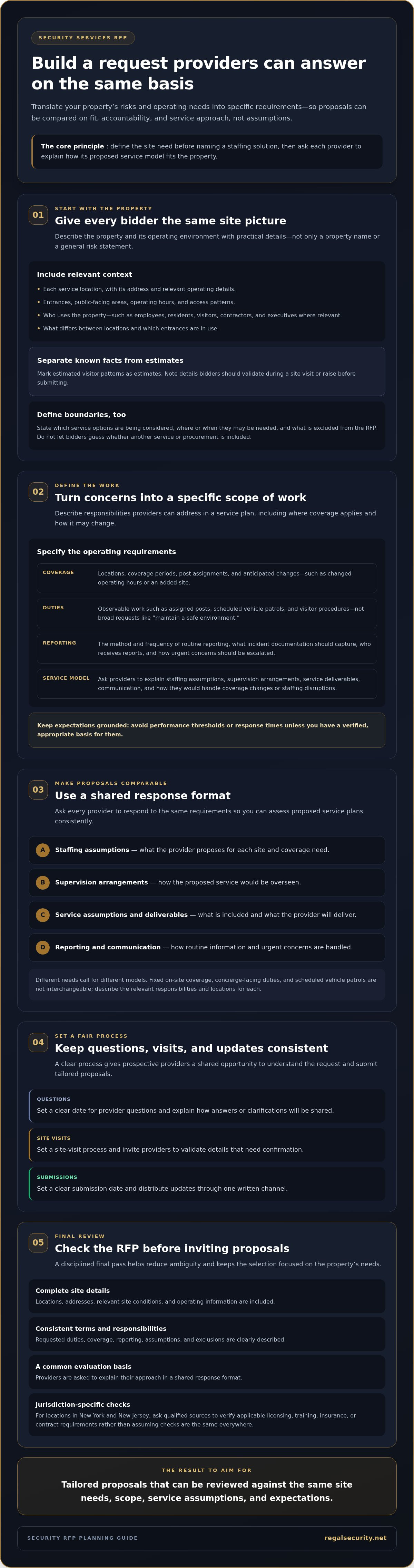
A well-planned procurement gives providers a reasonable opportunity to understand the request and gives your team time to review responses. Set dates for RFP release, bidder questions, site visits if applicable, proposal submission, evaluation, and selection. Allow time to review questions and issue shared clarifications before proposals are due. For New York and New Jersey locations, coordinate access with the appropriate site contacts and local stakeholders so bidders receive consistent information.
Before issuing the RFP, document the evaluation criteria and identify who will review proposals and make the selection. This helps reviewers use the same priorities rather than changing standards after seeing the bids. A practical sequence is: 1) prepare, 2) issue, 3) clarify, 4) evaluate, 5) verify, and 6) transition.
Plan questions and site visits consistently
Decide whether a site visit will help bidders understand the environment. If you offer one, provide interested providers with equivalent access and instructions, including the locations they may see and how to arrange entry. Set a question deadline and use one written channel for questions, answers, and updates. Share relevant answers with all participating bidders without identifying who asked or disclosing confidential material.
Not every detail belongs in an RFP distributed broadly. Keep sensitive site information in appropriate channels and limit access to authorized participants. If information is restricted, explain how eligible bidders can request it and administer the process consistently.
Verify finalists and prepare for service transition
After evaluating proposals, check references and verify credentials, insurance, and compliance claims through appropriate current sources or authorities. For sites in different jurisdictions, confirm which requirements apply to each location rather than treating New York and New Jersey as interchangeable. Resolve material questions before selection.
Discuss the proposed transition before making a final decision. Clarify onboarding responsibilities, key contacts, post instructions, communication channels, and how routine reporting will begin. These details help you judge whether the provider’s plan is practical as well as responsive to the RFP. For additional context on staffing expectations, consult Regal Security’s service information as part of your research.
If you’re assessing a staffing plan for your property, discuss your security staffing needs with Regal Security as one step in your provider review.
Finalize the RFP and Invite a Tailored Security Proposal
Before issuing the document, review it from a provider’s perspective. Consistent terms, complete location details, defined responsibilities, and clear exclusions help bidders understand the request. If you’re refining how to write a request for proposal for security services, use the final review as a clarity test: can providers identify the work, explain their assumptions, and respond in the required format?
Ask providers to show how their proposed service addresses your stated needs and constraints, rather than simply submitting a standard service description. Confirm that the requested service is within each provider’s offerings and ask them to verify availability for every location. This matters when a request covers New York City, New Jersey, or surrounding counties, since service availability should be confirmed for the specific sites involved.
Use a final pre-issue checklist
Before release, confirm that the RFP includes the essentials and that the people responsible for procurement and operations agree on its terms:
Scope: Are requested duties, schedules, locations, and exclusions clear?
Site information: Are the details needed to prepare a responsible proposal included, with sensitive information appropriately restricted?
Evaluation: Are the criteria and decision-makers identified before submissions arrive?
Response process: Are the required format, question channel, submission deadline, and other key dates consistent throughout?
Have appropriate procurement, property, legal, and operational stakeholders review the draft. Their perspectives can help identify unclear responsibilities, missing site details, and requirements that should be verified before bidders rely on them.
Move from proposal review to provider discussion
Prepare the same questions for each finalist. Ask them to clarify staffing assumptions, supervision, communication, service continuity, and any dependencies or exclusions in their proposal. For multi-location requests, discuss how the proposed service fits each site and confirm current availability for the locations under consideration. This conversation should clarify the response, not introduce different evaluation standards after proposals have been received.
Regal Security provides unarmed security officers, concierge services, vehicle patrol, and executive protection. These service categories may be relevant depending on the property’s requirements, but no single model suits every site. Ask providers to explain which requested services they can support and how their proposed plan addresses the responsibilities and operating conditions in your RFP.
If your requirements align with Regal Security’s service categories, discuss a tailored security services proposal with Regal Security. Share the relevant locations, responsibilities, and operating expectations so the conversation can focus on service fit.
Build a Clear Path to the Right Security Partner
A strong RFP turns property needs into a defined scope, gives providers a consistent basis for responding, and helps your team compare proposed staffing and service approaches fairly. As you apply how to write a request for proposal for security services, focus on clear responsibilities, measurable expectations, and verified requirements for each location. The aim is not to prescribe a one-size-fits-all solution, but to invite a plan suited to your site and operating conditions.
Regal Security provides unarmed security officers, concierge services, vehicle patrol, and executive protection. Its stated coverage includes New York City, New Jersey, and surrounding counties. Whether one of these service categories fits your RFP depends on your requirements and should be confirmed for the specific location.
Discuss a tailored security services proposal with Regal Security and share the locations, responsibilities, and operating expectations your RFP sets out. A conversation can help clarify whether the proposed service model aligns with your property. With a clear process and the right questions, you can move forward with greater confidence.
Frequently Asked Questions
What should a security services RFP include?
A security services RFP should describe the property, requested services, locations, schedules, responsibilities, proposal format, evaluation criteria, and key procurement dates. Include relevant operating details, such as entrances and visitor patterns, while distinguishing confirmed information from assumptions. State what falls outside the request, too. For sites in multiple locations, provide site-specific details so providers can explain their proposed staffing, supervision, communication, and reporting for each one.
How do I compare security services proposals fairly?
Give all bidders the same scope, site information, questions, response format, and deadline, then assess proposals against criteria set before submissions arrive. Compare scope fit, proposed staffing, supervision, communication, documentation, and transition approach. Note whether each provider identifies assumptions, exclusions, or dependencies. Consider price as one factor, not a substitute for evaluating whether the proposed service addresses your requirements and presents a clear, supportable plan.
Should an RFP specify the number of security officers?
Specify an officer count only when you have a sound operational basis for it. If you’re uncertain, describe the posts, locations, schedules, and duties, then ask providers to recommend staffing and explain their assumptions. This lets you compare different staffing models against the same needs. If you include a minimum or fixed count, clarify whether it is mandatory or whether bidders may propose an alternative with supporting rationale.
What questions should I ask security companies in an RFP?
Ask each provider how its proposed staffing plan addresses your scope, how assigned personnel would be supervised and supported, and how routine communication and incident documentation would work. Request relevant experience with comparable property types and ask providers to identify assumptions, exclusions, and service dependencies. You can also request a sample reporting format and ask how the provider would communicate proposed coverage changes or staffing disruptions.
How long does it take to prepare a security services RFP?
There’s no single preparation period that suits every request. Timing depends on the number of sites, how readily property information is available, how many stakeholders are involved, and whether site visits or jurisdiction-specific checks are needed. Allow time to define the scope, review the document with appropriate teams, answer bidder questions, and evaluate submissions. Set dates that give providers enough time to prepare considered responses and your team enough time to review them.
Do I need a site visit before issuing a security RFP?
A site visit isn’t always necessary, but it can help providers understand entrances, public-facing areas, and operating conditions that written materials may not fully convey. Decide whether a visit is appropriate, then offer interested bidders equivalent access and instructions. If sensitive details shouldn’t be shared broadly, provide them only through suitable channels to authorized participants. A visit should inform proposals, not replace a clear written scope.
What should I verify about a security provider before selecting one?
Verify references, relevant experience, and any credentials, insurance, licensing, or compliance claims through appropriate current sources or authorities. Requirements may differ by jurisdiction, so check them for each service location rather than assuming one review covers every site. This matters for properties in New York City, New Jersey, Manhattan, Brooklyn, Queens, the Bronx, Staten Island, Long Island, Nassau County, Suffolk County, Westchester County, Rockland County, or Orange County. Confirm service availability for each specific location, too.