Landlord Liability for Tenant Safety in NYC: Duties, Risks, and Security
If a tenant is injured after a building entrance is left unsecured, does the landlord automatically bear responsibility? Not necessarily. For owners researching “liability for tenant safety landlord NYC,” the answer depends on the circumstances: the nature of the hazard, who was responsible for the area, what management knew or should have known, and how the concern was handled.
A security lapse can lead to harm, a dispute, or a claim, especially when a landlord, managing agent, and on-site staff share operational responsibilities. This article explains general factors that may shape a NYC landlord-liability analysis and why prompt reporting, accurate documentation, and consistent property procedures matter. It also covers how an on-site security presence can support orderly access and attentive service as part of a broader safety plan, alongside maintenance and emergency-response procedures.
You’ll learn how to distinguish safety responsibilities, respond methodically to reported concerns, and assess practical measures for a residential building. No single measure eliminates risk or determines liability, but a clear, coordinated approach helps property teams address concerns consistently.
Table of Contents
What tenant safety means for NYC landlords, and why liability is not automatic
How NYC landlord liability is assessed: duty, notice, control, and causation
Building security failures in NYC: compare the condition, notice, and response
A practical NYC landlord response: report, document, address, and review
How professional security can support tenant safety without promising immunity
What tenant safety means for NYC landlords, and why liability is not automatic
Tenant safety is an ongoing property-management responsibility. It includes maintaining areas under the owner’s or manager’s control, responding appropriately to reported hazards, and following rules that apply to the building. It does not guarantee that no tenant will be injured or encounter crime. A break-in, fall, or other harmful event is a reason to examine what happened, but the event alone does not establish that the landlord is legally responsible.
For owners assessing liability for tenant safety landlord NYC, separate physical conditions and building-security practices from the wider body of tenant rights. Habitability, privacy, and other protections may raise different questions from whether a landlord acted reasonably in response to a specific risk. The broad subject of Landlord-tenant law includes concepts such as the implied warranty of habitability, but the rules that apply depend on the jurisdiction and circumstances.
Negligence is commonly described as a failure to use reasonable care that causes legally recognized harm. That general description does not decide any particular dispute. Whether a duty existed, whether conduct fell short of it, and whether that conduct caused the claimed injury can require careful legal analysis.
Which safety concerns can arise in a NYC residential building?
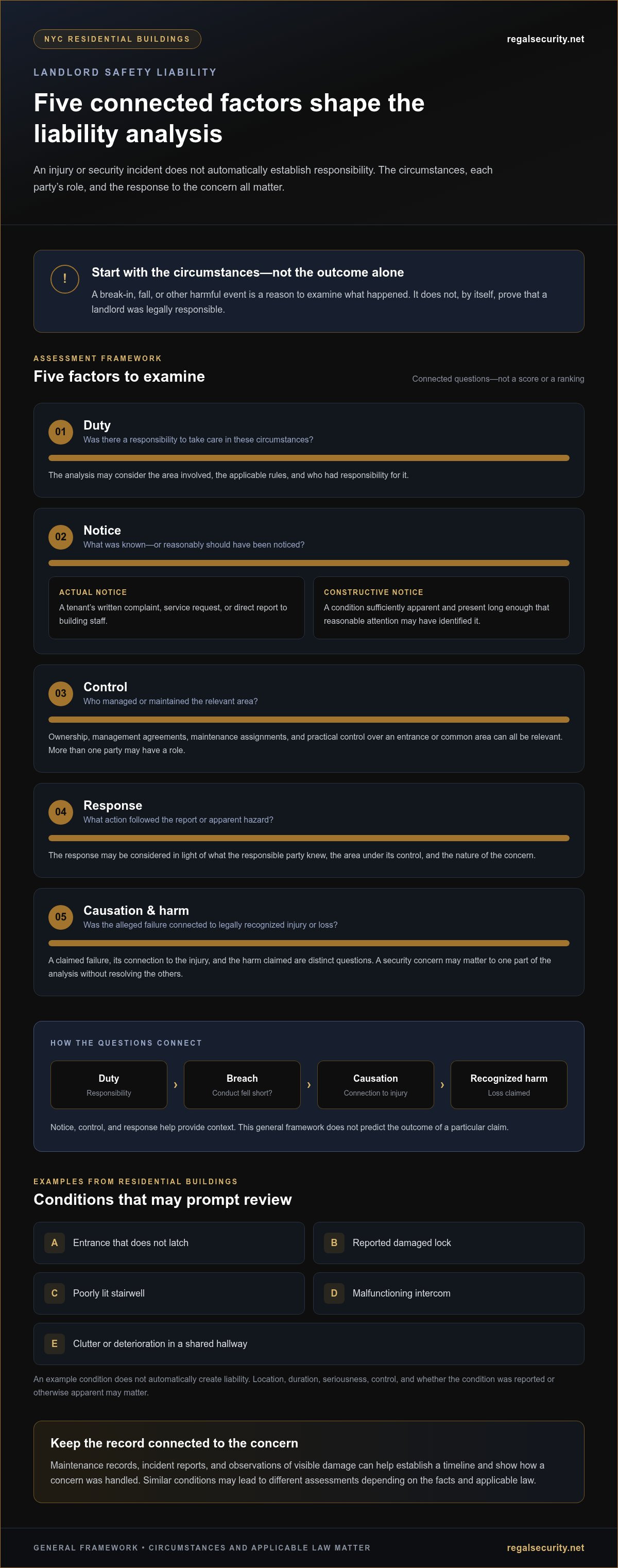
Concerns may include an entrance that does not latch, a reported damaged lock, a poorly lit stairwell, a malfunctioning intercom, or clutter and deterioration in a shared hallway. These examples do not mean every defect creates liability. Their significance may depend on the location, duration, seriousness, who controlled the area, and whether the condition was reported or otherwise apparent.
An immediate hazard, such as a broken entrance door that leaves the building exposed, calls for prompt attention. A recurring concern, such as repeated reports that a lock fails, raises questions about notice and follow-through. Building type, lease arrangements, management responsibilities, and applicable rules can all affect the analysis, so similar conditions do not necessarily lead to identical outcomes.
Does a landlord have to prevent every crime or injury?
No property can be perfectly secure, and reasonable safety responsibilities do not amount to a promise that every crime or injury will be prevented. In general terms, foreseeability asks whether a risk was reasonably recognizable in the circumstances. A decision-maker may also consider whether the response was reasonable given what the responsible party knew, the area under its control, and the nature of the concern.
These ideas do not create a universal requirement for a particular lock, staffing arrangement, or security measure. Relevant facts may include prior reports, the property’s condition, and the steps taken after notice. Legal standards and their application are fact-specific, so owners should obtain legal advice about a particular incident or claim.
How NYC landlord liability is assessed: duty, notice, control, and causation
For owners researching “liability for tenant safety landlord NYC,” the central question is not simply whether someone was harmed. A general negligence analysis may examine whether a legal duty applied, whether that duty was breached, whether the breach caused the injury, and whether the injured person experienced a legally recognized loss. These are broad concepts, not a formula for predicting the result of a claim.
In general terms, a landlord-liability analysis may consider duty, breach, causation, and legally recognized harm, alongside what the responsible parties knew and controlled. The facts and applicable law determine how those concepts apply.
Each element raises different questions. Duty concerns whether the law required a party to take care in the circumstances. Breach asks whether the party’s conduct fell short of that standard. Causation considers whether the alleged failure was connected to the injury, while legally recognized loss concerns the harm claimed. A security concern may be relevant to one part of the analysis without resolving the others.
How do notice and foreseeability affect a security concern?
Notice can help explain what a responsible party knew, or reasonably should have known, about a condition. Actual notice may be shown by a tenant’s written complaint, a service request, or a direct report to building staff. Constructive notice generally concerns a condition that was sufficiently apparent and present long enough that reasonable attention may have identified it. The precise legal standard depends on the circumstances.
For example, repeated reports that an entrance lock fails may create a different record from a defect that no one previously reported. Maintenance records, incident reports, and observations of visible damage can help establish the timeline and response. A prior incident is not necessarily required for a risk to be considered foreseeable; the surrounding facts matter.
Who may have responsibility for a residential building?
Responsibility may involve more than the property owner. Ownership, management agreements, maintenance assignments, and practical control over an entrance or common area can all be relevant. A managing agent may handle reports or coordinate repairs, while another party may have a defined role in maintaining a particular area. Those roles alone do not establish liability.
Review agreements and records that clarify who received complaints, who could arrange work, and who controlled the location at the relevant time. A lease or management contract may help explain assigned responsibilities, but its effect depends on the document and applicable law. Qualified New York counsel can assess how those details fit the facts of a particular building.
Clear building procedures and an attentive on-site presence can support orderly operations, while remaining distinct from legal advice or a determination of responsibility. For properties considering that operational support, residential security services can be one element of a broader approach to access and property management.
Building security failures in NYC: compare the condition, notice, and response
After a security-related incident, the building’s condition is only part of the picture. Records may help show what was present, when someone reported it, and how management responded. They do not, by themselves, establish that a condition caused a particular injury or determine who is legally responsible. The comparisons below are illustrative, not findings about any specific property.
No single security feature determines liability in every building or incident. The significance of an entry defect, lighting issue, or other condition depends on context, including notice, control, response, and the connection to the alleged harm. Legal conclusions require review of the particular facts.
What security conditions are commonly examined after an incident?
Broken locks, inadequate lighting, faulty intercoms, and neglected common areas may be examined when a security concern arises. Photographs can record visible conditions. Dated complaints may show when a concern was reported, and maintenance records can document inspections or work. These materials help establish a timeline, but evidence that a defect existed is different from proof that it caused an injury.
How can records clarify whether a response was reasonable?
Each record serves a different purpose. A tenant report can capture the concern as described. A work order can show that action was requested or assigned. An inspection note can record observed conditions, and an incident report can document what was reported after an event. None should be treated as conclusive on its own.
Keep entries accurate and dated, retain original records, and preserve relevant photographs and correspondence in their existing form. A clear chronology can help counsel assess what was known and what followed. Whether an alleged crime pattern made a particular risk foreseeable is a fact-dependent question for legal review. Management staff should document reports through established procedures, not alter records, confront alleged perpetrators, or conduct independent investigations.
A practical NYC landlord response: report, document, address, and review
A measured response begins with a reliable process, not an assumption about who is at fault. Handling reports consistently helps property teams address concerns and create a clear account of what was reported and what followed. These steps support responsible operations, but they do not determine legal responsibility or guarantee a particular outcome in a liability for tenant safety landlord NYC matter.
What should property managers do when tenants report a safety issue?
Use a consistent workflow, adapting it to the urgency and nature of the report:
Receive and acknowledge the report. Record when it came in, who received it, the location, and the tenant’s description. Acknowledge receipt without making assumptions about the cause or promising a particular result.
Assess immediate danger. If there is an immediate threat to life or safety, direct the caller to 911. Emergency response takes priority over routine building procedures. A maintenance request or management message is not a substitute for emergency services.
Document the concern. Create a dated record using factual language. Note what was observed, what the tenant reported, and what remains unknown. Limit access to personal details to people who need them to handle the matter.
Arrange appropriate action. Route the issue to the responsible management or maintenance contact. Record the assignment, relevant communication, and steps taken. For security concerns within an agreed role, professional unarmed security officers can support attentive on-site operations as part of a broader property plan.
Follow up and review. Confirm the concern was reviewed, record further developments, and keep the timeline together. If the issue persists or involves an injury, preserve related records and seek appropriate legal guidance.
Which NYC housing resources and records may be relevant?
The New York Attorney General’s tenant guide offers a general overview of renter rights and housing concerns. For NYC-specific housing information, property teams can consult the NYC Department of Housing Preservation and Development (HPD) for official guidance on housing conditions, complaints, and applicable requirements. Procedures and rules can change, so use current agency guidance for the particular issue rather than relying on an old form or saved instruction.
Keep the report, work order, inspection notes, and follow-up correspondence in an orderly record. A front desk may be the first point of contact, but its role should connect to a defined management process. For context on how a hospitality-focused on-site role can fit into property operations, see this concierge security officer guide.
For residential properties considering an attentive on-site presence alongside maintenance and management procedures, explore residential security support as part of a coordinated safety approach.
How professional security can support tenant safety without promising immunity
Professional security can add an attentive on-site presence to a residential property’s operations, but it is one part of a broader safety plan. It complements, rather than replaces, building maintenance, access procedures, management responsibilities, and compliance with applicable requirements. An officer can support orderly access and observe or communicate concerns within an agreed role. No staffing arrangement can guarantee that an incident will be prevented or eliminate potential landlord liability.
This distinction matters when considering liability for tenant safety landlord NYC. A security presence may support consistent day-to-day operations, but it does not determine who controls a condition, whether a report was addressed appropriately, or how the law applies to an incident. Property teams should maintain their repair and management processes, define responsibilities clearly, and seek legal advice about specific obligations or claims.
When might residential properties consider an on-site security presence?
Start with the property’s operating patterns rather than assuming every building needs the same arrangement. Consider resident volume, the number and use of entry points, visitor procedures, and how activity changes during normal operations. These factors can help clarify whether a consistent front-desk presence or another form of on-site support fits the building’s needs.
In a residential setting, concierge services can align resident assistance with an orderly reception area. Define the role so residents and management understand how the on-site presence fits into access procedures and how concerns are routed. Security staffing is not a universal requirement or a suitable answer for every property; its purpose and scope should reflect actual operational needs.
How can a security role fit into a broader property plan?
A useful plan connects the officer’s agreed responsibilities with management procedures. This may include guidance on receiving and escalating concerns, communicating with the designated property contact, and directing emergencies to appropriate response channels. Maintenance teams still address physical conditions, while management retains its own procedures for reports and applicable compliance matters.
Before an on-site role begins, property decision-makers can define who receives reports, how information is passed along, and which actions fall within the officer’s responsibilities. Clear boundaries support coordinated service without suggesting that security staff replace building management, maintenance personnel, or emergency responders. A professional residential security services approach can complement these property operations.
For owners and managers considering this support, discuss a tailored residential security approach with Regal Security. This operational conversation can help clarify how an on-site presence may fit the property’s needs; it is not a substitute for legal advice or a guarantee of any legal outcome.
Make tenant safety part of a deliberate operating plan
Review how safety concerns move through your property: who receives them, who is responsible for follow-up, and how decision-makers know an issue has been addressed. Clear ownership and regular review help keep day-to-day procedures aligned with the building’s needs as operations change.
For questions about liability for tenant safety landlord NYC, consult qualified New York counsel. Security planning can support property operations, but it cannot determine legal responsibility or replace advice about a specific duty, incident, or claim. With those boundaries understood, property owners can make considered decisions about practical support that complements their management approach.
Regal Security provides tailored services grounded in integrity, precision, and a reliable on-site presence. Its unarmed security officers, concierge services, vehicle patrols, and executive protection serve clients across New York City and New Jersey, including Manhattan, Brooklyn, Queens, the Bronx, Staten Island, Long Island, Nassau County, Suffolk County, Westchester County, Rockland County, and Orange County. Explore residential security support with Regal Security to discuss an approach suited to your property.
Frequently Asked Questions
Is a NYC landlord automatically liable if a tenant is injured in the building?
No. An injury alone doesn’t establish landlord liability. The review may consider the type and location of the condition, who was responsible for that area, what was known or reasonably knowable, and whether the condition contributed to the injury. Details such as where an incident occurred and when the condition was first observed may matter. Current legal standards and deadlines depend on the facts, so consult qualified New York counsel.
Can a landlord be liable for a crime committed by another person?
Possibly, depending on the circumstances and applicable law. A crime on the property doesn’t automatically prove negligence. Questions may include whether the risk was reasonably foreseeable, who had responsibility for the area, and whether a reasonable response could have addressed the relevant condition. Liability for tenant safety landlord NYC is fact-specific, so a qualified attorney familiar with New York law should assess the evidence before anyone draws conclusions.
What should a tenant do about a broken building lock in NYC?
Report it promptly through the building’s established management channel and keep a dated copy of the message, such as an email or service request confirmation. Describe the door and location plainly, and note whether the lock fails consistently or intermittently. If there’s immediate danger, call 911 rather than waiting for routine maintenance. Don’t attempt repairs or confront anyone who may pose a threat; seek tenant-rights guidance from an authoritative New York resource or attorney.
How long does a tenant have to bring a landlord-liability claim in New York?
There isn’t one deadline that can safely be applied to every landlord-liability claim. The applicable period may depend on the claim type, the parties, and other case-specific circumstances. Don’t use a general online summary to calculate a filing date, and don’t assume a complaint to building management pauses or extends a deadline. Anyone considering a claim should promptly ask qualified New York counsel to review the relevant dates and current law.
Can a managing agent or building owner share responsibility for a tenant’s safety?
Responsibility can depend on the ownership structure, management agreement, assigned tasks, control of the location, and circumstances of the event. Records may show whether a managing agent was authorized to arrange a repair or whether another party handled a particular area. Don’t assume a title alone settles responsibility. Preserve relevant agreements and communications, then ask qualified New York counsel to assess the specific relationships.
Does hiring a security officer eliminate a landlord’s liability for tenant safety?
No. An officer can support property procedures, but staffing doesn’t guarantee that an incident will be prevented or remove other responsibilities. Maintenance, management oversight, clear reporting channels, and emergency procedures still matter. The role should be defined and coordinated with the building’s operations. Regal Security provides tailored unarmed security services for residential clients in New York City and New Jersey, including Manhattan, Brooklyn, Queens, the Bronx, Staten Island, Long Island, Nassau County, Suffolk County, Westchester County, Rockland County, and Orange County.