Managing Security Guard Performance: A Practical Guide
What if a completed patrol log still doesn’t tell you whether an officer met the needs of the post? Managing security guard performance takes more than reviewing activity records. Expectations can differ across sites, shifts, and supervisors, leaving officers unsure how their work will be judged.
Clear standards and fair feedback resolve that uncertainty. Managers need reliable evidence to recognize sound judgment, identify gaps, and address concerns without weakening morale or service quality. When expectations are specific to each site and communicated consistently, officers can make better decisions throughout their shifts.
This guide explains how to set practical post expectations, assess performance using relevant observations and records, and provide feedback with clear follow-up. It also covers how to build dependable communication among security teams, supervisors, and clients. For organizations overseeing properties across New York City and New Jersey, a consistent approach supports the reliable on-site presence provided by unarmed security and concierge services.
Table of Contents
What Managing Security Guard Performance Means for Site Safety and Service
Managing security guard performance means assessing whether an officer carries out assigned duties reliably, behaves professionally, exercises sound judgment, and communicates clearly. These elements work together. A visible presence can reassure occupants, while attentive observation and timely reporting help make that presence useful to the people responsible for a property.
Performance definition: An officer’s performance is the quality and consistency of their work measured against post expectations that have been clearly communicated for that specific site.
Fair assessment separates individual accountability from conditions outside an officer’s control. A missed instruction may point to a performance concern, but it may also reflect unclear post orders, a change in site conditions, or a staffing gap. Before drawing a conclusion, establish what the officer was asked to do, what information was available, and whether the working conditions allowed the task to be completed. This distinction supports fair decisions and directs attention to the right remedy.
Which duties and behaviors should a security officer demonstrate?
At any post, expectations may include arriving ready for duty, remaining attentive, treating visitors respectfully, and following the instructions established for that location. The precise responsibilities depend on the assignment. A concierge security post, for example, may call for a different balance of visitor interaction and observation than a vehicle patrol assignment. The role itself is broad, as the overview of a Security guard illustrates.
Good performance also includes noticing relevant changes and sharing information through the appropriate channel in a timely, accurate manner. Presence alone is not enough if an officer overlooks an issue or leaves colleagues without information they need. Post orders should specify what the officer is responsible for observing, recording, and reporting, without assigning duties beyond the post.
Why do consistent expectations matter across New York and New Jersey sites?
A corporate lobby, residential entrance, and executive assignment can differ in visitor flow, access routines, and daily priorities. Even properties with similar uses may operate differently. Hours of activity, building procedures, and client preferences shape what an officer must focus on during a shift, so one generic checklist may not fairly measure performance at every location.
For teams working across New York City, New Jersey, and surrounding counties, consistency means applying the same fair process, not imposing identical tasks everywhere. Define duties for each post, communicate changes, and assess officers against the instructions relevant to their assignment. A clear understanding of professional unarmed security officers can help frame the conduct and service qualities that support a dependable on-site presence.
When officers, supervisors, and client representatives understand the expectations, strong work is easier to recognize and concerns are easier to discuss. That shared understanding builds confidence in both the officer’s conduct and the site’s daily operations.
How to Set Meaningful Security Guard Performance Standards
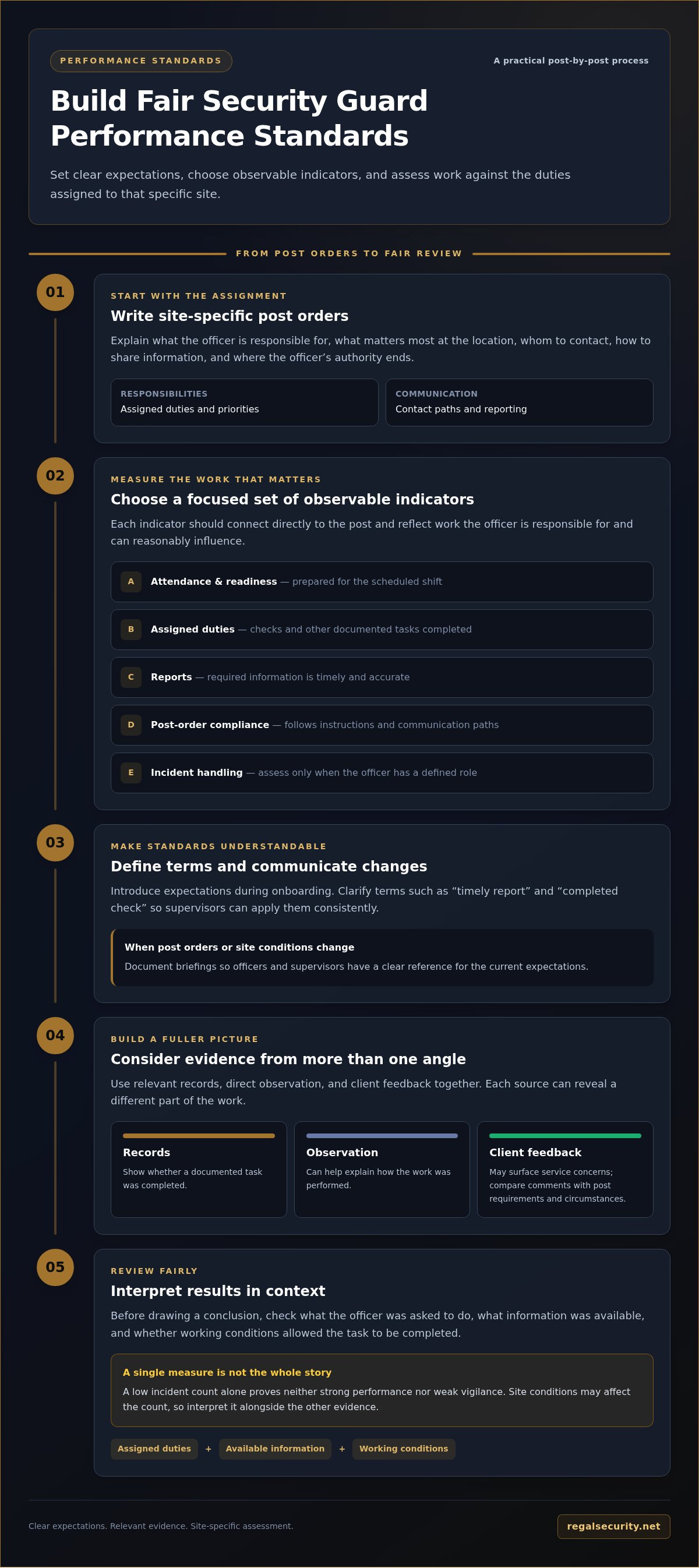
Meaningful standards begin with written post orders, not a generic scorecard. They should explain the officer’s responsibilities, the location’s priorities, whom to contact, how to communicate information, and where the officer’s authority ends. This gives officers a practical reference and helps supervisors assess work against requirements that were clear in advance.
Next, select a small number of observable indicators tied directly to those duties. A measure is useful only when it reflects work the officer is responsible for and can reasonably influence. Attendance may matter for any scheduled shift; a response measure is relevant only if the officer has a defined role in that response. The U.S. Bureau of Labor Statistics’ Occupational Requirements for Security Guards describes work requirements that can inform how responsibilities are framed, but site standards still need to reflect the actual post.
Which indicators help assess security officer performance?
Choose indicators that can be verified and interpreted in context. Depending on the assignment, useful measures may include:
Attendance and readiness for the scheduled shift.
Completion of assigned checks or other documented duties.
Timeliness and accuracy of required reports.
Adherence to the instructions and communication paths in the post orders.
Handling of an incident when the officer has a defined responsibility in the response.
Consider these records alongside supervisor observations and relevant client feedback. Records can show whether a documented task was completed, while observation may help explain how it was performed. Client comments can reveal service concerns, but should be compared with the post requirements and the specific circumstances. A low incident count alone proves neither strong performance nor weak vigilance; it may reflect conditions at the site rather than the quality of an officer’s work.
How can managers make expectations clear and fair?
Introduce the standards during onboarding, then document briefings when post orders or site conditions change. Define terms such as “timely report” or “completed check” so supervisors can apply them consistently. Before evaluation begins, agree on thresholds, reporting expectations, and how exceptions will be recorded. This prevents standards from shifting after the work has been assessed.
Fairness also requires recording context that could reasonably affect results, such as a changed assignment, unclear instruction, or staffing condition. That record helps distinguish an individual performance issue from a process or site-level concern. In practice, managing security guard performance means using evidence to assess both what happened and what the officer was expected and able to do.
For organizations defining post-specific expectations, Regal Security’s tailored unarmed security officer services provide a practical foundation for aligning on-site responsibilities with client needs.
Security Guard Performance Reviews: Metrics, Observation, and Coaching
A fair review draws on more than one kind of evidence. Records show what was documented, observation reveals how duties were carried out, an officer’s account can explain decisions, and client feedback can identify how service is experienced. Each source answers a different question. Consider them together, then compare the evidence with the responsibilities and expectations for the post.
This balanced approach matters because a metric is a signal, not a verdict. A patrol record may show that a check was logged, but not establish the quality of the officer’s attention. Response-time data may raise a question, yet the incident timeline, communication path, and available information help explain what happened. The Federal Security Guard Qualification Standards apply to federal positions; they offer a reference for role expectations, not a substitute for evaluating an officer against duties assigned at a particular site.
What can performance metrics reveal, and what can they miss?
Use records to identify questions for review, not to make assumptions. A log can establish that a duty was recorded; it cannot automatically establish whether it was completed attentively. Likewise, response-time figures need the incident timeline and communication context. Comparing records with observation, officer input, and relevant client feedback reduces the risk of treating one incomplete measure as the whole account.
How should supervisors conduct a useful performance review?
Prepare examples from the review period and bring the relevant post expectations and records. Describe observable conduct rather than relying on broad labels. For example, identify a report that lacked a required detail and explain how that detail supports a clear handoff. Invite the officer to share context before deciding what went well and what needs attention.
Close with a practical agreement:
Recognize a specific strength or contribution.
Describe the improvement needed and the agreed next action.
Record any support required and set a proportionate follow-up date.
Coaching should be respectful and precise. Confirming the next step and revisiting it at the agreed time makes feedback useful while preserving accountability. That is the discipline behind managing security guard performance: evidence informs the conversation, and the conversation leads to a clear action.
How to Build a Repeatable Security Guard Performance Management Process
A dependable process moves from clear duties to evidence, a fair conversation, and a check on progress. Consistency does not mean giving every concern the same response. It means following the same careful method, documenting decisions respectfully, and making clear who is responsible for each next step.
Confirm the expectation. Review the relevant post instruction and determine whether it was current, clear, and communicated to the officer.
Gather specific facts. Record what happened, when it happened, and which duty was affected. Separate direct observations from reports or assumptions.
Consider the pattern and context. Compare the concern with other relevant examples. An isolated mistake may call for clarification or support; repeated conduct after expectations are understood may require a more structured response.
Discuss the concern privately. Explain the observed gap, invite the officer’s account, and check whether changing conditions, staffing, or unclear instructions played a part.
Agree on action and ownership. Set out the corrective step, any coaching or resources needed, who will provide them, and when progress will be reviewed.
Follow up and close the loop. Compare subsequent work with the agreed expectation, acknowledge progress, and document any further action.
Distinguish an isolated error from a recurring pattern using relevant evidence, not frustration or a single impression. A missed report detail may be resolved through clarification if it is unusual and the instruction was unclear. If the same omission continues after a clear discussion and support, a supervisor has a stronger basis to address it as a repeated performance concern.
What steps should a supervisor follow when performance falls short?
Keep the conversation factual and private. Describe the specific action or omission, explain the expectation it relates to, and let the officer provide context before settling on a response. If instructions were incomplete or inconsistent, correct that gap as part of the plan. Record the agreed action and follow-up owner so the officer and supervisor share the same understanding.
How can training and recognition support sustained performance?
Match coaching or refresher training to the actual gap, whether it concerns a procedure, report writing, or communication. Recognize dependable conduct with a concrete example, such as a clear handoff that helped the next shift understand an unresolved matter. When a problem recurs, also examine whether instructions, communication, or site conditions contributed. Improvement may require attention to the work environment as well as individual practice.
Set a review cadence that fits the post and the issue, rather than applying a universal timetable. For example, a manager might review routine duties periodically, check progress sooner after a coaching conversation, and revisit expectations when site operations change. The interval is a planning example, not a fixed rule. Name the next review date and responsible person, then complete the follow-up.
For organizations seeking a consistent on-site presence supported by clear expectations, explore Regal Security’s unarmed security officer services for corporate and residential settings.
Applying Consistent Performance Management to Tailored Security Services
A consistent standard does not require identical duties at every property. It requires a fair way to define, communicate, and review responsibilities that fit each assignment. A corporate office may prioritize a professional reception presence and clear visitor procedures. A residential property may place greater emphasis on courteous interactions with residents and guests. Executive protection and vehicle patrol assignments have distinct responsibilities, so performance expectations should reflect the agreed scope rather than a generic checklist.
Across New York City, New Jersey, and surrounding counties, operating patterns vary from site to site. Visitor volume, property routines, client preferences, and the officer’s assigned role all shape what reliable service looks like. Align staffing needs with site responsibilities, then make expectations clear to the people responsible for carrying them out.
How should performance expectations reflect the site and client?
Start with the service scope and the property’s daily rhythm. At a corporate office, clarify how the officer supports visitor arrivals and communicates concerns to the appropriate representative. At a residential location, define the expected balance of attentive presence and respectful service. For an executive protection assignment or vehicle patrol, specify the relevant duties, reporting path, and boundaries for that role. This gives supervisors a sound basis for evaluation and helps officers understand what their assignment requires.
Consistency also depends on communication. Client representatives should share relevant changes or priorities with supervisors, who can ensure officers receive clear direction. Evaluators should understand updated instructions whenever expectations change. This is especially valuable when an organization oversees multiple properties, since a standard that fits one location may not suit another.
What is the next step toward reliable security coverage?
Put the framework into practice by confirming four essentials: defined duties, evidence that reflects those duties, constructive feedback, and follow-up with clear ownership. Together, these elements help distinguish the quality of an officer’s work from conditions or instructions that may have affected it. They also create a shared reference for client contacts, supervisors, and on-site officers.
Regal Security provides tailored unarmed security officers and concierge security for corporate, residential, and executive clients. Aligning officer responsibilities with a property’s needs is a practical starting point for dependable coverage, whether the assignment involves one site or properties with different service expectations. Explore Regal Security’s professional security services to consider how tailored coverage can support your organization’s needs.
Make Performance Standards Part of Everyday Operations
Make performance expectations part of how each site operates, rather than a document revisited only when a concern arises. As responsibilities or property needs change, keep communication current and give officers and client representatives a way to raise practical questions. This preserves a shared understanding of the work and supports accountability without losing sight of the people behind the service.
Managing security guard performance is an ongoing commitment to integrity, precision, and thoughtful oversight. With expectations suited to each assignment and constructive follow-through, organizations can strengthen the professional presence their properties and communities rely on.
Regal Security provides unarmed security officers and concierge services for corporate, residential, and executive clients across New York City, New Jersey, and surrounding counties. Explore Regal Security’s professional security services to consider how tailored coverage can support your organization’s needs.
Clear direction and steady attention help a security team move forward with confidence.
Frequently Asked Questions
How often should security guard performance be reviewed?
Set a review rhythm that reflects the assignment and changes in its demands, rather than relying on one fixed interval for every officer. Brief check-ins can surface small concerns, while a more structured discussion may be useful after an assignment change or notable event. For a stable post, routine reviews can reveal patterns over time. Document why the cadence was chosen and revisit it when conditions change.
What should a security guard performance report include?
Include enough detail for another supervisor to understand what occurred without relying on assumptions: the date and time, post or area, duty involved, sequence of observable events, actions taken, and who was notified. Note whether information came from the officer, a witness, or direct observation. Record outstanding matters and who owns follow-up. Keep conclusions about performance separate from factual descriptions so the report remains clear and useful.
Can technology alone measure a security guard’s performance?
No. Technology can organize timestamps, task entries, and other recorded activity, but it can’t establish by itself whether an officer used sound judgment, communicated respectfully, or handled an unusual situation appropriately. Data may also be incomplete or entered inconsistently. Supervisors should compare records with the assignment and discuss discrepancies with the officer before reaching a conclusion. Use technology to guide review, not to replace human judgment.
What should a manager do when a security guard’s performance declines?
Address the change promptly, first checking whether duties, instructions, workload, or site conditions have shifted. Bring specific examples to a private conversation and invite the officer to explain any obstacles. Then agree on practical actions, relevant support, and a date to revisit progress. If the concern involves an immediate operational risk, follow the site’s established escalation process. Document the discussion and assess whether performance returns to the expected standard.
How can managers assess performance across different types of security posts?
Define expectations for each assignment, then apply the same fair review principles across them. A reception-focused post in Manhattan may call for different service measures than a residential assignment in Queens or a vehicle patrol route in New Jersey. The same care applies across New York City, Brooklyn, the Bronx, Staten Island, Long Island, Nassau and Suffolk counties, and Westchester, Rockland, and Orange counties. Compare like duties, not unlike posts.
Does recognizing strong security guard performance improve engagement?
Specific recognition can support engagement by showing officers that dependable work is noticed and valued. Name the conduct, such as a clear handoff or a courteous interaction during a busy period, and explain why it helped the site. Keep praise proportionate and equitable across shifts. Recognition should accompany honest coaching, so officers understand which practices to continue and where improvement is still expected.