Manufacturing Plant Security in the Bronx: A Practical Guide
What does an effective security presence look like when production needs to keep moving? For plant leaders considering manufacturing plant security Bronx facilities need, practical priorities often include managing access, maintaining awareness of key areas, and supporting daily operations without unnecessary disruption.
Employees, contractors, delivery drivers, and visitors may arrive on different schedules. Loading areas and restricted spaces also call for clear procedures and consistent attention. A professional, unarmed on-site officer can support established access practices through a visible presence, clear communication, and duties tailored to the facility’s layout and operating rhythm.
This guide explains how on-site officers can support access management and orderly operations, where their presence may be most useful, and how coverage can reflect shift patterns and site priorities. It also compares on-site officers, scheduled vehicle patrols, and electronic systems so you can assess what fits your facility.
Table of Contents
Why Manufacturing Plant Security in the Bronx Starts with Daily Operations
What Unarmed Security Officers Can Do at a Bronx Manufacturing Facility
On-Site Officers, Patrols, and Security Systems: What Fits a Bronx Plant?
How to Plan Manufacturing Plant Security Coverage in the Bronx
A Tailored Regal Security Presence for Bronx Manufacturing Plants
Why Manufacturing Plant Security in the Bronx Starts with Daily Operations
Effective plant security should support production, not compete with it. At a Bronx facility, employees may use one entrance while delivery drivers, contractors, and visitors follow different access procedures. An on-site officer can help keep those routines orderly by observing activity, communicating clearly, and supporting the facility’s established rules.
Start by looking at how people and materials move through the site. Entry points, loading activity, shift changes, and restricted areas each have different needs. The officer’s responsibilities should reflect the site’s procedures and stay within the assigned duties. As part of broader physical security measures, a clearly defined post can connect access practices with the facility’s day-to-day operations.
Which plant areas shape the security plan?
Consider how employees, visitors, vendors, and contractors enter and move around the property. Depending on the facility, priority areas might include employee entrances, visitor reception, loading docks, parking areas, and authorized restricted spaces. The goal is to identify where observation or access support is useful, not to assume every plant has the same layout.
Operating hours and shift patterns also shape post priorities. One site may need particular attention during delivery periods; another may prioritize employee entry during shift changes. Manufacturing plant security Bronx facilities can benefit from a plan based on their actual access patterns, rather than assumptions about the borough or a generic factory layout.
How does security support normal production?
Consistency matters. Courteous, predictable interactions help employees, vendors, contractors, and visitors understand how to follow site procedures. Officers can observe activity, communicate relevant information, and support established access steps, while production decisions remain with facility staff.
Clear post instructions should explain what an officer is expected to observe, whom to notify, and how to handle questions or concerns under site procedures. This gives the officer a defined role without assigning responsibility for production work. For more on this role, see Regal Security’s guide to professional unarmed security officers.
Quotable takeaway: “A security post is most effective when its duties reflect the facility’s actual layout, access patterns, and operating rhythm.”
What Unarmed Security Officers Can Do at a Bronx Manufacturing Facility
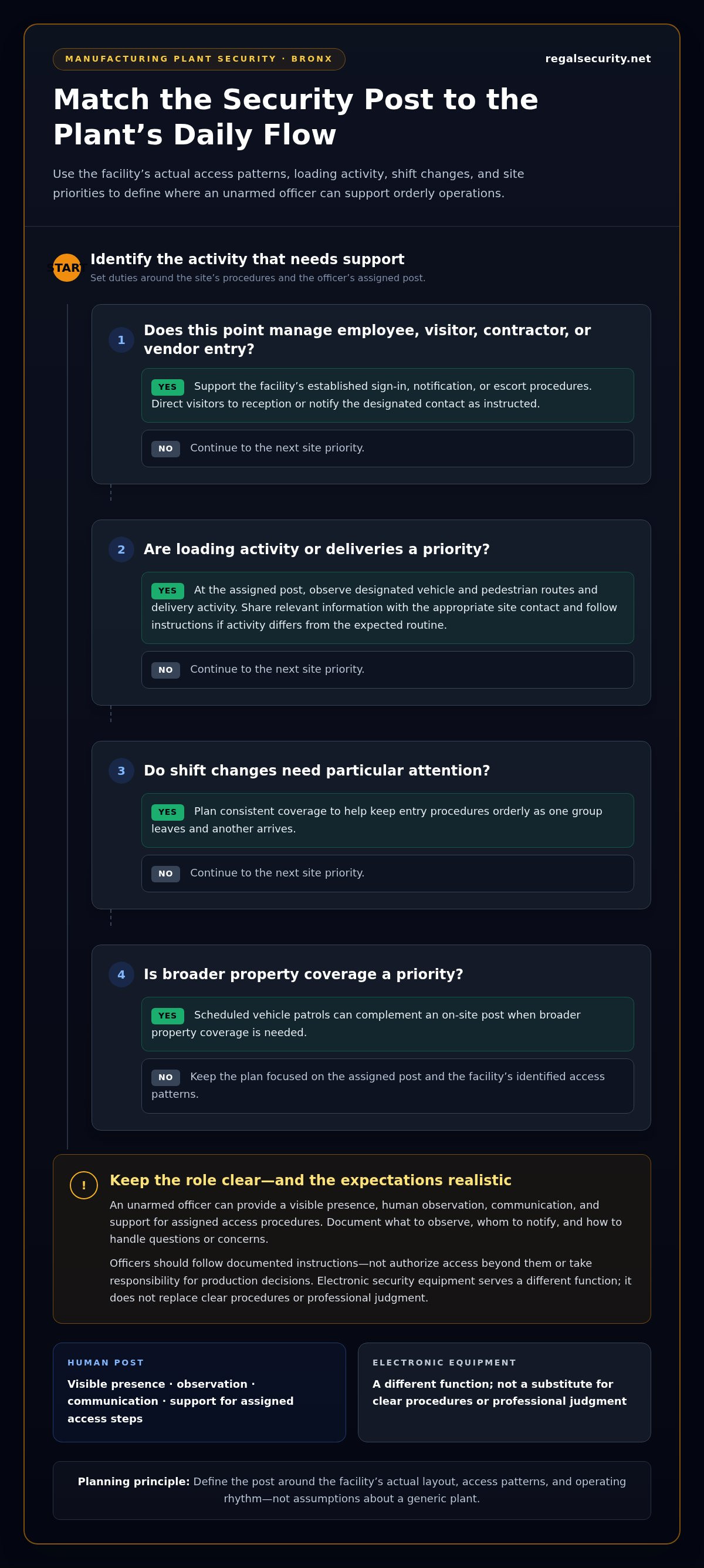
An unarmed officer’s role can include maintaining a visible presence, observing activity, communicating concerns, and supporting the facility’s assigned access procedures. In a manufacturing setting, that might mean directing a visitor to reception, notifying a designated contact about an arrival, or following site instructions when someone requests access to a restricted area.
Define the scope in writing around the facility’s policies and the officer’s assigned post. Officers can follow documented instructions and report questions or exceptions through the agreed communication process. They should not authorize access beyond those instructions or take responsibility for production decisions. Unarmed security is a service approach, not a promise that every incident can be prevented. Clear duties make the role useful and keep expectations realistic. The Critical Manufacturing Sector Security Guide offers additional context on security considerations for the manufacturing sector.
Managing employees, contractors, and visitor access
At an employee entrance or visitor reception point, an officer can support the site’s sign-in, notification, or escort procedures. Facility management should define the steps. If a contractor or vendor arrives during an active shift, calm communication can help establish whom they are visiting and where they should wait, without interrupting nearby work or bypassing the documented access process.
Consistency helps employees and regular vendors know what to expect, while visitors receive a courteous explanation of the next step. This people-focused approach to manufacturing plant security Bronx facilities can be adapted to the site’s access policies and workflow.
Supporting loading areas and shift transitions
Loading areas call for attention to designated vehicle and pedestrian routes, delivery activity, and the facility’s procedures for receiving or directing arrivals. From an assigned post, an officer can observe activity, share relevant information with the appropriate site contact, and follow instructions when an arrival or movement differs from the expected routine.
During shift transitions, consistent coverage can help keep entry procedures orderly as one group leaves and another arrives. Scheduled vehicle patrols can complement an on-site post when broader property coverage is a priority. Regal Security’s guide to vehicle patrol security services provides more information about this type of coverage.
Key distinction: “An officer provides human observation and communication at an assigned post; electronic security equipment serves a different function and doesn’t replace clear procedures or professional judgment.”
Regal Security provides unarmed officers whose assigned duties can be tailored to a facility’s priorities and operating rhythm. More information about its on-site approach is available through Regal Security’s professional security services.
On-Site Officers, Patrols, and Security Systems: What Fits a Bronx Plant?
These approaches serve different purposes. A staffed post places an officer at an assigned location. Vehicle patrols provide scheduled mobile observation of designated property areas, while electronic systems support functions such as monitoring or access control. Manufacturing plant security Bronx facilities can assess each option based on their layout, operating rhythm, and priorities. No single approach is right for every site, and none guarantees that every incident will be prevented.
These methods can be combined when each has a clear purpose. Regal Security provides unarmed security officers and vehicle patrol services. Facilities reviewing employee safety can also consult OSHA’s resource on preventing workplace violence as part of a broader review of workplace practices.
When does a dedicated on-site post make sense?
A dedicated post may suit a facility with defined access points, regular visitor activity, or a need for consistent attention at a particular location. Duties can reflect the operating schedule and workflow, from receiving arrivals to communicating questions through designated channels. Clear instructions and adherence to the client’s procedures are central: officers support site processes rather than changing them independently.
When can scheduled vehicle patrols complement coverage?
Scheduled patrols can provide mobile observation of designated areas across a property, while an on-site post maintains a presence at its assigned location. One does not replace the other. The right fit depends on which locations need a fixed post and which are suited to periodic checks. For additional context on safeguarding property and assets, read Regal Security’s guide to professional asset protection.
A considered plan matches each method to a defined purpose and sets out how information should be communicated among the people responsible for site procedures. Regal Security tailors unarmed officer and vehicle patrol coverage to a facility’s priorities. Details are available through Regal Security’s security services.
How to Plan Manufacturing Plant Security Coverage in the Bronx
A useful coverage plan turns the facility’s daily activity into clear priorities and assigned responsibilities. For manufacturing plant security Bronx operations, begin with the site itself rather than a standard post description. Use this sequence to build a practical plan:
Map activity: Mark entrances, delivery routes, reception points, loading areas, and restricted spaces.
Identify priorities: Note where access support or observation is most valuable during the workday.
Define posts: Match officer responsibilities to specific locations and operating periods.
Document procedures: Set out routine duties, access steps, and escalation contacts.
Review communication: Agree on how officers, supervisors, and facility contacts share relevant information.
This sequence turns a broad security objective into an operational plan. Regal Security tailors professional security solutions to client needs, with officer duties shaped by facility priorities, operating hours, and day-to-day workflows.
Map facility activity and priority areas
Start with a current site map. Mark employee and visitor entrances, delivery routes, reception points, and restricted spaces. Add notes on when employees, contractors, visitors, and deliveries typically arrive or move through the property. Consider shift patterns and operating hours, especially periods when arrival and delivery activity overlap. This creates a facility-specific picture, since plants in the Bronx do not all share the same layout or access patterns.
Set post responsibilities and communication procedures
Written post instructions can clarify routine duties, the limits of an officer’s authority, and whom to contact when a situation falls outside those duties. Include communication expectations for the officer on duty, supervisors, and designated facility contacts so questions and observations reach the appropriate person.
Review the plan when operating hours, access routes, or work routines change. An operational adjustment can affect where a post is most useful or which contact should receive an update. Keep instructions clear enough to guide routine work, while leaving site-specific decisions with the facility’s designated personnel.
Planning principle: “A tailored officer assignment should reflect the facility’s access points, activity patterns, operating hours, and communication procedures.”
Regal Security’s approach to coverage is tailored to a plant’s daily operations. Learn more about security coverage with Regal Security.
A Tailored Regal Security Presence for Bronx Manufacturing Plants
A well-planned security presence should reflect how a facility operates, not impose a generic routine on employees. Regal Security provides unarmed officers for Bronx manufacturing plants, with assigned duties tailored to client needs. Those duties can define where an officer is posted, which access procedures they support, and how they communicate observations to designated facility contacts.
This approach connects security with daily operations. Officers provide a professional, visible presence and interact respectfully with employees, visitors, contractors, and vendors. Their responsibilities follow the client’s procedures and remain distinct from production management. Clear expectations help everyone understand the officer’s role and where site-specific decisions belong.
What a considered security partnership should provide
Regal Security’s principles of integrity, precision, and reliable on-site presence inform how security duties are arranged. A thoughtful assignment begins with the facility’s operational priorities, then translates them into clear responsibilities and communication expectations. For example, an officer supporting an established entrance procedure should know how to direct arrivals and whom to notify with questions, while following the site’s access instructions.
These details matter in manufacturing plant security Bronx facilities, where operating schedules and access patterns vary from site to site. The goal is a composed presence that supports orderly routines, not a disruptive addition to the workday. Consistent communication between officers and designated facility contacts helps keep assigned responsibilities aligned with the client’s procedures.
Discuss your Bronx facility’s coverage needs
A useful discussion about coverage can begin with practical details: the facility’s layout, operating schedule, key entrances and areas, and existing access procedures. Information about how employees, deliveries, contractors, and visitors move through the site helps shape an approach around actual needs rather than assumptions.
Regal Security provides customized protection solutions for Bronx facilities, with unarmed officer duties tailored to site priorities and operating rhythms.
Shape Security Coverage Around Your Plant’s Daily Rhythm
Effective manufacturing plant security Bronx facilities can rely on starts with the site’s actual operating patterns. Map how employees, contractors, visitors, and deliveries move through the facility, then align coverage with key access points, operating hours, and shift activity. Clear post responsibilities and communication procedures help an officer support established routines without disrupting production.
Unarmed officers contribute through observation, communication, and support for assigned access procedures. Scheduled vehicle patrols and electronic systems serve different functions, so assess each according to facility priorities rather than treating one approach as a complete solution. A tailored plan gives everyone a clearer understanding of responsibilities and how security supports orderly operations.
Regal Security serves the Bronx with unarmed security officers and tailored protection solutions. Discuss a tailored security presence for your Bronx facility, shaped around your layout, schedule, and access priorities.
With a thoughtful plan and clear communication, your facility can support security while keeping its daily work on track.
Frequently Asked Questions
Can unarmed security officers help protect a manufacturing plant?
Yes. Unarmed officers can provide an assigned, visible presence, observe activity, support established access procedures, and communicate with designated facility contacts. Their responsibilities should follow the plant’s instructions and the duties defined for their post. This coverage is one professional layer within a broader site plan, not a guarantee against every incident. Clear procedures help officers understand what to address within their duties and when to notify facility personnel.
What should manufacturing plant security officers do at loading docks?
At a loading dock, officers may observe activity, support established delivery or visitor procedures, and communicate concerns to designated facility contacts. Written, site-specific post instructions clarify these duties and the appropriate communication path. Officers support the facility’s processes; they do not direct production, authorize access beyond their instructions, or replace the plant’s own safety and delivery procedures. Responsibilities should reflect the loading area’s layout and routines.
How can a Bronx manufacturing plant manage visitor and contractor access?
A plant can manage access by applying consistent visitor and contractor procedures. These may include directing arrivals to a designated entrance, following sign-in instructions, and contacting an authorized employee when needed. An assigned officer can support the process through courteous communication and observation, following facility directions about access. Since layouts and policies differ, each plant should define procedures around its own visitor flow rather than assume one method fits every site.
Are on-site security officers better than cameras for a manufacturing facility?
They serve different functions, so one is not universally better. Cameras can record or display activity in covered areas, while an on-site officer can observe, communicate, and support assigned people-facing procedures. A facility may use either approach or both, depending on its priorities. Regal Security provides security personnel, including unarmed officers. Any officer’s duties should be clearly defined within the plant’s established procedures.
How do you plan security coverage for a manufacturing plant?
Start by mapping entrances, loading areas, visitor routes, restricted spaces, operating hours, and shift changes. Then identify the facility’s priorities, define officer post duties, name communication contacts, and review how the planned coverage fits daily workflows. This sequence turns site activity into clear responsibilities. A site-specific plan is more useful than assuming every plant needs the same staffing arrangement, post locations, or officer duties.
Does Regal Security provide unarmed security officers in the Bronx?
Yes. Regal Security provides unarmed security officers and serves the Bronx with tailored protection solutions. Officer duties can align with a facility’s access procedures, operating priorities, and communication needs. Regal Security also serves New York City and New Jersey, including Manhattan, Brooklyn, Queens, the Bronx, Staten Island, Long Island, Nassau County, Suffolk County, Westchester County, Rockland County, and Orange County.