NJ Parking Lot Security Guide for Property Managers
Could a carefully timed vehicle patrol suit your parking property better than a constant on-site post? The right parking lot security patrol New Jersey property managers choose should reflect how the site is used, not simply follow a fixed schedule. A busy daytime lot, a residential garage, and a property with late-evening activity may call for different coverage.
It’s reasonable to want a dependable presence while still having questions about how often patrols should occur, which hours matter most, or when an on-site officer makes more sense. Clear expectations for vehicles, pedestrian areas, after-hours activity, and incident reporting help turn those questions into a practical plan.
This guide explains how to match mobile patrol or unarmed on-site coverage to your property’s activity, set patrol priorities and schedules, and assess a security partner in New Jersey. It also covers useful questions to discuss before service begins, including what officers should observe and how findings should be reported. The aim is a measured, professional presence that supports safety without overstating what security can guarantee.
Table of Contents
What Parking Lot Security Patrol in New Jersey Should Cover
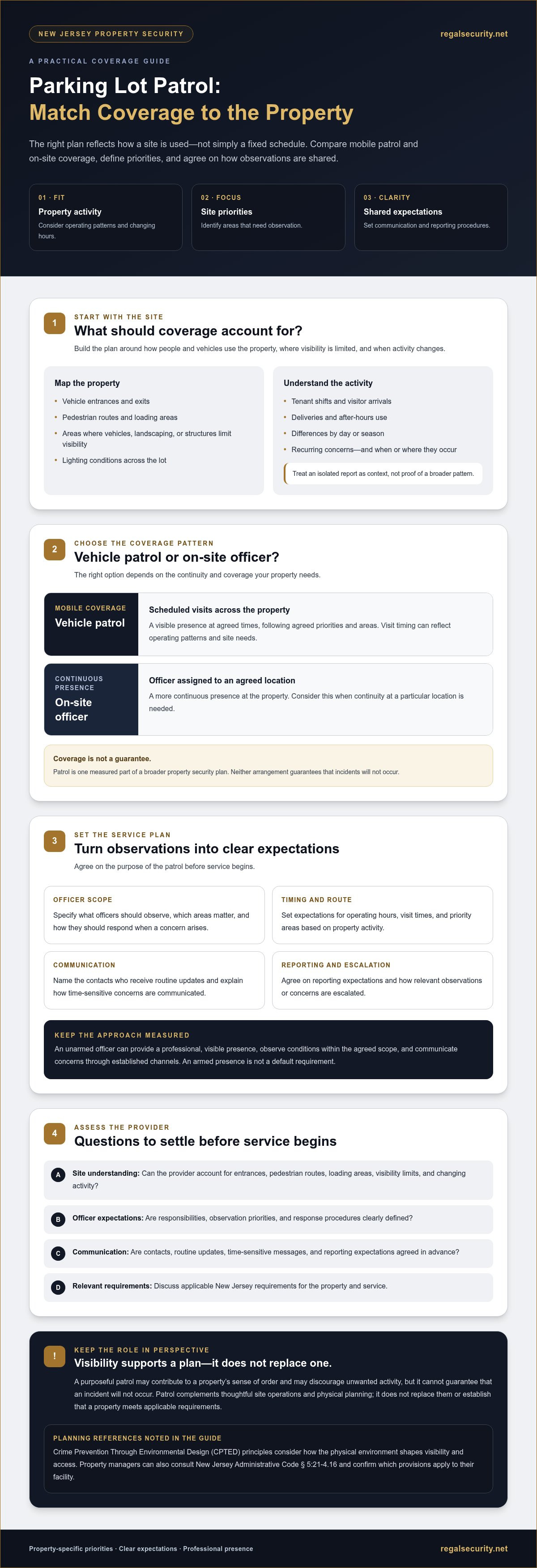
A parking patrol is most useful when its purpose is defined around the property, rather than treated as a routine drive-through without clear priorities. For a commercial lot, residential community, or workplace parking area, the plan should account for how people and vehicles use the site, which areas need observation, and when activity changes.
A parking lot patrol is a planned officer presence that observes site-specific conditions and communicates concerns as one part of a broader property security plan. Coverage may come from scheduled vehicle patrols, which provide a visible presence at agreed times, or an on-site officer assigned to remain at the property. Neither arrangement guarantees that incidents will not occur. The right option depends on the continuity and coverage the site needs.
Which parking lot conditions should a New Jersey property manager assess?
Start with a site map. Mark vehicle entrances and exits, pedestrian routes, loading areas, and locations where parked vehicles, landscaping, or structures limit visibility. Note lighting conditions across the lot as well. These details help identify where an officer’s attention may be most useful and which areas a patrol route should cover.
Next, consider the schedule. Tenant shifts, visitor arrivals, deliveries, and after-hours use may vary by day or season. Ask the property team to identify recurring concerns and when or where they occur. Avoid treating one isolated report as proof of a broader pattern. These observations give a provider useful context for planning coverage.
What can an unarmed parking lot patrol reasonably provide?
An unarmed officer can provide a professional, visible presence, observe conditions within the agreed scope, and communicate relevant concerns through established channels. A vehicle patrol can make scheduled visits across a property, while an on-site officer offers a more continuous presence at an agreed location. The service plan should specify what officers are expected to observe and how they should respond when a concern arises.
Clear procedures matter as much as visibility. Property managers and providers should agree on communication contacts, reporting expectations, and how concerns are escalated. Patrols can complement broader planning informed by Crime Prevention Through Environmental Design (CPTED) principles, which consider how the physical environment shapes visibility and access. Treat patrol as one measured part of a security plan, not a promise of prevention or a substitute for sound site operations.
How New Jersey Parking Lot Patrols Support Deterrence Without Escalation
A visible patrol can contribute to a property’s sense of order and may discourage unwanted activity, but it can’t guarantee that an incident won’t occur. Its value depends on how well the presence fits the site. A vehicle patrol should follow agreed priorities and schedules, while an on-site officer may provide continuity where a consistent presence is needed. The plan should be measured, professional, and based on the property’s assessed needs.
Effective patrol doesn’t require an armed presence by default. Property managers should match the type of officer and coverage to concerns identified during planning, rather than assume a more forceful approach is more effective. An unarmed officer can provide visibility, observe conditions, and communicate concerns according to agreed procedures. Define those responsibilities before service begins.
Can mobile patrol discourage unwanted activity in a parking lot?
It may, when the patrol is visible and purposeful. A vehicle making scheduled visits to agreed areas can signal attentive oversight, particularly when visit times reflect the property’s operating patterns. Identify which areas merit attention and how patrol activity should account for tenant, visitor, or delivery schedules. Visibility is one element of a considered security plan, not a promise of prevention.
Patrol planning also belongs alongside thoughtful property operations. For design considerations, property managers can consult New Jersey Administrative Code § 5:21-4.16 and confirm which provisions apply to their facility. Patrol service complements site planning. It doesn’t replace decisions about the physical layout or establish that a property meets applicable requirements.
How should officers communicate observations and concerns?
Before service begins, agree on who receives routine updates, how time-sensitive concerns are communicated, and what information belongs in a report when reporting is part of the agreed scope. A useful report records relevant observations clearly, helping the property team review patterns and decide whether priorities or coverage need adjustment.
Communication should remain calm and courteous with tenants, visitors, and property representatives. Officers should follow established site procedures, including the agreed path for escalating concerns. Routine patrol is not the same as emergency response. The service plan should explain how to notify the appropriate contacts, while urgent situations should be handled through the property’s established emergency procedures. If you’re considering a tailored parking lot security patrol New Jersey plan, discussing these expectations with a provider such as Regal Security’s vehicle patrol team can help clarify how visibility, observation, and communication fit your site.
On-Site Officer or Vehicle Patrol: Choosing Parking Lot Coverage in New Jersey
The choice is not simply between “more” and “less” security. Consider where a professional presence needs to be, how continuously it is required, and how the parking property operates. Use the comparison below to clarify which model better matches your site before discussing a schedule or service scope.
When may a dedicated on-site officer fit a parking property?
Consider an on-site officer when the property needs a consistent staffed presence at a defined location, such as a post where visitors regularly arrive or where coordination with property operations matters. Discuss expected hours, assigned location, visitor interaction, and communication responsibilities. Staffing arrangements depend on the property’s requirements and the service agreement, so define those details rather than assuming they are standard.
When may scheduled vehicle patrol be a practical fit?
Vehicle patrol may be appropriate when attention needs to move among several parts of a site, such as separate lots or entrances. Consider whether planned visits align with the property’s activity and priorities. Ask how patrol frequency will be agreed, which areas visits should cover, and what reporting is included. A scheduled patrol does not provide continuous coverage between visits.
Some properties may warrant a combination or adjustment, but only if the site assessment supports it. For example, a manager might discuss whether a defined on-site presence is needed during a particular operating period and mobile visits at other agreed times. Treat this as a planning option, not a standard package or assumed recommendation. For additional parking operations resources, the International Parking & Mobility Institute (IPMI) offers material managers can consult alongside their own site requirements.
For a parking lot security patrol New Jersey plan, compare the coverage pattern with actual operating needs, then confirm hours, priorities, communication, and reporting in the agreement. Neither model is universally superior. The right fit is the one whose defined presence aligns with the property’s assessed needs.
How to Plan a Parking Lot Security Patrol for Your New Jersey Property
A useful patrol plan starts with information the property team can verify and a clear agreement about what the officer or patrol is expected to cover. Work through these steps before service begins, then revisit the plan if operating patterns or site priorities change.
Assess the lot. Gather a site plan and mark vehicle entrances and exits, pedestrian access, loading areas, and locations that need particular attention. Record operating hours and relevant property procedures.
Identify priorities. Describe recurring concerns factually, noting where and when they have been observed. Separate confirmed observations from assumptions, and identify which areas or operating periods merit attention.
Define coverage. Discuss service hours, the coverage model, patrol focus, and schedule requirements. Make sure the proposed plan reflects how tenants, visitors, and other users access the property.
Agree on communication. Identify the authorized property contact, how routine updates and time-sensitive concerns should be shared, and who should receive reports when reporting is part of the agreement.
Review the service. Set a process for discussing whether coverage remains aligned with site priorities. Clarify how schedule changes, access issues, or newly identified concerns will be raised and considered.
What information should a New Jersey property manager prepare?
Bring the site map, access details, operating schedule, and relevant property procedures to the planning discussion. Identify one client representative authorized to receive updates and make operational decisions, along with an appropriate alternate contact. This preparation helps keep instructions consistent and gives the provider a practical basis for proposing a site-specific plan.
Which service expectations should be agreed before patrol begins?
Put the agreed service hours, areas of attention, communication procedures, and reporting arrangements in writing. Discuss how the provider and property team will handle schedule adjustments, access difficulties, and emerging concerns. Before launch, compare the plan against the site map and operating schedule to spot gaps, such as an entrance or pedestrian route that has not been addressed.
Also verify current New Jersey requirements for providers and security personnel through authoritative state sources. Requirements can depend on the service and circumstances, so confirm what applies rather than relying on assumptions or outdated summaries. A clear, documented parking lot security patrol New Jersey plan helps both parties understand the intended coverage and how it will be reviewed.
To discuss how vehicle patrol or unarmed officer coverage could be tailored to your property’s priorities, contact Regal Security about parking lot patrol planning.
Choosing a New Jersey Parking Lot Security Patrol Partner
A provider should be able to explain how its proposed coverage relates to your property, not simply describe a general patrol service. Before selecting a partner, assess how well they understand the site, define officer responsibilities, and set practical expectations for communication and reporting.
What questions should you ask a parking patrol provider?
Use these questions to guide the discussion and compare proposals on consistent terms:
Site assessment: How will you assess the parking areas, entrances, pedestrian access, operating schedule, and priorities we identify?
Patrol plan: How will those priorities shape the proposed coverage pattern, service schedule, and areas of attention?
Officer expectations: What will officers be expected to observe, and how should they interact with tenants, visitors, and property representatives?
Communication: Who should receive routine updates or time-sensitive notifications, and how will schedule changes or access issues be raised?
Reporting: What reports are included in the proposed scope, what observations will they document, and who will receive them?
Qualifications and requirements: What relevant qualifications can the provider confirm, and how does it address applicable New Jersey requirements?
Verify current requirements for both the provider and personnel through authoritative New Jersey sources, such as the appropriate state agency. Ask the provider to identify which requirements apply to the proposed service, then confirm that information independently. Avoid relying solely on an informal summary or an outdated checklist.
Before choosing a patrol provider, ask how it will assess your site, define officer responsibilities, communicate concerns, document agreed observations, and verify applicable requirements. Clear answers help you judge whether the proposed service is a practical fit, rather than assuming a broad service description covers your needs.
How can Regal Security discuss coverage for a New Jersey parking lot?
Regal Security provides unarmed security officers and vehicle patrol, with services tailored to client requirements. A discussion can begin with the property’s location, operating hours, site layout, and coverage priorities, then consider which service category may align with those needs. Clarify the precise scope, schedule, communications, and reporting expectations before service begins.
If you’re assessing a parking lot security patrol New Jersey plan, a conversation can help you outline the questions and site details a provider needs to consider. Discuss parking lot patrol coverage with Regal Security without treating an initial discussion as a commitment.
Build a Patrol Plan Around Your Property
A well-considered parking lot security patrol New Jersey plan starts with the property’s actual activity, not a one-size-fits-all schedule. Map the areas that need attention, compare the continuity of an on-site officer with the mobile coverage of vehicle patrol, and agree on service hours, communication paths, and reporting expectations before coverage begins.
Choosing a provider is part of that planning. Look for a partner who takes time to understand the site, explains officer responsibilities clearly, and is prepared to discuss applicable requirements. These practical steps support a measured, professional presence without promising that incidents will never occur.
Regal Security offers unarmed security officers and vehicle patrol, with service tailored to client requirements and guided by integrity, precision, and a reliable presence. To discuss your property’s location, operating hours, and coverage priorities, discuss parking lot patrol coverage. A focused conversation can help you outline an approach that fits your site and gives your team a clear foundation for moving forward.
Frequently Asked Questions
Is an unarmed security patrol suitable for a parking lot?
Yes, an unarmed patrol may suit a parking lot when the property’s priorities call for a professional visible presence, observation, and communication. The plan should define where officers focus, what they’re expected to observe, and how they report concerns. An unarmed officer can support a site-specific security approach, but patrol presence can’t guarantee that incidents won’t occur or replace the property’s established emergency procedures.
Can a vehicle patrol cover multiple parking areas?
Yes, a vehicle patrol can visit multiple parking areas if the agreed route and schedule account for each location. Provide the patrol provider with a site map, access details, operating hours, and the areas that need attention. Discuss how visits will be organized and how observations will be communicated. Coverage between visits is not continuous, so confirm that this pattern fits the property’s needs.
How often should a parking lot security patrol visit?
There’s no single visit frequency that suits every property. Base the schedule on operating hours, changes in tenant and visitor activity, access points, and the areas identified as priorities. A parking lot security patrol New Jersey plan should specify agreed service times and how schedule changes will be handled. Review the arrangement with the provider if property use or coverage needs change.
What should a parking lot patrol plan include?
A practical plan should identify the property’s operating schedule, entrances and exits, pedestrian routes, areas requiring attention, and the patrol coverage pattern. It should also state officer expectations, communication contacts, how concerns are escalated, and who receives reports when reporting is included in the service scope. Documenting these details gives the property team and provider a shared understanding of the work.
Do New Jersey security patrol providers have to meet specific requirements?
Yes, New Jersey security officers, including officers assigned to parking lots, must meet applicable state requirements. The state’s Security Officer Registration Act (SORA) calls for registration with the New Jersey State Police, a background check, and completion of a certified training program. Requirements can change, so property managers should verify current rules through the New Jersey State Police and confirm how they apply to the proposed service.
How much does parking lot security patrol cost in New Jersey?
There isn’t one price for every property, and the service information available here doesn’t establish a rate. Ask providers to prepare a proposal based on your location, operating hours, coverage model, patrol priorities, and reporting expectations. For properties in New Jersey and Regal Security’s local footprint, including New York City, Manhattan, Brooklyn, Queens, the Bronx, Staten Island, Long Island, Nassau County, Suffolk County, Westchester County, Rockland County, and Orange County, confirm that the provider can address your specific site.
Should I choose an on-site officer or a vehicle patrol for my parking lot?
Choose based on the presence your property needs. An on-site officer may fit a site requiring a consistent staffed presence at a defined post, while vehicle patrol may suit priorities spread across several lots or entrances through scheduled visits. Compare continuity, coverage pattern, operating hours, and reporting arrangements. Neither option is universally better; match the agreed service to your site assessment and daily operations.