NYC Vacant Property Security: A Buyer’s Guide
The most visible security presence isn’t always the right fit for a vacant building. Some properties may benefit from an on-site officer to coordinate access, while others may be suited to scheduled vehicle patrol. The right security solutions for vacant properties NYC depend on the site, the expected vacancy period, and how people should enter.
Before leaving a property unoccupied, clarify who can access the building, how visits will be handled, and what happens if an officer or patrol identifies a concern. A written service scope should set out these procedures so owners, property managers, and security personnel have a shared understanding of their roles.
This guide compares practical approaches to vacant-property security and explains what to clarify when assessing coverage. You’ll learn how site conditions and access requirements can shape the choice between an on-site presence and vehicle patrol, and what to ask providers about reporting, escalation, and service boundaries. With those details in view, you can identify a plan suited to your property and discuss its specific needs with a local provider such as Regal Security.
Table of Contents: Security Solutions for Vacant Properties NYC
Why Vacant Properties in NYC Need a Site-Specific Security Plan
An empty building still needs defined oversight and clear access procedures. The right level of security depends on what is happening at the property, who may need to enter, and how long the space is expected to remain unoccupied. A residence awaiting a tenant, a closed commercial space, and a renovation site each have different coordination needs. A plan that overlooks those differences can leave important questions unanswered, even when security personnel are present.
Vacancy can also raise concerns about unauthorized entry or occupation. Owners assessing the dangers of squatting should consider how entry points will be monitored and how a concern will be reported and escalated. Base the service plan on the actual property and its access arrangements, not assumptions about the neighborhood or building type.
Which vacant-property conditions should shape coverage?
Start by establishing whether the building is fully empty, partly occupied, under renovation, or awaiting a tenant. The expected vacancy period matters: a short transition may require different oversight from a longer vacancy with recurring contractor access. Map entrances, shared areas, delivery points, and spaces that are off limits. For a renovation, clarify how authorized workers enter and how access procedures may change as work progresses.
Record access hours, approved visitors, and the person authorized to make decisions. If an owner approves entry while a property manager handles daily coordination, specify how those responsibilities connect. These details help determine whether continuous on-site coverage, periodic vehicle patrol, or another arrangement should be assessed.
Why does NYC location matter to the service plan?
Location affects practical coordination. Borough, building access, parking, and travel logistics can influence how a provider discusses coverage and how personnel reach the site. A Manhattan high-rise may require coordination around building entry and shared areas, while a street-level property or several separate buildings may require attention to distinct entrances and distances between locations. Neither situation automatically calls for the same staffing approach.
Describe the site precisely, including its building type, access arrangements, and any restrictions that could affect entry. Before relying on a proposed plan, confirm current service availability for the specific borough and property type. Verify applicable licensing, building, or emergency-response requirements with authoritative sources as well. Requirements can depend on the circumstances, so don’t assume one rule applies to every property.
With these conditions documented, comparing security solutions for vacant properties NYC becomes more practical. The goal is to match presence and procedures to actual site needs, with responsibilities for access and communication clearly established.
How Unarmed Officers and Vehicle Patrol Can Support Vacant Buildings
Once the property’s access needs are clear, consider what type of personnel presence may fit. An on-site unarmed security officer and scheduled vehicle patrol are different services. One provides a consistent presence at an agreed location during the coverage period, while the other involves periodic visits. Neither guarantees that incidents won’t occur. Their value depends on a clear scope, suitable coverage, and reliable procedures for communicating concerns.
When might a dedicated unarmed officer be appropriate?
A dedicated officer may be appropriate when authorized access happens regularly, such as during deliveries, contractor visits, or operational handoffs. Before coverage begins, agree on the role. It might include observing conditions, following established entry procedures, and reporting concerns to a designated contact. Clarify visitor approvals, access boundaries, and escalation steps in writing. Duties must remain within the contracted role, the officer’s training, and applicable requirements.
Personnel-based security is not the same as electronic security. Regal provides unarmed security officers and vehicle patrol, but doesn’t install CCTV or alarm systems. For information about how the city handles concerns involving vacant buildings, consult its NYC vacant building complaints resource. That process is separate from defining the duties of a private security provider.
When might scheduled vehicle patrol fit the property?
Vehicle patrol may suit a site where decision-makers are considering periodic visits instead of continuous on-site staffing. It can be assessed for a property with defined checkpoints or for multiple locations where a recurring visible presence is sought. The right schedule depends on the site and the owner’s objectives. A patrol visit is not continuous observation and shouldn’t be treated as a guarantee against incidents.
During a scope discussion, specify the route, proposed visit frequency, checkpoints, access arrangements, and reporting expectations. Ask how observations or concerns will be relayed and who will receive them. For broader considerations when planning mobile coverage, see the vehicle patrol security services guide.
The choice isn’t simply between more or less security. It’s about matching the service type and agreed duties to the property’s operating conditions. For a property-specific discussion of security solutions for vacant properties NYC, you can contact Regal Security to review whether unarmed officers, vehicle patrol, or both merit consideration for the site.
How to Compare Vacant Property Security Solutions in NYC
A useful comparison looks beyond the service name. Consider how regularly someone will be present, how the arrangement handles authorized access, and what information you’ll receive. The table below is a discussion aid, not a promise that every option is available for every property or a universal recommendation. Confirm the proposed scope and current availability for your site.
How should the property’s use affect the decision?
For a renovation, contractor access and changing work schedules can make coordination central to the plan. Establish who will share schedule changes, approve entry, and receive reports about site conditions. At a vacant residence or commercial space, name the people authorized to enter and the contact responsible for receiving updates. A written scope with specific roles and procedures leaves less room for assumptions.
Compare security solutions for vacant properties NYC against the actual pattern of access and oversight your building requires. An officer service involves personnel on site during agreed coverage; patrol involves scheduled visits. Neither should be treated as a guarantee that incidents won’t occur. For additional context on defining an officer’s role and service expectations, consult the professional unarmed security officers guide.
Before deciding, ask each provider to describe the proposed coverage pattern, access responsibilities, reporting process, and service boundaries in writing. Then assess whether that scope aligns with the property’s use, layout, and vacancy period.
What to Confirm Before Hiring Vacant Property Security in NYC
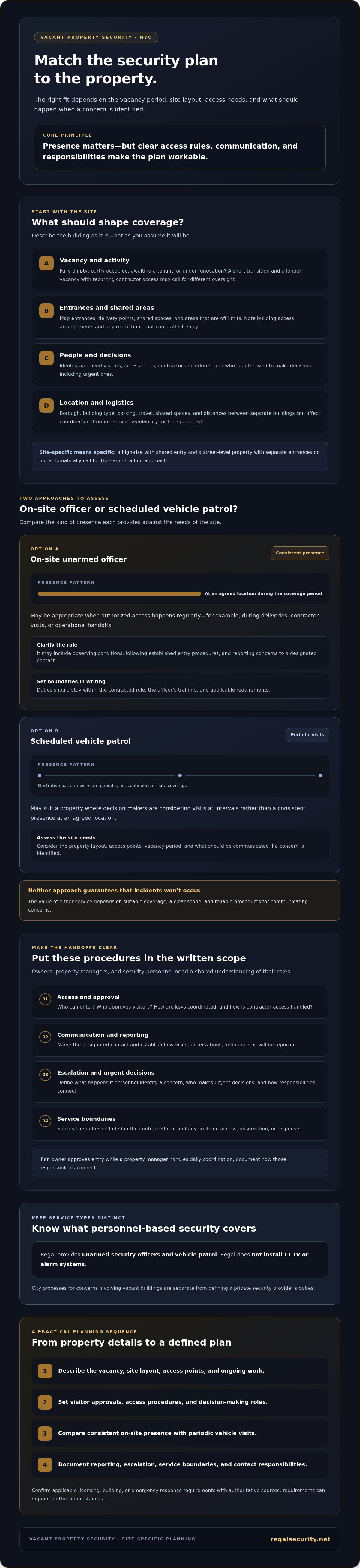
A clear scope makes it easier to assess whether a proposed service fits the building and its vacancy period. Before comparing security solutions for vacant properties NYC, gather relevant site details and ask providers to put coverage, responsibilities, and communication procedures in writing.
Document site conditions. Prepare the property address, vacancy timeline, entrances and other access points, operating hours, and a primary site contact. Note any current occupants, contractors, restricted areas, and established access procedures.
Define duties and boundaries. State the outcomes you’re seeking, then clarify which duties are included in the proposed service. Confirm the locations covered, schedule, and limits of the provider’s role instead of assuming a particular service is automatically suitable.
Agree on access and communication. Identify who manages keys, approves visitors, coordinates contractor entry, and communicates schedule changes or exceptions. Name the person authorized to make urgent decisions and establish how that person can be reached.
Review reporting and escalation. Ask what observations will be documented, who receives updates, and how concerns are escalated. Confirm the process in writing, including the appropriate contacts and what happens when the usual contact is unavailable.
What information should property managers prepare?
Bring a concise site summary to the scope discussion: address, expected vacancy period, operating hours, access points, and contact details. Include known occupants or contractors, restricted areas, and procedures already in use. Be specific about the desired outcome, such as clearer access coordination or a defined reporting process, without presuming that on-site coverage or patrol is the right fit.
Which provider questions clarify the proposed scope?
Ask which duties are included, how observations are documented, and who receives updates. Clarify how schedule changes, access exceptions, and urgent concerns are handled. Before contracting, verify current availability for the property’s NYC borough and type, and confirm any provider or personnel credentials relevant to the proposed service.
A well-defined scope gives the property representative and provider a shared reference point. Before agreeing to coverage, ensure the written proposal identifies locations, schedule, boundaries, access coordination, reporting, and escalation contacts. To discuss your property’s security requirements with Regal Security, contact the team about a site-specific scope.
Build a Vacant Property Security Plan with Regal Security
With your property details and priorities documented, the next step is a scope discussion grounded in the site’s actual conditions. Share the vacancy timeline, building layout, access arrangements, expected contractor or visitor activity, and the outcomes you want to support. This gives a provider a clearer basis for assessing whether unarmed security officers, vehicle patrol, or a proposed combination merits consideration.
What can a site-specific discussion establish?
A focused discussion can clarify whether the property may benefit from an on-site presence during agreed coverage hours, scheduled patrol visits, or a combination to assess. It should also establish who may enter, how access exceptions are handled, who receives reports, and which contact makes urgent decisions. The written scope should describe coverage locations, schedule, duties, boundaries, and escalation contacts so responsibilities are understood before service begins.
Confirm current service availability for the property’s NYC borough, building type, and requested schedule before making a decision. Any proposed plan should reflect those factors rather than rely on a standard package or an assumption that one service suits every vacant site. Regal provides unarmed security officers and vehicle patrol; the appropriate scope is subject to a property-specific assessment.
How does professional staffing fit a wider protection plan?
Security personnel can support agreed access and reporting procedures, but they don’t replace the owner’s or property manager’s responsibilities. Keep property records current, communicate changes in occupancy or work schedules, and ensure designated contacts can respond to reported concerns. Clear coordination helps the service operate within its defined role.
For related planning context, read the professional asset protection guide. As you evaluate security solutions for vacant properties NYC, use the discussion to assess whether the proposed duties and communication process align with your site’s needs, not simply whether a provider offers a particular service category.
A measured conversation can help turn property details into a clearly defined scope without promising outcomes no service can guarantee. Contact Regal Security to discuss vacant-property coverage and the requirements of your NYC property.
Choose Coverage That Fits Your Property
A sound vacant-property plan begins with the building’s actual conditions: how long it will be unoccupied, who needs access, and what oversight the site calls for. Compare an on-site unarmed officer with scheduled vehicle patrol by considering the continuity of presence, access coordination, and reporting each arrangement can provide. Then document duties, coverage boundaries, communication, and escalation contacts before service begins.
The right security solutions for vacant properties NYC are shaped by site needs, not a one-size-fits-all formula. Regal Security offers unarmed security officers and vehicle patrol for consideration through a property-specific scope discussion. Confirm that the requested service and schedule are available for your borough and property type, and remember that personnel support agreed procedures without replacing property management responsibilities.
With your site details and desired outcomes prepared, take the next step toward a clearly defined plan. Discuss your vacant property’s security needs with Regal Security. A careful conversation can help you move forward with greater clarity.
Frequently Asked Questions
Is an unarmed security officer suitable for a vacant property?
An unarmed security officer may be suitable when a property needs an agreed on-site presence, particularly if authorized visitors, deliveries, or contractors require coordination. Suitability depends on the building’s layout, vacancy period, access needs, and desired duties. For security solutions for vacant properties NYC, define what the officer is expected to observe, how access procedures are followed, and how concerns are reported before selecting coverage.
Can vehicle patrol secure a vacant property in NYC?
Vehicle patrol can provide scheduled visits and a periodic visible presence, but it isn’t the same as continuous on-site staffing and can’t guarantee that incidents won’t occur. Discuss the route, proposed visit schedule, checkpoints, access arrangements, and reporting expectations with the provider. Whether patrol fits depends on the property’s conditions and oversight needs. Confirm that the service is available for the specific NYC property and requested schedule.
How much does vacant property security cost in NYC?
Costs depend on the proposed service scope, so request a property-specific proposal rather than assuming a standard rate. The coverage type, schedule, site layout, access requirements, and reporting expectations can all affect what a provider proposes. Share these details when requesting an estimate and ask which duties are included. Compare proposals by scope and responsibilities, not price alone, and confirm that the arrangement fits the property’s needs.
What happens if someone needs access to a vacant building?
Set an access procedure before coverage begins. Identify who may approve visitors, who coordinates keys, how contractors are authorized, and which contact resolves exceptions or urgent requests. Share approved access information with the provider and agree on how entries or concerns will be documented and reported. Don’t rely on informal assumptions; clear roles help property representatives and security personnel follow the same process.
What should I ask a vacant property security company before hiring?
Ask which duties are included, where coverage applies, and what schedule is proposed. Clarify how visitor approvals, keys, contractor access, schedule changes, and exceptions will be handled. Find out how observations are documented, who receives updates, and how urgent concerns are escalated. Also verify current availability for your property’s location and any credentials relevant to the proposed service. Request the scope and responsibilities in writing before contracting.
Does Regal Security install cameras or alarm systems for vacant properties?
No. Regal Security provides unarmed security officers and vehicle patrol, not CCTV or alarm-system installation. Its stated markets include New York City and New Jersey, including Manhattan, Brooklyn, Queens, the Bronx, Staten Island, Long Island, Nassau County, Suffolk County, Westchester County, Rockland County, and Orange County. Confirm current availability for your property type, location, and requested schedule. Ask an appropriate separate provider about electronic security-system needs.