Private Event Security on Long Island: A Practical Planning Guide
What if effective event security were measured less by how many officers guests notice and more by how smoothly the evening unfolds? A thoughtful private event security Long Island plan balances a welcoming atmosphere with clear access procedures, attentive coverage, and readiness to follow agreed steps if a concern arises.
It’s understandable to wonder how many officers an event needs, where they should be positioned, and how security can work alongside venue staff without interrupting the occasion. The answer depends on the event’s purpose, guest flow, venue layout, arrival arrangements, and schedule. Mapping these details helps identify where an unarmed officer’s presence can support orderly access, observe activity, and provide a clear point of communication.
This guide offers a practical framework for planning an event in Nassau or Suffolk County. You’ll learn how to assess staffing and post locations, coordinate venue access and arrivals, and establish clear roles for communication and escalation. The goal is a composed, professional presence that supports event readiness and the guest experience.
Table of Contents
What Private Event Security on Long Island Should Accomplish
Private event security is a planned, professional on-site presence that supports guest safety and orderly event operations. Its role can include supporting access at assigned points, observing activity, and providing a clear communication link, while fitting the event’s atmosphere and the venue’s procedures.
Effective planning starts with the event itself, not a preset staffing formula. A corporate gathering with scheduled arrivals may call for different coverage than a private celebration where guests move between indoor and outdoor spaces. Attendance patterns, the layout, event timing, and the number and location of entry points all influence where attention is most useful. Identify the event’s priorities first, then match post assignments to the activities and access needs they are meant to support.
These decisions reflect broader physical security principles, in which access measures, protective features, and procedures work together. For a private event, consider how guests enter, where movement is expected, and how assigned officers will coordinate with venue staff. A tailored plan makes the security presence more purposeful and easier to integrate with event operations.
Which Long Island events may benefit from on-site officers?
Private celebrations, corporate gatherings, and invitation-based events may benefit from an on-site officer when organizers want support for guest access or a dependable point of contact. The appropriate presence depends on the event’s needs; not every occasion calls for the same arrangement.
An indoor reception may have one defined arrival area, while an outdoor celebration could involve open approaches and several activity spaces. A venue with multiple rooms or separate event areas may require attention to how guests move between them. Consider where arrivals gather, where guests may need direction, and which spaces should remain restricted. These details help organizers describe the assignment without assuming that a larger or more visible setup is automatically better.
How does a professional presence support a welcoming event?
Security and hospitality can work in concert. At an arrival point or another assigned post, calm, courteous interactions can help guests understand where to go and support orderly access. A visible officer can also reassure attendees by making it clear that someone is attentive and available, without creating an unnecessarily intimidating atmosphere.
Professionalism depends on more than appearance. Discretion, respectful communication, and awareness of the event’s tone help officers remain approachable while carrying out their assigned role. Regal Security provides unarmed officers and a tailored on-site presence shaped around event objectives and venue operations. With clear coordination and a reliable presence, private event security Long Island organizers plan can support readiness while allowing the gathering to remain centered on its guests.
How Long Island Venue Layout and Guest Flow Shape Event Security
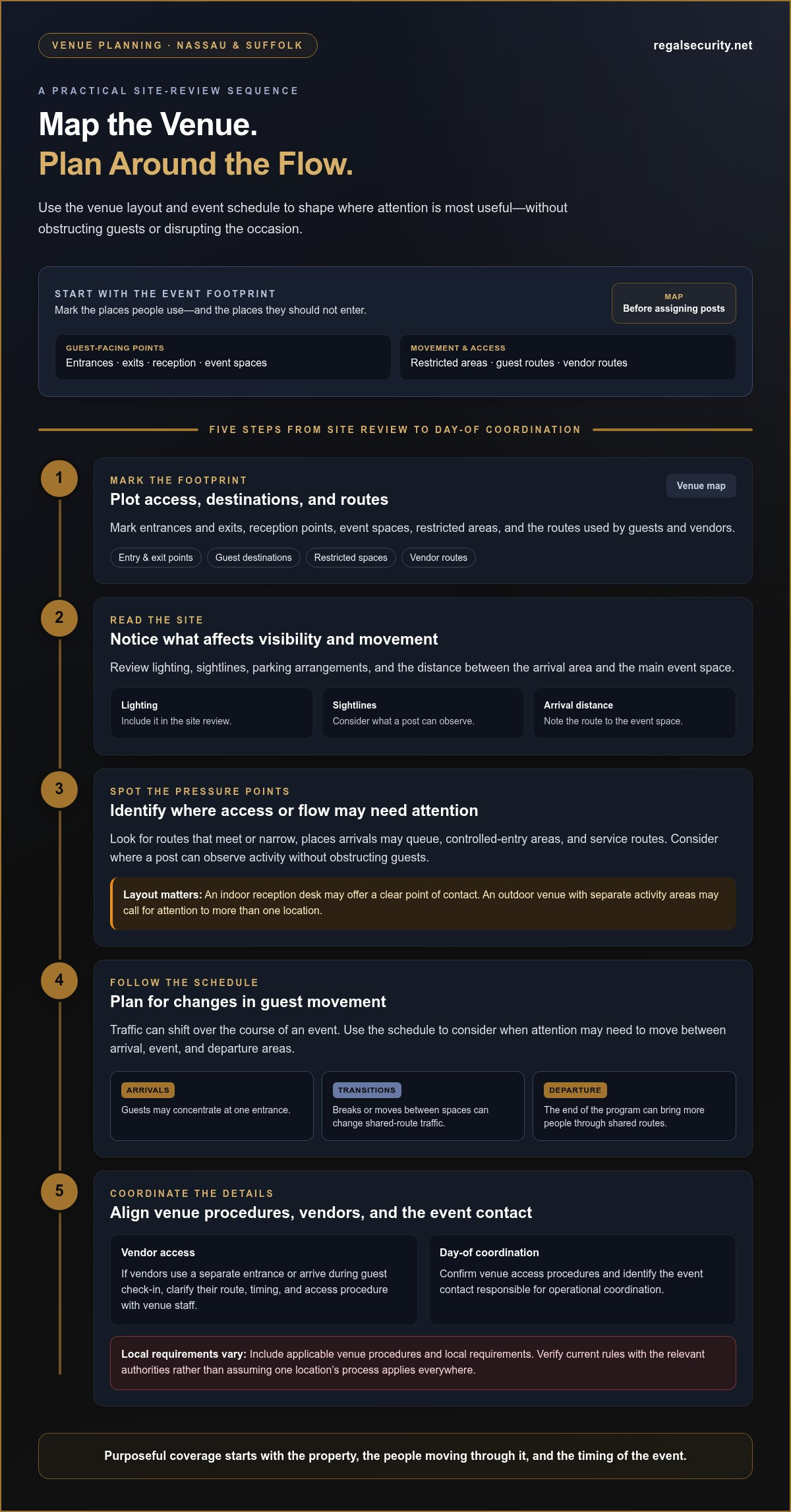
A venue map is a practical starting point for placing event security. Mark entrances and exits, reception points, event spaces, restricted areas, and the routes guests and vendors will use. Then note where routes meet or narrow, where arrivals may queue, and which areas should remain separate from guest spaces. This makes it easier to decide where a post can support access and movement without obstructing the event.
For private event security Long Island planners arrange, the site review should reflect the specific property, whether it is in Nassau or Suffolk County. Consider lighting, sightlines, parking arrangements, and the distance between the arrival area and the main event space. A reception desk may provide a clear point of contact indoors, while an outdoor venue with separate activity areas may call for attention to more than one location.
What should an event security site review consider?
Walk the event footprint with venue operations in mind. Identify controlled-entry areas, service routes, and places where a post could observe activity without obstructing guests. Clarify the venue’s access procedures and identify the event contact responsible for operational coordination on the day. The CISA Venue Security Guide offers venue operators a resource for considering security options and potential disruptions.
Requirements can differ by venue and municipality, including across Nassau and Suffolk County. Include applicable venue procedures and local requirements in planning, and verify current rules with the relevant authorities rather than assuming one location’s process applies everywhere.
How should coverage adapt to guest arrivals and event transitions?
Guest movement changes over the course of an event. Arrivals may concentrate at one entrance, while a scheduled break, a move between spaces, or the end of the program can bring more people through shared routes. Post assignments should account for these phases rather than treating traffic as constant from start to finish. Use the schedule to identify when attention may need to shift between arrival, event, and departure areas.
Vendor deliveries and service windows also matter. If vendors use a separate entrance or arrive while guests are checking in, clarify the route, timing, and access procedure with venue staff. This helps keep service activity distinct from guest-facing operations and reduces the chance of confusion at arrival points.
Before the event: Mark access points, restricted areas, parking, and guest routes on the venue plan.
During the program: Note transitions, breaks, and any movement between event spaces.
At departure: Identify exit routes and the event contact for coordination.
A clear site picture helps Regal Security tailor an unarmed officer presence to the venue’s operations and event flow. Explore Regal Security’s event security approach as you plan coverage for your Long Island venue.
Comparing Private Event Security Coverage Options on Long Island
Coverage is best considered by post and purpose, not by a universal staffing formula. A contained venue with one defined access point may call for a different arrangement than a property with several entrances, separate event areas, or vendor access. For private event security Long Island planners are arranging, the event’s layout, attendance pattern, schedule, and access needs help determine whether one assigned post is appropriate or whether coverage should be coordinated across locations.
It also helps to distinguish three functions. Access support focuses on the assigned entry point and orderly arrivals. Observation means remaining attentive to activity in the designated area. Response coordination means following agreed communication and escalation procedures if a concern arises. The CISA security planning workbook offers a planning resource for considering event security needs alongside the event’s specific conditions.
When may a single assigned post be sufficient?
A single post may suit an event where one entrance serves as the primary arrival point and the event remains within a clearly defined area. Its value comes from a focused assignment: supporting orderly access, observing activity at that point, and communicating with the designated event contact. This is not a headcount rule. It is an option to consider when the venue and event flow give that post a clear objective.
When might an event need coordinated coverage?
Multiple entrances, separate indoor and outdoor areas, or a vendor route apart from guest access can create distinct responsibilities. Coordinated coverage helps clarify who is assigned to each area, how officers communicate, and how a concern is escalated under the agreed procedures. The scope should be tailored to the event and venue, with roles aligned to the schedule and access needs rather than assumed in advance.
A tailored unarmed officer presence can bring these functions together through clear coordination and respectful guest interaction. Regal Security shapes its on-site presence around event objectives and venue operations, helping planners consider coverage that is measured, professional, and suited to the occasion.
How to Prepare a Long Island Private Event Security Brief
A concise event brief gives the host, venue team, and security officers a shared understanding of the occasion and their respective roles. For private event security Long Island planners are arranging, the brief should connect practical details, such as the schedule and access points, with the host’s priorities and day-of communication plan.
What details should the event brief include?
Prepare the information in a sequence that moves from the event overview to on-site coordination:
Summarize the event. Note its format, date, venue address, operating hours, and host or organizer.
Describe attendance and timing. Share attendance expectations, guest arrival patterns, and scheduled transitions or departures.
Outline the venue. Include a layout showing entrances, exits, event areas, restricted spaces, and any separate vendor or service access.
Record operating procedures. Note venue-specific access arrangements, vendor arrival windows, and relevant instructions from venue management.
Set out priorities and contacts. Identify the host’s key concerns, the designated event decision-maker, and the venue contact for operational coordination.
For a venue in Nassau or Suffolk County, include the county and any location-specific details that affect arrival or access. A clear address and venue contact keep coordination grounded in the actual site rather than assumptions about how similar venues operate.
How can hosts prepare for smooth security coordination?
Use the brief to establish how information will be shared before and during the event. Provide the assigned security team with the final schedule and access arrangements, then agree on how officers should communicate concerns and who will make event decisions. This clarity helps distinguish an officer’s assigned responsibilities from the host’s authority over event operations.
Before event day, review the plan with the venue contact and identify the appropriate person to resolve operational questions. Requirements may vary by venue and location, so review current applicable rules with the relevant venue or local authority. Avoid relying on assumptions drawn from another event or municipality.
Keep the brief accessible to the people responsible for coordination, and update it if the schedule, access plan, or venue arrangements change. A well-prepared document supports a tailored, composed on-site presence without overcomplicating the planning process.
To discuss a tailored event security plan, connect with Regal Security.
Choosing Private Event Security on Long Island: What Regal Security Brings
A sound security partnership begins with understanding the host’s priorities and how the venue operates. For private event security Long Island hosts are planning, Regal Security provides unarmed officers and a professional on-site presence tailored to event needs. The approach is measured: establish clear responsibilities, coordinate with the venue, and support the occasion through respectful guest interactions.
What should hosts expect from a tailored security partnership?
Event priorities, venue conditions, and officer responsibilities should align. A defined arrival post, for example, has a different purpose from observation in a separate event area. Regal Security shapes its on-site presence around the event rather than applying a generic template. Clear communication with the host and venue contact supports dependable coordination and helps officers carry out their assigned duties with precision.
Integrity matters in how those duties are carried out. Officers should understand whom to contact, what falls within their assignment, and how the host wants concerns communicated. These expectations support a composed presence without overstating what security can guarantee. The result is a plan grounded in the event’s operating needs and a professional relationship built around clear roles.
How does unarmed event security fit a guest-conscious approach?
Unarmed officers can support access arrangements, remain attentive to activity within their assigned areas, and communicate relevant concerns through agreed channels. Courteous interactions at arrival points help maintain a welcoming tone, while a visible, professional presence supports orderly operations. The emphasis is on attentiveness and respect, not unnecessary disruption.
For a broader overview of officer responsibilities and professional conduct, see The Essential Guide to Professional Unarmed Security Officers. In an event setting, these principles take shape through assignments suited to the host’s priorities and the venue’s conditions, with hospitality remaining central to the guest experience.
Regal Security brings a commitment to integrity, precision, and reliable on-site service to events across Long Island, including Nassau and Suffolk Counties. Hosts can take the next step by sharing their event objectives, venue details, and schedule to begin a practical planning conversation.
Plan an Event Presence That Fits the Occasion
Thoughtful event security starts with the venue and the way people will use it. Map guest and vendor access, note key transitions in the schedule, and define the responsibilities and communication channels that will guide the day. These steps help shape private event security Long Island around the event rather than a one-size-fits-all formula.
A concise brief gives the host, venue team, and security officers a common reference for the schedule, access arrangements, and event priorities. With those details in place, it’s easier to plan a professional presence that supports orderly operations while keeping the guest experience welcoming.
Regal Security provides unarmed security officers, with an on-site approach grounded in integrity, precision, and reliability. For an event in Nassau or Suffolk County, take the next step toward a plan tailored to your venue and priorities: Plan private event security with Regal Security.
With clear preparation and thoughtful coordination, security can support a composed, confident event from arrival through departure.
Frequently Asked Questions
How much private event security does a Long Island event need?
There’s no universal staffing number for every event. The appropriate coverage depends on the venue layout, the number and location of access points, the schedule, expected guest movement, and the host’s priorities. A practical brief helps Regal Security shape an on-site presence around those details rather than a one-size-fits-all formula. For example, a contained venue with one defined entrance presents different planning considerations than a property with separate event areas.
What does private event security do?
Private event security supports orderly access, observes assigned areas, communicates concerns, and follows agreed event procedures. Officers may help manage guest or vendor entry at designated points, according to the plan. Define their responsibilities with the venue and event contact before the event begins, including who receives updates and who makes event decisions. Clear assignments help security complement the event’s operations and atmosphere.
Is unarmed security suitable for a private event?
Unarmed security may suit events that need a professional visible presence, attentive observation, and orderly access support. Whether it fits depends on the event’s objectives, venue, guest flow, and operating procedures. A clear plan sets officer responsibilities and communication channels while keeping interactions measured and respectful. Regal Security provides unarmed security officers for tailored client needs, with an on-site presence shaped around event priorities and venue operations.
When should I arrange private event security on Long Island?
Begin planning once the venue, event date, and broad schedule are established. Early preparation gives you time to outline access points, expected guest movement, vendor arrangements, and venue procedures. Include the venue’s operational contacts and local logistics in the brief. Regal Security serves Long Island, including Nassau and Suffolk Counties, as well as New York City, Manhattan, Brooklyn, Queens, the Bronx, Staten Island, New Jersey, Westchester County, Rockland County, and Orange County.
Can event security help manage guest and vendor access?
Yes. An event plan can assign officers to support orderly access at designated points and coordinate vendor entry according to host and venue procedures. Identify guest entrances, vendor routes, and restricted areas in the brief, then name the person who can resolve access questions. Clear roles help maintain a courteous arrival experience while supporting organized event operations and keeping guest-facing areas distinct from service activity.
What should I include in a private event security plan?
Include the event date, venue address, operating schedule, attendance expectations, site layout, access points, vendor arrangements, and host contact. Note restricted areas, key transitions, venue procedures, and how concerns should be communicated. For an event in Nassau or Suffolk County, include relevant location and venue logistics. Review applicable local requirements and confirm current details through appropriate official guidance before finalizing the plan.
What New York requirements apply to event security officers?
Applicable New York requirements depend on the security work and circumstances, so avoid treating a general online checklist as a definitive answer. Before stating or relying on a specific licensing or regulatory rule, consult current official New York State guidance and account for the venue’s procedures. This careful approach helps event hosts prepare responsibly without relying on assumptions or outdated information.