Queens House of Worship Security: A Buying Guide
What should a security presence look like when a congregation wants people to feel both protected and welcome? That balance is central to security for houses of worship Queens congregations can plan with care. A composed, visible presence can support a welcoming environment when it reflects the site’s layout, schedule, and community expectations.
It’s understandable to be unsure how much officer coverage is appropriate, where an officer should be positioned, or how needs change between services, regular gatherings, and larger events. A useful plan starts with specific details: which entrances people use, when arrivals and departures peak, and who will coordinate with the officer. Rather than assume every congregation needs the same arrangement, match the scope to the site’s routines and the community’s expectations.
This guide compares on-site security options and explains how to shape respectful coverage around your Queens location. You’ll learn what to consider when planning an officer’s presence, how unarmed security can contribute to calm access management, and how Regal Security can tailor support to your site and schedule. The goal is a practical plan that helps people gather with confidence while preserving the warmth and openness at the heart of worship.
Table of Contents
Security for Houses of Worship in Queens: What a Respectful Presence Should Accomplish
How to Evaluate Unarmed Security for a Queens House of Worship
Match Queens Worship-Site Security to the Property, Schedule, and Gathering
Plan a Security Arrangement That Protects Congregational Trust
Regal Security for Houses of Worship in Queens: Discuss a Tailored Unarmed Presence
Security for Houses of Worship in Queens: What a Respectful Presence Should Accomplish
For congregations considering security for houses of worship Queens locations, the goal is not to make a place of worship feel guarded or unapproachable. It is to plan a professional human presence that supports safety, orderly access, and peace of mind while respecting the congregation’s purpose and traditions. Broad security principles can inform the approach, but the plan should reflect the people, entrances, and routines of the individual site.
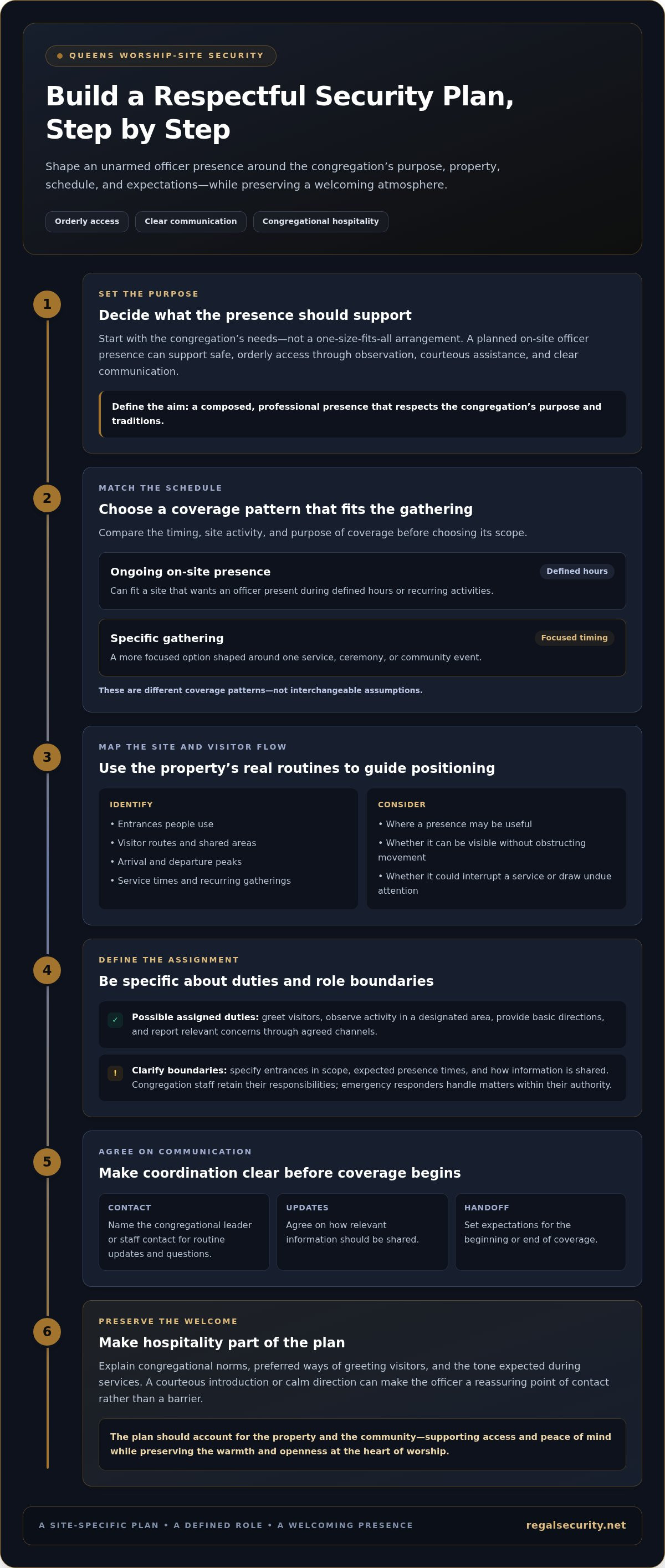
Respectful, unarmed worship-site security is a planned on-site officer presence that supports safe, orderly access through observation, courteous assistance, and clear communication, while preserving the congregation’s welcoming character. This definition keeps both responsibilities in view: a composed presence and a hospitable environment.
What does a security officer contribute at a house of worship?
An officer can provide a visible, professional point of contact, observe activity within the assigned area, assist visitors with basic directions, and communicate relevant concerns through agreed channels. Before coverage begins, site leadership should define the officer’s assignment, position, and reporting contact. For example, leaders can identify the entrance where arrivals typically gather and name the person who should receive routine updates. Clear boundaries align the role with the congregation’s needs without implying that an officer can prevent every incident or exercise law-enforcement authority.
Coverage may be planned as an ongoing on-site presence or around a specific gathering. Ongoing coverage can fit a site that wants an officer present during defined hours or recurring activities. Support for one service, ceremony, or community event is a more focused option shaped around that gathering’s timing and visitor flow. These are different coverage patterns, not interchangeable assumptions. Compare the schedule, site activity, and purpose of coverage before choosing a scope.
How can a security presence remain welcoming?
Hospitality should be part of the plan from the outset. Leaders can explain congregational norms, preferred ways of greeting visitors, and the tone expected during services. A courteous introduction or calm direction can help an officer serve as a reassuring point of contact rather than a barrier. Respectful conduct matters especially as congregants and visitors arrive, gather, and leave.
Positioning also matters. A presence near an entrance may support orderly arrivals, while other site routines may call for a different location. Consider whether the officer can be visible without obstructing movement, drawing undue attention, or interrupting a service. Review service schedules, entrances, and visitor flows with site leadership, then communicate expectations before coverage starts. This gives security for houses of worship Queens congregations a practical foundation that accounts for both the property and the community’s hospitality.
How to Evaluate Unarmed Security for a Queens House of Worship
Before discussing staffing arrangements, decide what the coverage is meant to support. A clear purpose helps congregational leaders describe the needs of their property and schedule, then consider a suitable unarmed officer presence. For security for houses of worship Queens locations, planning should account for the site’s layout and routines rather than rely on a one-size-fits-all outline.
Use this checklist to prepare:
Scope: Identify the purpose of coverage, such as greeting visitors, observing activity in an assigned area, or providing directions.
Schedule: Note the days and hours coverage is needed, including services, recurring gatherings, and any changes to the calendar.
Site needs: Identify relevant entrances, visitor routes, shared areas, and places where an officer’s presence may be useful.
Communication: Name the congregational leader or staff contact for routine updates and questions, and agree on how those updates should be shared.
Expectations: Describe the desired manner of interaction, reporting process, and any handoff at the beginning or end of coverage.
Which duties and coverage expectations should leaders define?
Be specific about the assigned duties. A congregation might want an officer to greet visitors, observe activity near a designated entrance, direct guests, or report relevant concerns to a named contact. Clarify which entrances are in scope, when the officer is expected to be present, and how information should be shared. If leaders expect arrivals to be especially busy before a service, include that timing in the coverage discussion.
Just as important, define the boundaries of the role. Congregation staff retain their own responsibilities, while emergency responders handle matters within their authority. Clear distinctions help everyone understand whom to contact and what the officer is expected to do within the agreed assignment.
What should a service conversation cover?
Bring practical details to the discussion: the property layout, service calendar, attendance patterns, and recurring gatherings. A Queens site with several entrances or a varied schedule may need a different plan from a location with one primary entrance and a consistent routine. Explain any hospitality standards that should shape the officer’s interactions and positioning. It can also help to identify who will share schedule changes and who should receive routine updates.
Regal Security tailors unarmed security services to client needs. A service conversation can translate your priorities into a proposed scope that describes the intended officer presence and communication with designated congregational leadership. For further context on the role, read Regal Security’s guide to professional unarmed security officers. Learn more about unarmed coverage from Regal Security.
Match Queens Worship-Site Security to the Property, Schedule, and Gathering
The right coverage conversation starts with how a property is used, not with an assumed staffing pattern. Shared spaces, several points of entry, arrival peaks, and a congregation’s calendar can all shape the proposed scope. Site activity and schedule should guide the coverage conversation, so the presence considered fits the property’s routines and the gathering it is meant to support.
Use these patterns as planning options, not fixed packages or a signal that every congregation needs ongoing coverage:
When might a congregation discuss routine on-site coverage?
A recurring schedule may make a routine presence worth discussing, particularly if the property has consistent visitor flow or shared spaces used throughout the day. Leaders can map the entrances people use, note which areas are active at different times, and identify staff who should coordinate with the officer. Routine coverage can be scoped to defined periods. It does not automatically mean continuous or round-the-clock coverage.
How should services, holidays, and special gatherings affect planning?
Ordinary service days may have familiar arrival and departure rhythms, while holidays or special programming can bring different attendance patterns and visitor needs. Consider where people approach the property, how parking and entrances affect movement, and who will communicate schedule changes. For example, organizers can identify the period when arrivals are busiest and confirm which entrance visitors should use. These details help shape an orderly, considerate presence without disrupting the gathering.
Where visitor assistance is an important part of the experience, professional concierge security offers useful context on the relationship between service and security. A tailored discussion of security for houses of worship Queens congregations can reflect the property’s access points, shared spaces, and calendar, rather than treating every service or event alike. Explore tailored security coverage with Regal Security.
Plan a Security Arrangement That Protects Congregational Trust
A respectful arrangement depends on more than an officer’s presence. Congregational leaders and the security provider need a shared understanding of the site’s routines, the officer’s assigned responsibilities, and how communication will work. A deliberate planning process helps preserve trust because expectations are clear before coverage begins and can be revisited as the congregation’s needs change.
Use this sequence to prepare:
Step 1: Agree on priorities. Identify what the congregation wants the arrangement to support, such as orderly arrivals, visitor assistance, or a consistent on-site presence during defined activities.
Step 2: Document relevant routines. Gather service schedules, recurring gatherings, access information, and the roles of staff or volunteers who coordinate site activity.
Step 3: Set expectations. Describe how the officer should greet visitors, respond to routine questions, and communicate observations to designated leadership. Clarify role boundaries, too.
Step 4: Develop a tailored scope. Bring the priorities and site information into a discussion about the proposed unarmed officer presence, schedule, and communication approach.
Step 5: Review and adjust. Set a check-in to consider whether the scope, communication, and schedule still reflect how the property is used.
What information should leaders prepare before planning coverage?
Useful preparation includes the service calendar, recurring gatherings, access details, and key contact roles. Leaders should also outline expectations for greeting visitors, handling routine questions, and sharing relevant concerns. Keep sensitive site details in appropriate, secure communications rather than public materials or unsecured channels. The aim is to provide enough context for planning without exposing information unnecessarily.
How can leaders review whether the arrangement is working?
Schedule a regular check-in with the designated staff contacts to review communication, agreed coverage, and upcoming calendar changes. Feedback can focus on whether expectations are understood and the officer’s presence aligns with the congregation’s hospitality standards. Respect congregants’ privacy by gathering relevant observations without collecting unnecessary personal details. If property use, access patterns, or community needs shift, update the scope and expectations accordingly.
Clear direction and consistent communication help make security for houses of worship Queens congregations plan feel considered rather than intrusive. Regal Security provides unarmed security services tailored to client needs, with the scope shaped around the site, schedule, and community expectations. Learn about tailored coverage for your Queens location.
Regal Security for Houses of Worship in Queens: Discuss a Tailored Unarmed Presence
Regal Security provides unarmed security officers and tailored security services for Queens locations. For a house of worship, planning starts with the congregation’s priorities: the site’s layout, the schedule of services and gatherings, and the kind of presence that supports its hospitality standards. Those details provide a practical foundation for considering coverage that reflects how the property is used.
What can a tailored Regal Security discussion address?
Leaders can describe the presence they have in mind, the schedule it should support, and the responsibilities they want included in the proposed scope. The conversation can also establish how an officer should communicate with designated site leadership and how the congregation’s expectations for visitor interaction should inform the assignment.
These details help set clear expectations for both the congregation and the officer. The scope and responsibilities should be established for each client location rather than assumed to be the same across different sites. A defined plan gives the unarmed officer presence a clear purpose while allowing the congregation’s routines and standards to remain central.
How can Queens congregational leaders take the next step?
Before a discussion, it may help to gather a few practical details:
The site’s general layout and the entrances relevant to the proposed coverage
Service times, recurring gatherings, and any schedule variations leaders want to discuss
The congregation’s priorities for officer presence and visitor interaction
The designated leadership contacts and preferred communication process
Sharing this context helps make a discussion about tailored unarmed coverage for your Queens location more focused. For additional perspective on thoughtful security planning, explore Regal Security’s guide to peace of mind security planning.
For congregations considering security for houses of worship Queens, a useful next step is a conversation grounded in the specific property, schedule, and community expectations. Discuss tailored unarmed coverage with Regal Security.
Plan a Welcoming, Well-Considered Security Presence
A thoughtful security plan begins with your congregation’s needs, not a preset staffing arrangement. Consider how the property is used, when people gather, and what kind of officer presence fits your community’s hospitality standards. Clear expectations for responsibilities and communication help site leadership and officers work from a shared understanding.
For security for houses of worship Queens congregations can tailor to their location, Regal Security provides unarmed security officers as its primary service and serves Queens. Coverage can be shaped around client needs, including the site, schedule, and expectations for a composed presence. Regal Security serves communities across New York City and New Jersey, including Manhattan, Brooklyn, Queens, the Bronx, Staten Island, Long Island, Nassau County, Suffolk County, Westchester County, Rockland County, and Orange County.
When you’re ready to discuss an approach for your location, discuss tailored unarmed security for your Queens house of worship with Regal Security. A clear conversation is a constructive first step toward a plan that supports your community with care and confidence.
Frequently Asked Questions
Is unarmed security appropriate for a house of worship in Queens?
Unarmed security can be appropriate when a congregation wants a composed, visible presence to support orderly access and visitor assistance. The right approach to security for houses of worship Queens sites depends on the property, schedule, community expectations, and purpose of coverage. Leaders should define the officer’s assigned responsibilities and communication process in advance. An officer’s presence can support a broader plan, but it shouldn’t be treated as a guarantee against every incident.
What should a security officer do at a house of worship?
An officer’s duties should be agreed upon with site leadership before coverage begins. Depending on the assigned scope, responsibilities may include greeting visitors, observing activity in a designated area, offering basic directions, and communicating relevant concerns to a named contact. Leaders should also clarify coverage hours, entrances, and handoffs. Congregation staff retain their own duties, and emergency responders handle matters within their authority. Clear boundaries help everyone understand the officer’s role.
How can a congregation keep security welcoming and respectful?
Set hospitality expectations as part of the coverage plan. Explain preferred ways to greet visitors, answer routine questions, and communicate during services or gatherings. Consider where an officer can be visible without obstructing entrances or congregation movement. Calm, courteous interaction and awareness of congregational norms can help the officer serve as a reassuring point of contact. Site leadership can share feedback and clarify expectations so the presence remains consistent with the community’s character.
Can security coverage be planned around services and special events?
Yes. Coverage discussions can reflect the congregation’s calendar, including regular services, holidays, and individual gatherings. Leaders can describe when attendance patterns change, where people arrive and depart, and how entrances or parking approaches affect visitor flow. This context helps shape a proposed scope for defined activities and times. Event support and routine on-site coverage are different planning options, and the congregation can discuss which pattern best fits its site and priorities.
What information should we prepare when discussing worship-site security?
Prepare the service schedule, recurring gathering dates, general access details, and the roles of staff or leaders who will coordinate with the officer. Note the congregation’s expectations for greeting visitors, handling routine questions, and sharing relevant observations. It’s also useful to identify the intended purpose and schedule of coverage. Keep sensitive site information in appropriate, secure communications rather than public materials or unsecured channels.
How do we decide between routine on-site coverage and event coverage?
Consider whether the need relates to regular site activity or a specific gathering. A congregation with recurring services or a steady visitor flow may discuss routine coverage for defined periods. If additional planning is relevant only to a holiday, ceremony, or community event, focused event coverage may be a better fit. Compare the schedule, expected activity, access points, and communication needs, then discuss a scope tailored to those priorities.
Does Regal Security provide unarmed security officers in Queens?
Yes. Regal Security provides unarmed security officers in Queens and tailors security services to client needs. Congregational leaders can discuss the proposed on-site presence, schedule, assigned responsibilities, and communication with designated site leadership. Regal Security also serves locations across New York City, including Manhattan, Brooklyn, the Bronx, and Staten Island, as well as New Jersey, Long Island, Nassau County, Suffolk County, Westchester County, Rockland County, and Orange County.