Security Guard Turnover Solutions: A Guide for Employers
What if the most practical security guard turnover rate solutions begin with the design of the assignment, not another round of hiring? A dependable on-site presence takes more than filling a post. Officers also need clear expectations, workable schedules, and consistent support.
Frequent vacancies can disrupt continuity, increase recruitment and onboarding demands, and make it harder for officers to learn residents’ routines, employee needs, visitor procedures, and site protocols. Employers are right to look for ways to improve retention, but changes must also preserve coverage and service quality.
This guide explains how to identify workplace factors that may contribute to departures and compare retention strategies by likely impact, feasibility, and operational fit. It also shows how assignment design, officer support, and client expectations can work together at sites across New York and New Jersey.
Table of Contents
Why security guard turnover disrupts coverage and client confidence
Diagnose the reasons security officers leave before choosing a solution
Compare security guard turnover solutions by effort, fit, and operational impact
Build a measurable security officer retention plan in practical stages
How Regal Security supports a more consistent on-site security presence
Why security guard turnover disrupts coverage and client confidence
A security post is more than a place on a roster. The officer assigned to it learns how the property operates, who regularly enters, which procedures matter, and how to communicate with people on site. When that officer leaves, a replacement needs time and guidance to build the same familiarity. Frequent changes can affect service consistency even when every shift is staffed.
Security guard turnover rate solutions are most useful when employers first understand what turnover measures and what it does not. A rising figure deserves attention, but it is a workforce signal to investigate, not proof of a specific management failure.
How turnover affects security operations at a site
Turnover is the share of a workforce that separates from an organization during a defined period. Operationally, it indicates how often staffing continuity needs to be restored. A departure is different from a temporary vacancy, such as an unfilled post while a replacement is arranged, or from routine schedule changes that leave the assigned team intact.
Repeated officer changes can interrupt site knowledge and handoffs. A new officer may not yet recognize regular visitors, understand property-specific procedures, or know which details to pass between shifts. At a residential or corporate property, this can make interactions feel less consistent and prompt clients to question whether expectations are being followed. General background on the role and responsibilities of a security guard can help explain why familiarity matters. Site-specific instructions determine how that role is carried out.
Vacancies also create practical work. Supervisors may need to rearrange coverage, brief replacement staff, follow up on instructions, and monitor a post more closely. Recruitment, selection, onboarding, and site orientation take time, too. These direct demands can create indirect burdens when experienced staff take on additional handoffs or managers have less capacity for other priorities. The effect depends on the assignment and how departures are handled.
What a turnover rate can, and cannot, tell you
For a meaningful comparison, keep the measurement period and definition consistent. One common approach divides the number of separations during a period by the average workforce for that same period, then expresses the result as a percentage. State which separations are included and apply the same rule each time. Otherwise, a change in calculation can look like a change in retention.
Organization-wide results can conceal differences among accounts. A stable overall figure may coexist with repeated departures at one post, while a change at a single location may have little effect on the company-wide result. Compare like with like: use the same period, role or account scope, and separation criteria. Protect employee privacy when reviewing records. The rate cannot explain why someone left, whether a vacancy affected coverage, or whether a schedule change caused a departure. Treat it as a prompt to examine patterns alongside site conditions and feedback, not as a verdict or a universal score to meet.
Diagnose the reasons security officers leave before choosing a solution
A retention measure is useful only when it leads to careful inquiry. A departure may reflect an individual circumstance, a difficult assignment, or a recurring workplace condition. Treat each explanation as evidence to assess, not a conclusion to impose. This helps employers focus on changes that fit the actual post instead of applying the same remedy everywhere.
Which workforce signals deserve a closer review?
Review vacancy duration, early departures, attendance patterns, and staffing continuity at each post. Compare departure timing and location, then look for patterns alongside assignment records. Timing can suggest a question to investigate, but it does not establish why someone left. Keep definitions consistent, limit access to personnel information, and record documented reasons separately from management interpretations.
Consistent measurement makes workforce patterns easier to compare and less likely to be mistaken for causes. The security guard workforce report from the University of California, Berkeley Labor Center provides broader context on job quality and workforce conditions. Local, post-level evidence is still needed to guide a specific response.
How to gather candid feedback without assigning blame
Use the same respectful questions in exit conversations and periodic check-ins, and explain how responses will inform workplace review. Invite officers to describe assignment clarity, schedule changes, supervisor access, and whether training prepared them for the post. Summarize recurring themes without naming individuals or exposing confidential details. A consistent process makes feedback more useful and helps employees speak plainly.
Identify patterns. Compare vacancies, early departures, attendance, and continuity by location and assignment. Use a consistent review period and separation definition. Distinguish recorded reasons from assumptions based on when a person left.
Speak with current officers. Ask what supports or complicates their work. Specific prompts about shift predictability, communication, and access to a supervisor can reveal issues that general questions may miss.
Examine assignment conditions. Test possible contributing factors rather than treating them as established causes. Review schedule predictability, commute expectations, workload, supervision, training, and communication. For example, repeated last-minute changes may warrant a closer look at how schedules are shared and managed.
Prioritize causes. Separate recurring, actionable themes from isolated circumstances. Consider which issue affects the most posts, what evidence supports it, and which adjustment can be evaluated without compromising coverage.
For operations across New York and New Jersey, review current local employment and security licensing requirements before adopting policy recommendations or changing qualification practices. Requirements can shape what an employer may implement, so rely on current rules rather than assumptions or outdated guidance.
For property teams reviewing how post expectations and staffing fit together, Regal Security provides tailored unarmed security staffing as part of a broader approach to a dependable on-site presence.
Compare security guard turnover solutions by effort, fit, and operational impact
Retention measures work best when they address a diagnosed concern and fit the realities of the post. A schedule adjustment may be straightforward at one property but difficult where coverage requirements vary. Added onboarding may support readiness, but takes time to organize. Before deciding what to test, compare likely benefit, effort, ownership, and a practical monitoring signal. Treat these security guard turnover rate solutions as operational choices, not guaranteed ways to improve retention.
Which retention measures can be addressed at the site level?
Start with the conditions officers encounter each shift. Clear post orders should explain core responsibilities, reporting lines, and procedures in language that reflects the actual assignment. Realistic expectations help prevent confusion about workload or the nature of the post. Consistent shift communication and accessible supervisory support can reinforce those instructions as conditions change. Choose measures that reflect site needs, officer feedback, and applicable requirements rather than copying a plan without review.
Staffing structure also affects continuity. A defined approach to roles, coverage, and communication connects the officer’s work to the client’s expectations. Regal Security’s guide to security staffing services provides related context on organizing professional protection around operational needs.
When should an employer review its staffing arrangement?
Consider a review when repeated vacancies coincide with recurring handoff problems, unclear responsibilities, or operating expectations that no longer match the assignment. Check whether the existing plan establishes who covers each post, how concerns are escalated, and how updates reach the people who need them. A staffing arrangement should support reliable coverage and an orderly client experience, with roles defined rather than left to informal assumptions.
For context on the role and expectations of personnel at a post, see Regal Security’s overview of professional unarmed security officers. Reviewing that role alongside site requirements can help employers assess whether the current structure supports consistent service.
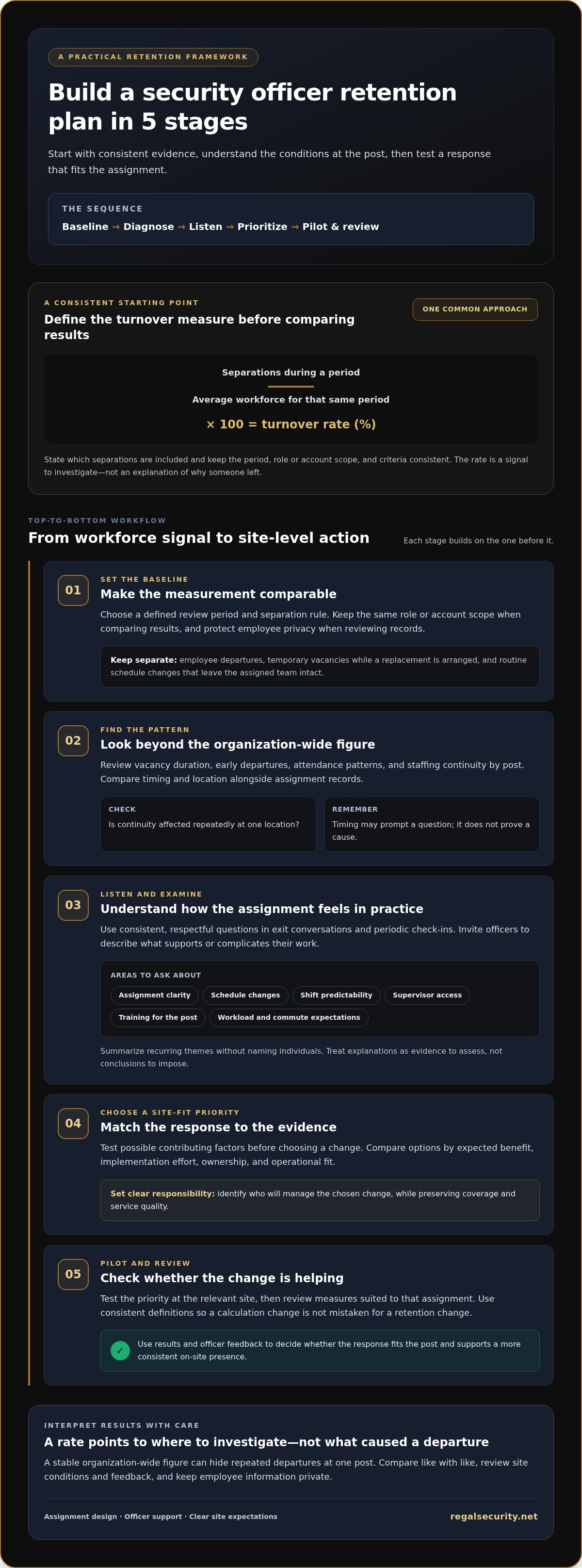
Build a measurable security officer retention plan in practical stages
A retention plan turns observations into a disciplined process: define what to measure, choose a focused change, and review whether the intended signal moves. For security guard turnover rate solutions to be useful, employers need comparable records and a clear way to learn from results without treating a single change as proof of cause.
Establish a baseline. Define the workforce or site being reviewed, the reporting period, and which departures count. Record current vacancy duration, schedule stability, and post continuity where those measures fit the assignment.
Select a priority. Choose one actionable concern supported by records or officer feedback, rather than attempting to change several workplace conditions at once.
Assign ownership. Name the manager responsible for carrying out the change, maintaining records, and bringing findings to review.
Pilot the change. Where operationally appropriate, test it at one site or assignment and record the expected signal and review date.
Review and adjust. Compare results with the baseline, consider relevant changes in conditions, and decide whether to continue, revise, or stop the measure.
Set a baseline and choose a limited number of measures
Choose indicators that can be collected consistently and interpreted together. For example, a site might track how long posts remain vacant, how often scheduled shifts change, and whether the same post is staffed consistently. Define each measure before reviewing results, and compare equivalent roles over equivalent periods. Note changes in assignment scope or operating conditions that could affect interpretation. Restrict employee data to appropriate, authorized personnel, and use summaries for broader review when individual details are not needed.
Pilot changes and review them with officers and clients
A pilot should be clear enough to evaluate. Record the practice being tested, why it was selected, the signal expected to change, the accountable manager, and the planned review date. For instance, if the test concerns shift communication, monitor whether handoff information is consistently shared and ask officers and relevant client contacts whether the process is workable. Feedback may show that the practice needs refinement. A single data point cannot establish that the change caused a workforce result, so interpret it alongside records and ongoing feedback.
Apply the plan responsibly in New York and New Jersey
Before changing employment practices, schedules, or recordkeeping, review current state and local requirements with qualified counsel or official agency guidance. Keep documentation consistent and handle employee information with care. A result from one New York or New Jersey location may reflect its particular assignment, workforce, or operating conditions. Use it to inform, not dictate, decisions at another site.
A retention plan needs both a named owner and a regular review cadence. For a tailored discussion of on-site officer staffing and continuity, connect with Regal Security.
How Regal Security supports a more consistent on-site security presence
Retention planning is strongest when it connects staffing decisions with the experience a property needs each day. Regal Security provides tailored security services for corporate and residential clients in New York and New Jersey. Clear expectations help officers understand the assignment, while consistent communication helps keep the client and security team aligned.
Connect staffing expectations to the site’s daily needs
A practical staffing plan begins with the property’s priorities. A corporate location may need a professional, consistent presence at key points of entry. A residential property may place particular importance on courteous interactions with residents and visitors. In either setting, defining post expectations and communication responsibilities gives officers a clearer understanding of the work and helps clients know how site needs are being addressed.
Regal Security’s service principles are integrity, precision, and professional presence. These principles inform a tailored approach to unarmed security officers and concierge security, with the service structure suited to the client’s setting and expectations. Clear site guidance can support officer readiness and a reliable on-site presence, but it is part of sound operations, not a promise of a particular retention result.
Outline the responsibilities and expectations associated with each post.
Identify how site updates and concerns should be communicated.
Describe what a dependable, professional presence should look like for the property.
Share continuity concerns, such as recurring handoff difficulties or a need for greater familiarity with site procedures.
These details give the staffing discussion a practical foundation. They help distinguish essential site needs from preferences, so the approach can reflect the property’s operating priorities without relying on assumptions about why individual officers stay or leave.
Take the next step toward a steadier security operation
Before discussing a new or adjusted arrangement, decision-makers can gather information that describes the assignment: coverage needs, site priorities, post expectations, communication routines, and continuity concerns. That preparation makes it easier to consider whether unarmed security officers or concierge security is the right approach for the property.
Regal Security serves corporate and residential clients across New York City, New Jersey, Long Island, and nearby counties. If your organization is reviewing its on-site security presence, discuss your staffing needs and continuity priorities with Regal Security. A clear conversation about the site’s daily requirements is a measured first step toward an approach built around professional service and dependable presence.
Make workforce stability part of your next staffing decision
Workforce stability is not a one-time project. It grows through steady attention to how an assignment is structured, how expectations are communicated, and whether the approach continues to fit the property. Keep that review active as site needs change, and use feedback from officers and clients to guide adjustments. The aim is not simply a lower turnover figure; it is a reliable presence that feels informed, consistent, and well suited to the people the site serves.
This perspective helps employers put security guard turnover rate solutions into practice without relying on a one-size-fits-all remedy. Regal Security works with corporate, residential, and executive clients across New York and New Jersey, providing unarmed security officers and concierge security tailored to client needs.
As you consider your next step, identify the coverage priorities and continuity concerns that matter most at your property. Discuss a tailored security staffing approach with Regal Security and take a considered step toward a more dependable on-site operation.
Frequently Asked Questions
Can better scheduling help reduce security guard turnover?
Yes. More predictable scheduling can make an assignment easier to plan around, though it will not address every reason an officer may leave. Managers can publish rosters consistently, clarify how shift changes are communicated, and avoid relying on the same officers to absorb repeated coverage changes. Review whether disruptions cluster around particular posts or shifts, then discuss practical adjustments with affected officers before changing the coverage plan.
Does increasing security guard pay always improve retention?
No. Higher pay does not guarantee improved retention, and compensation is only one factor officers may weigh. A review can compare the role’s responsibilities and expectations with the employer’s compensation approach, while also considering supervision, training, scheduling, and working conditions. If officers cite pay in feedback, take that concern seriously and assess it alongside other evidence. A pay change should have a clear rationale and should not substitute for addressing avoidable problems elsewhere in the assignment.
How can a security company help a client maintain continuity when an officer leaves?
A security company can support continuity by providing clear site expectations and relevant information about the assignment to incoming personnel. A focused handover can cover access procedures, key contacts, visitor expectations, and unresolved operational matters. For a property in Manhattan, Queens, New Jersey, or elsewhere in the service area, clients can also identify which routines must remain consistent during a personnel change. The transition should reflect the assignment and staffing arrangement.
What should a security officer’s onboarding include at a new site?
Onboarding should prepare an officer to carry out the assignment, not simply introduce the property. Provide current post instructions, explain site-specific access and visitor procedures, identify the appropriate contacts, and clarify how to report concerns. A guided walkthrough can connect written instructions to the physical setting. Where practical, a new officer can also receive a structured handoff from someone familiar with the post, followed by an opportunity to ask questions before working independently.
Can employee recognition improve security guard retention?
Thoughtful recognition may support morale and help officers feel that their work is noticed, but it cannot guarantee they will stay. Keep recognition specific, timely, and fair. For instance, a supervisor might acknowledge an officer’s careful communication during a busy shift rather than offer generic praise without context. Recognition should complement sound supervision and workable assignment conditions, not replace them. Employers can ask officers which forms of acknowledgment feel respectful and appropriate to the workplace.
How often should employers review security guard turnover data?
Review operational indicators on a regular, predetermined schedule, such as monthly for emerging staffing concerns and quarterly for broader patterns. The right cadence depends on workforce size and the amount of reliable information available. Avoid drawing conclusions from a single departure or a short period with few staffing changes. If a sudden cluster of vacancies affects coverage, review it promptly, then return to the established schedule so comparisons remain meaningful.
Do New York and New Jersey security employers follow the same employment requirements?
Employers should not assume that requirements are identical across New York and New Jersey. Review current employment and security licensing rules with the appropriate official agencies or qualified counsel before setting policies or assigning personnel. This applies to operations in New York City, Manhattan, Brooklyn, Queens, the Bronx, Staten Island, Long Island, Nassau County, Suffolk County, Westchester County, Rockland County, and Orange County, as well as New Jersey. Review requirements for each jurisdiction where work is performed.