Security to Prevent Vandalism at a Construction Site in Queens
What kind of on-site presence can help deter vandalism at a Queens construction site? The question behind “security to prevent vandalism at construction site Queens” is practical: how can you protect a changing worksite with coverage that fits its needs?
Damage, trespassing, and disruption can affect a project whether crews are working or the site is unattended. A visible, professional unarmed officer can support deterrence and provide a consistent presence. Vehicle patrol can complement that coverage when the site’s layout and operating pattern call for it. No arrangement can guarantee vandalism will not occur, but coverage planned around the property, activity, and schedule can address specific concerns.
This article explains how to assess site-specific risks, compare security coverage, and plan a dependable presence as worksite conditions change. You’ll learn which details shape the approach, from the site layout and access points to work hours and periods of lower activity. With a clearer picture of the project, you can identify a practical next step for arranging professional security in Queens.
Table of Contents
Why construction-site vandalism prevention in Queens starts with a site assessment
How unarmed officers and patrols can support construction-site deterrence
How to compare construction-site security coverage in Queens
A practical checklist for planning construction-site security in Queens
Plan construction-site vandalism deterrence with Regal Security in Queens
Why construction-site vandalism prevention in Queens starts with a site assessment
Exposed materials, shifting work phases, and stretches when crews are away can all raise practical security concerns. A site that is easy to observe during active work may look different when equipment is repositioned, temporary boundaries move, or a section becomes unattended. Planning security to prevent vandalism at construction site Queens should start with the conditions at that property, not with a standard coverage pattern.
Vandalism can take different forms. Understanding Vandalism can help clarify the range of conduct a site manager may be concerned about. A security presence can help discourage opportunities for interference and support observation, but no plan can guarantee that vandalism will not occur. The aim is to reduce exposure to risk and establish a considered presence, not to promise a crime-free site.
Which construction-site conditions should a Queens security assessment consider?
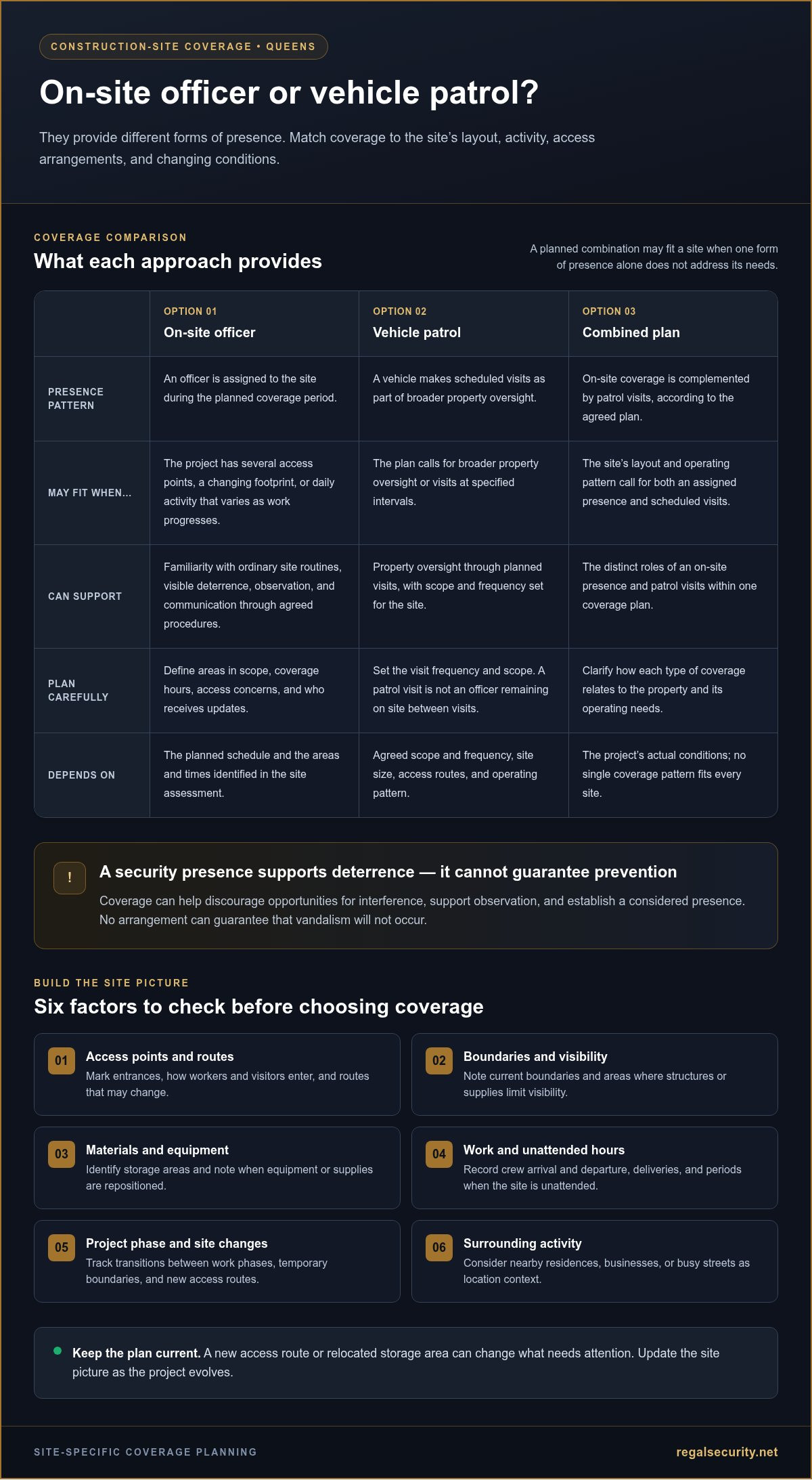
Begin with a practical site map. Mark permanent and temporary entrances, the current boundary, material and equipment storage areas, and places where structures, stacked supplies, or site changes limit visibility. Note how workers and authorized visitors enter, and whether access routes shift as the project advances. These details help identify where observation may be most valuable.
Next, record when activity changes: crew arrival and departure, periods when the site is unattended, deliveries, and transitions between work phases. Consider the immediate surroundings, too. A site beside residences, active businesses, or a busy street may have different patterns of movement and visibility. Nearby uses are context, not proof of risk. Assess conditions at the individual location rather than inferring risk from a neighborhood label.
A site-specific assessment turns security from a generic presence into a plan shaped by the property’s access, activity, and changing conditions.
What can a professional security presence realistically do?
A visible, professional unarmed officer can deter opportunistic interference by making the site’s security presence apparent. The value of that presence depends on how it relates to the site. Positioning and coverage hours should reflect the areas and times identified in the assessment, rather than assume every entrance or work phase presents the same concern.
A planned presence can also support observation and communication. Officers can remain attentive to assigned areas, communicate concerns through the agreed process, and document incidents according to the site’s procedures. These steps help managers keep a clearer account of what was observed and when, without implying that every incident can be prevented or intercepted.
Map: entrances, boundaries, storage areas, and visibility limitations.
Record: active and unattended periods, work-phase changes, and surrounding activity.
Align: the intended security presence with the conditions identified on site.
As the project evolves, update the assessment. A new access route or relocated storage area can change what needs attention, so a current site picture is a useful foundation for dependable coverage planning.
How unarmed officers and patrols can support construction-site deterrence
Professional unarmed construction-site security provides a visible presence focused on observation and deterrence. An officer remains attentive to assigned areas, recognizes activity that may need attention, and communicates concerns through the procedures established for the site. To support security to prevent vandalism at construction site Queens, that presence should fit the project’s access arrangements and operating needs rather than rely on a uniform formula.
On-site coverage and vehicle patrol provide different forms of presence. An officer assigned to the site can be there during the planned coverage period, while a vehicle patrol makes scheduled visits as part of a broader property oversight plan. Neither approach is automatically sufficient for every project. Compare each with the site’s layout, activity, and identified concerns.
When can an on-site officer be the more suitable option?
An on-site officer may suit a project with several access points, a changing footprint, or daily activity that varies as work progresses. A consistent presence during the agreed coverage period can help an officer become familiar with ordinary site routines, such as authorized arrivals and changes to work areas. That familiarity can make unusual activity easier to recognize. The project plan should still define the actual coverage schedule.
Site managers can make the role clearer by setting responsibilities in advance: which areas are in scope, how access concerns should be communicated, and who should receive updates. This creates a shared understanding without assuming an officer can monitor every part of a complex site at once.
When might vehicle patrol complement site coverage?
Vehicle patrol can complement on-site coverage when a plan calls for broader oversight of the property or visits at specified intervals. Its value depends on the agreed scope and frequency, as well as the site’s size, access routes, and operating pattern. A patrol visit is not the same as an officer remaining on site between visits, so make that distinction clear when planning coverage. Regal Security provides vehicle patrol security services as part of tailored security approaches.
Deterrence can reduce opportunities and strengthen observation, but it cannot promise that every incident will be prevented. Clear communication helps ensure an observation becomes useful information rather than an isolated note. Before coverage begins, site management and security personnel can agree on how routine updates are shared, who receives urgent notifications, and how incidents are documented. The process should identify the appropriate management contact and a practical escalation path, without assuming a particular response time.
On-site officer: a visible presence during the established coverage period.
Vehicle patrol: scheduled visits that can extend oversight across the property.
Combined approach: both options, arranged around project requirements.
These distinctions help project managers turn site concerns into a defined coverage plan. For information about unarmed officers and vehicle patrol in Queens, visit Regal Security.
How to compare construction-site security coverage in Queens
Once a project’s needs are defined, compare each coverage approach with the worksite’s actual operating rhythm. A plan should make clear what presence is intended, which areas it addresses, and how security personnel communicate observations. “Security to prevent vandalism at construction site Queens” describes a goal, not a guaranteed result. The practical task is to select coverage that corresponds to the site’s exposure and changing conditions.
Coverage approach | Purpose | Type of presence
On-site officer | Visible presence and observation within assigned areas | Present during the schedule set by the project plan
Vehicle patrol | Periodic oversight along an agreed route or scope | Scheduled visits, rather than continuous presence at the site
Combined coverage | Brings on-site presence and patrol into one plan | Both forms, arranged around project requirements
This comparison is a starting point, not a ranking. A compact site with one primary access route may call for a different approach than a larger footprint with multiple entrances and active deliveries. Coverage should reflect the intended hours, the areas requiring attention, and the current project phase. Do not assume any one option addresses every site condition by itself.
What should a Queens project security plan specify?
A useful plan identifies the included areas and access points, states the intended schedule in relation to site operations, and names the project contacts who will receive updates. It should also describe how observations and incidents are communicated and documented. These details make the scope clear to site management and security personnel, and help prevent uncertainty about where coverage applies or how concerns are raised.
Define the communication path before coverage begins. For example, identify the designated contact for routine observations and the escalation route for an incident. Clarify what information is recorded and how it reaches project management. Procedures should fit the project rather than be assumed to be identical across sites.
How do you assess whether coverage fits the project?
Test the proposed scope against the site’s footprint, access points, operating hours, and exposure. Then consider how conditions shift during deliveries, shutdowns, or phase transitions. A layout change may alter sightlines or access, while a delivery period may bring different movement through the site. Professional unarmed security officers provide a visible presence shaped around project requirements.
Check the scope: Are the relevant areas and access points identified?
Check the schedule: Does planned coverage correspond to site activity?
Check communication: Are contacts and reporting procedures clear?
Revisit the plan: Will it be reviewed as the worksite changes?
A clear comparison shows whether the proposed coverage matches the project, without reducing the decision to a single service type or an unsupported price comparison. Regal Security tailors unarmed officer and vehicle patrol coverage to project requirements in Queens.
A practical checklist for planning construction-site security in Queens
A sound coverage plan starts with useful information and connects it to clear responsibilities. This checklist can help project managers prepare for a focused discussion about security to prevent vandalism at construction site Queens. Keep the notes current, since a change in access, work hours, or project phase may affect security needs.
What information should project managers gather before arranging coverage?
Prepare a current layout and a concise record of how the project operates. The goal is to give everyone planning coverage a shared, accurate picture of the worksite and its priorities.
Define the concerns. Note the issues that matter most, such as unwanted access, interference with materials, or disruption during inactive periods. Distinguish observed concerns from general assumptions.
Document the layout. Mark current site boundaries, entrances, material storage areas, and places where construction or stored items affect visibility. Identify temporary routes or access changes as well.
Summarize operations. Record work hours, inactive periods, expected deliveries, and planned phase changes. A delivery pattern or shift in work areas may alter how the site is used.
Name the contacts. Identify project leadership and the designated contacts for routine updates and incident escalation. Clarify who can receive information and make decisions about site operations.
Verify applicable requirements. For legal or regulatory questions, check current guidance from the relevant New York City and New York State sources. Don’t rely on an informal summary when a project-specific requirement needs to be established.
How should site management review a coverage plan?
Review the proposal against documented conditions, not just its general description. Check that the stated presence and scope correspond to the areas of concern, operating schedule, access arrangements, and project phase. If coverage is expected to change as work progresses, clarify how those changes will be incorporated into planning.
Communication matters as much as presence. Confirm that the plan describes how observations and incidents will be recorded, how information reaches designated project contacts, and what escalation path applies to urgent concerns. Expectations should be clear enough that managers and security personnel understand their respective roles.
Use this review to identify gaps before coverage begins. If a new entrance is planned, for example, make sure the site information and coverage scope reflect that change. As the project evolves, revisit the checklist rather than allowing the original plan to become outdated. Regal Security’s asset protection information offers additional context for considering protection needs.
For a discussion of coverage shaped around your Queens project’s layout and operating needs, review construction-site security with Regal Security.
Plan construction-site vandalism deterrence with Regal Security in Queens
A dependable security arrangement starts with a clear understanding of the project, not a preset package. Regal Security provides professional unarmed officers and vehicle patrol in Queens, with coverage tailored to a construction project’s requirements. The goal is a measured, visible presence that supports deterrence and observation while respecting the realities of the worksite. Security can help reduce opportunities for vandalism, but no plan can promise that every incident will be prevented.
For project decision-makers considering security to prevent vandalism at construction site Queens, the assessment and comparison above offer a useful starting point. Bring forward the details that shape the worksite: where coverage may be needed, when site activity changes, and how project leadership expects concerns to be communicated. That context turns a broad security concern into a practical service-planning conversation.
What a tailored security discussion should cover
Begin with the project’s Queens location, current layout, operating schedule, and principal security concerns. Describe access points, active work areas, material storage, and upcoming changes that may alter how the site is used. Then explain the intended coverage scope and how it should align with site operations, reporting expectations, and designated contacts. A project-focused discussion can address the conditions that matter instead of assuming one standard package fits every site.
It also helps to distinguish the coverage objective from the method. Project leadership may need a visible presence in a defined area during agreed hours, or may want vehicle patrol as a complement to other coverage. Clear priorities make it easier to discuss which approach suits the layout and operating rhythm.
How Regal Security supports a dependable site presence
Professional unarmed officers offer a visible, composed presence focused on observation and deterrence. Their role can be aligned with the project’s stated coverage scope and communication procedures. Where the plan calls for broader property oversight, vehicle patrol can complement on-site coverage. Regal Security approaches these options with integrity and precision, tailoring protection to client needs without presenting any arrangement as a guarantee against vandalism.
A well-planned presence brings greater clarity to a project’s security arrangements: who is responsible for communication, what areas fall within the agreed scope, and how the approach relates to current site operations. As construction advances, managers can revisit those details when work patterns or site conditions change. This helps keep the plan relevant without assuming one configuration will fit every phase.
Queens project decision-makers can take the next step by sharing their site’s layout, schedule, and priorities with Regal Security. Discuss construction-site security needs with Regal Security to plan an approach to unarmed officer presence and vehicle patrol.
Set a Clear Next Step for Your Queens Project
A construction site changes as work advances, so security planning should stay connected to current conditions. Use your site notes to frame the next conversation: identify the concerns that matter most, the type of presence you’re considering, and how the plan should fit the work schedule. This gives project decision-makers a practical foundation for discussing security to prevent vandalism at construction site Queens without treating any approach as a guarantee.
Regal Security serves Queens and surrounding New York areas with professional unarmed security officers and vehicle patrol services. These options can be tailored to project needs, with a focus on integrity, precision, and a dependable presence. A composed, well-defined plan can support confidence as the worksite evolves.
Discuss construction-site security for your Queens project and take a thoughtful next step toward coverage shaped around your site.
Frequently Asked Questions
Can unarmed security officers help prevent vandalism at a construction site?
Yes. Unarmed officers can support deterrence, though they can’t guarantee vandalism won’t occur. For example, an officer may notice an unfamiliar person lingering near a restricted entrance and relay that observation through the agreed communication process. Site managers can make the process useful by identifying who receives routine updates, who handles urgent concerns, and what information should be recorded, such as the location and time of an incident.
Is on-site security more effective than patrols for a Queens construction site?
Neither option is inherently more effective for every site. An on-site officer provides a presence at the location during the agreed coverage period, while vehicle patrol offers scheduled visits. At a site with several separated work areas, management may value a consistent presence in one area, broader patrol oversight, or a tailored combination. Let the project’s coverage objectives and operating conditions guide the decision, not a blanket preference for one method.
What should construction-site security cover after work hours?
After-hours coverage should reflect what changes once crews leave, rather than simply extend daytime arrangements. A project manager can identify which entrances remain in use, whether deliveries are expected, and whether materials or equipment have been moved. The plan should also clarify which contact receives a report if an issue arises. Define the intended hours and scope in writing so coverage matches the site’s actual inactive periods.
How do I assess vandalism risks at a construction site in Queens?
Start by distinguishing observed issues from general concerns. Record where an incident or attempted access occurred, what part of the site was affected, and whether the circumstances coincided with a delivery, layout change, or inactive period. Use those observations to guide security to prevent vandalism at construction site Queens, rather than assuming every Queens worksite has the same exposure. Revisit the notes as the project changes.
Can vehicle patrols replace an on-site security officer?
Not in every situation. A patrol visit and an on-site presence provide different forms of coverage. If a project relies on scheduled patrols, managers should consider what happens between visits and whether that arrangement addresses the site’s priorities. A smaller or simpler site may have different needs from one with separated areas or changing access routes. Set the coverage objective first, then assess which presence supports it.
What information should I prepare before arranging construction-site security?
Prepare a current site plan, the location, operating hours, expected deliveries, and a brief description of the concerns to address. Include the name and role of the project contact responsible for receiving updates. Regal Security serves New York City and New Jersey, including Manhattan, Brooklyn, Queens, the Bronx, Staten Island, Long Island, Nassau County, Suffolk County, Westchester County, Rockland County, and Orange County. Verify applicable legal requirements with current authorities.
Does construction-site security guarantee that vandalism will not happen?
No. Security can support deterrence and help site management receive relevant observations, but it can’t promise that every incident will be prevented. Set expectations by defining the purpose and limits of planned coverage, along with how concerns should be reported. A report can help managers understand where an issue arose and consider whether changed site conditions call for a plan review. A clear process supports informed decisions without implying certainty.