Tenant Safety Solutions: A Buying Guide for Managers
A visible security presence isn't automatically the right answer for every residential property. The most effective tenant safety solutions for property managers begin with the concerns at hand, whether they involve building access, common areas, or the need for a reassuring point of contact, and match support to residents’ daily experience.
That balance matters. Residents need to feel welcome, while managers need clear responsibilities and dependable procedures. A staffed post, mobile vehicle patrol, concierge service, or management-led process may each suit different needs, and some properties may benefit from a considered combination.
This guide offers a practical framework for choosing an approach across varied New York City and New Jersey properties. You’ll learn how to assess when unarmed on-site officers, concierge services, or vehicle patrol may fit, what duties and escalation procedures to clarify with a provider, and how to weigh safety needs alongside resident comfort and building operations. The goal is a composed, consistent presence that supports the property without making everyday life feel needlessly restrictive.
Table of Contents
What Tenant Safety Solutions Should Property Managers Evaluate First?
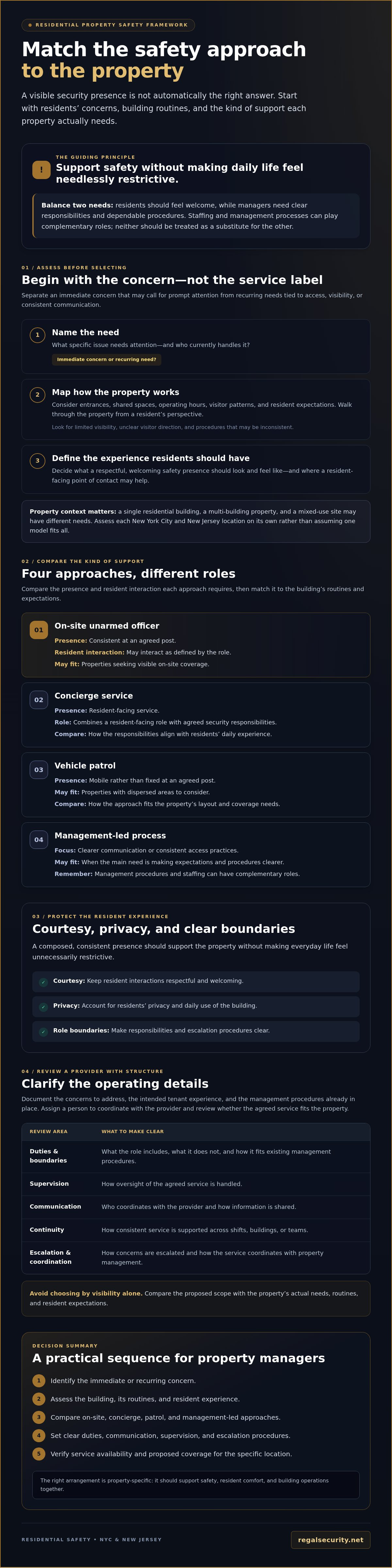
A property manager’s task is to protect residents while keeping the building welcoming and functional. Before comparing providers, separate an immediate concern that may call for a prompt response from recurring needs such as unclear visitor procedures, limited visibility in shared spaces, or inconsistent communication. The right approach depends on the nature of the concern, the property’s routines, and the experience residents should have each day.
Tenant safety solutions are the people, practices, and property-specific arrangements that help residential managers address safety concerns while supporting residents’ privacy and daily use of the building. Staffing and management processes play different, complementary roles: an unarmed officer may provide an on-site presence, while clear visitor procedures and staff communication help make expectations consistent. Neither should be treated as a substitute for the other.
Which property conditions shape tenant safety needs?
Start with the physical layout and how people use it. Consider the number and type of entrances, shared spaces, operating hours, visitor patterns, and resident expectations. A single residential building may need a different approach from a multi-building property or a mixed-use site with separate residential and commercial activity. In New York City and New Jersey, assess each location on its own rather than assuming one model will suit every property.
Walk the property from a resident’s perspective. Note where visibility is limited, where visitors need direction, and where existing procedures may be unclear. Principles of Crime Prevention Through Environmental Design (CPTED), including natural surveillance and access control, can help managers consider how the physical environment and daily operations contribute to safety.
Use this initial checklist to identify priorities:
Immediate concerns: What specific issue needs attention, and who currently handles it?
Access and movement: Where do residents, visitors, and service personnel enter and move through the property?
Visibility and presence: Which areas or routines may benefit from added attention or a resident-facing point of contact?
Consistency: Are procedures and communication clear across shifts, buildings, or teams?
Resident experience: What should a respectful, welcoming safety presence look and feel like here?
What should managers define before comparing providers?
Document the concerns to address, the intended tenant experience, and the management procedures already in place. Then assign a person to coordinate with any provider and review whether the agreed service fits the property’s needs. If considering personnel, clarify the proposed role and boundaries; this guide to professional unarmed security officers offers context for evaluating that option. With a defined scope, managers can compare support more fairly and avoid selecting a service based on visibility alone.
How Do On-Site Officers, Concierge Security, and Patrols Compare?
Each service model offers a different kind of presence and requires different coordination from management. An on-site officer may provide a consistent visible presence, while concierge services combine a resident-facing role with agreed security responsibilities. Vehicle patrol can be considered for properties with dispersed areas, and management-only procedures may be appropriate when the main need is clearer communication or consistent access practices. None replaces property management or prevents every incident.
Compare options against your building’s layout, operating needs, and resident expectations. NYC managers can also consult the city’s information on legal obligations for tenant safety as they determine their responsibilities.
When might a property manager consider on-site unarmed officers?
A consistent post may be worth evaluating when a property wants a visible presence in a particular area or regular coordination around agreed responsibilities. Define the post’s duties with the manager and confirm them with the provider, including how communication and escalation should work. For a closer look at personnel roles, read this guide to professional unarmed security officers.
When might concierge security or vehicle patrol fit better?
Concierge services may suit buildings where greeting and assisting residents are central to the desired experience, alongside clearly agreed security responsibilities. Learn more about the concierge security officer. For properties with multiple areas to consider, evaluate whether mobile coverage aligns with the site’s needs; this overview of vehicle patrol security services provides further context.
The right choice among tenant safety solutions for property managers depends on the specific site, not a universal formula. To compare the available options, explore Regal Security’s services and consider how they align with your property’s needs.
Will Security Services Make Residents Feel Less Welcome?
Not necessarily. A security presence doesn’t have to feel intimidating; its effect on residents often depends on how the service is designed and delivered. Visibility can offer reassurance and a clear point of contact, but it should be balanced with privacy, courtesy, and respect for residents’ routines. The goal is not to make a residential building feel restricted. It’s to establish a professional presence that fits the property.
Service conduct and clear responsibilities shape residents’ daily experience. A courteous greeting, a calm response to questions, and a clear understanding of the role can help make security feel like a considered part of building operations rather than an unfamiliar authority. Managers should explain the role to residents and coordinate with property staff so people know whom to contact for different concerns.
How can security support a respectful tenant experience?
Set expectations with the provider before service begins. Discuss how personnel should communicate with residents, what responsibilities they’ll perform, and how they’ll coordinate with management. Clarify role boundaries so security personnel and building staff don’t give conflicting directions or leave residents unsure who handles a request. Agree on communication and escalation procedures, including how concerns are relayed to the appropriate manager. These details help create consistency without assuming every resident will respond to a visible presence in the same way.
For a resident-facing assignment, ask how courtesy and privacy will be reflected in day-to-day conduct. If a tenant raises an issue outside the agreed role, personnel should understand how to direct or communicate it rather than making promises beyond their responsibilities.
How can managers assess trade-offs without overpromising?
Consider the practical commitments alongside the potential value of added visibility. On-site support may require staffing and coordination; a different service model may offer less direct interaction. Weigh these demands against the property’s operating needs and resident preferences, and be candid about what the selected service is intended to address. Don’t present a security presence as a guarantee of satisfaction or incident prevention.
Before finalizing an arrangement, establish how management and the provider will review service concerns, tenant feedback, and any proposed assignment changes. A review process gives managers a way to assess whether the approach remains suitable as building needs or resident expectations shift. Keep responsibilities and communication channels clear, and use feedback to guide a conversation with the provider rather than assuming one arrangement will suit every resident.
For broader context on planning protection around a property’s needs, see this guide to peace of mind security services. Thoughtful tenant safety solutions for property managers account for both the support a security presence may provide and the way that presence is experienced by residents.
How Should Property Managers Select a Tenant Safety Provider?
A sound selection process begins with the property’s actual needs, not a predetermined service model. For tenant safety solutions for property managers, the aim is to define responsibilities, compare suitable options, and establish how service will be reviewed, without expecting a provider to guarantee safety outcomes.
Define the need. Describe the concerns to address, the areas or routines involved, the tenant experience you want to support, and the procedures management already follows.
Compare service models. Consider whether on-site unarmed officers, concierge services, vehicle patrol, or management-led procedures best fit the property’s layout and operating needs. For multi-site portfolios, assess each location individually.
Assess provider fit. Ask how the provider learns the property’s priorities and turns them into a written service scope. Clarify proposed personnel duties, supervision, reporting, communication channels, continuity, and coordination with property staff.
Agree on review practices. Set a baseline using the service expectations you’ve agreed on, then establish how and when you’ll review consistency, documented feedback, and operational concerns.
What questions belong in a provider evaluation?
Ask who will coordinate the assignment, how updates or concerns will reach management, and how often the service will be reviewed. Confirm how proposed duties fit existing building procedures, including who handles resident questions or escalates an issue. For New York City and New Jersey properties, verify current service coverage and applicable local operating requirements directly with the provider. Licensing and other compliance details should also be checked for the relevant jurisdiction and service arrangement.
How can managers plan a useful service review?
Review the agreed scope against documented experience rather than unsupported promises. At established intervals, discuss whether responsibilities are being carried out consistently, whether communication is working, and whether tenant feedback or operational concerns suggest a change is needed. If a property’s needs shift, discuss any proposed assignment changes with the provider before treating them as part of the service.
For a portfolio, compare findings by location. A staffed entrance at one building and dispersed areas at another may call for different arrangements, even under the same management team. This keeps the review grounded in each property’s conditions instead of assuming identical coverage will fit every site.
If you’re ready to discuss your property’s needs and potential service fit, discuss property security needs with Regal Security.
How Can Regal Security Support Property Managers in New York and New Jersey?
Property needs vary from one building to another, so service planning should begin with the site, its residents, and the responsibilities management wants support with. Regal Security provides unarmed security officers, concierge services, and vehicle patrol for residential and other clients. Its service footprint includes New York City and New Jersey, with surrounding counties identified in its business information. Managers should confirm current availability and service fit for their specific property rather than assume every option is available at every location.
Which Regal Security services may suit residential properties?
For a defined on-site presence, managers can discuss whether unarmed security officers fit the property’s layout and operating needs, then clarify proposed duties, schedules, communication, and escalation procedures. Concierge services may be worth considering where resident-facing responsibilities are central to the desired experience. Vehicle patrol is a separate option to discuss when the property’s layout or coverage needs call for a mobile approach. Each service should have a clear scope, coordinated with existing management responsibilities.
These options give property managers a basis for discussing tenant safety solutions for property managers without presuming that one arrangement suits every building. The right conversation considers how personnel would interact with residents, what remains the responsibility of building staff, and how the proposed service would fit the property’s routines.
What should managers prepare before making an inquiry?
A concise property brief can make an initial discussion more productive. Gather:
Property details: Type of building, location, and whether the site is part of a multi-property portfolio.
Operating context: Relevant schedules, shared spaces, and the routines that shape how residents and visitors use the property.
Known concerns: Specific issues the service is intended to address, without assuming a provider can guarantee a particular outcome.
Existing procedures: How management currently handles communication, tenant requests, and escalation.
Service expectations: Preferred resident interactions and responsibilities that should remain with property staff.
With these details in hand, ask Regal Security to confirm whether the requested service can be considered for the location and property, and to review proposed duties and coordination before any arrangement is finalized. This keeps the discussion focused on operational fit, resident experience, and verified availability.
To discuss tenant safety solutions for your property, contact Regal Security about your property’s needs.
Choose a Safety Approach That Fits Your Property
Effective tenant safety solutions for property managers begin with a clear understanding of the property’s needs and the resident experience you want to maintain. Compare service models by their presence and responsibilities, then agree on communication, coordination, and review practices before selecting a provider. A thoughtful plan supports day-to-day operations without promising outcomes no service can guarantee.
Regal Security’s primary offering is unarmed security officers, with concierge services and vehicle patrol also available for managers to consider. The company serves New York City and New Jersey, though specific availability and service fit should be confirmed for each property.
Prepare your location, operating needs, known concerns, and preferred tenant interactions before starting a conversation. Discuss tenant safety solutions for your property with Regal Security and explore an approach suited to your building. Clear planning can help you move forward with confidence while keeping residents’ comfort in view.
Frequently Asked Questions
What are tenant safety solutions for property managers?
Tenant safety solutions for property managers are the services and management practices selected to address a residential property’s safety needs while respecting residents and daily operations. They may include unarmed security officers, concierge services, or vehicle patrol, alongside clear procedures for communication and coordination. The right mix depends on the building, its concerns, and resident expectations. These services support property management; they don’t replace its responsibilities or guarantee that incidents won’t occur.
Which security service is best for an apartment building?
No single security service is best for every apartment building. A property seeking an on-site presence may evaluate unarmed security officers; a building with resident-facing front desk needs may consider concierge services. Vehicle patrol may be worth discussing for a property with dispersed areas. Compare options based on layout, operating needs, resident interaction, and the responsibilities management can coordinate. Confirm each proposed service’s duties and fit with the provider before making a decision.
Can security officers help improve tenant safety without making residents uncomfortable?
They may support a property’s safety approach while maintaining a respectful resident experience, provided conduct and responsibilities are clearly established. Managers can discuss courteous communication, privacy, role boundaries, and coordination with building staff before service begins. Explain to residents how the role fits into property operations and whom they should contact for different concerns. A visible presence can affect residents differently, so gather feedback and avoid promising satisfaction or prevention of incidents.
How should property managers compare security providers?
Compare providers by how clearly they understand the property’s needs and define the proposed service. Ask about personnel duties, supervision, communication channels, reporting, continuity, and coordination with existing management procedures. Request a written scope and clarify how performance and concerns will be reviewed. For New York City or New Jersey properties, verify coverage, licensing, and other applicable requirements directly for the location and service arrangement. Assess the proposed service, not just its label.
Is concierge security different from a front desk security officer?
The terms can describe different service arrangements, but the title alone doesn’t establish the responsibilities. Concierge services may combine resident-facing assistance with agreed security responsibilities, while a front desk security officer may have a different defined scope. Ask the provider to specify duties, resident interactions, role boundaries, and how personnel coordinate with property staff. Confirm which requests they handle and how they direct concerns that fall outside their assigned responsibilities.
When should a property manager consider vehicle patrol?
Consider discussing vehicle patrol when a property has dispersed areas or needs a mobile rather than fixed presence. It may be a separate option from staffing a building entrance, so assess whether it aligns with the site’s layout and the concerns management wants addressed. Ask the provider to clarify the proposed coverage and procedures, and verify service fit for the specific property. Vehicle patrol doesn’t replace building management or guarantee that incidents won’t occur.
What should a property manager prepare before contacting a security provider?
Prepare the property type and location, operating schedule, known concerns, existing management procedures, preferred resident interactions, and responsibilities that should remain with staff. Regal Security serves New York City and New Jersey, including Manhattan, Brooklyn, Queens, the Bronx, Staten Island, Long Island, Nassau, Suffolk, Westchester, Rockland, and Orange counties. Confirm current service availability for the specific site, then discuss whether the proposed duties and service model fit its needs.