Choosing a Security Partner: 2026 Business Buying Guide
A polished proposal can still leave the most important question unanswered: will the people, coverage, and oversight fit the way your business operates? Choosing a security partner for your business means looking beyond a service description to understand how a provider’s plan will support your property, people, and daily routines.
You need to know who will be assigned, how coverage aligns with operating hours, how concerns are escalated, and how service quality is reviewed. The right fit depends on your site and requirements, not simply on the breadth of a provider’s offering.
This guide gives you a practical framework for comparing providers, verifying operational fit, and building a shortlist. You’ll learn what to ask about staffing, communication, supervision, local coverage, and service agreements. You’ll also see how to assess options such as unarmed security officers, concierge services, vehicle patrol, and executive protection against your actual needs. By the end, you’ll be better prepared to select a provider with a service plan and accountability that suit your business.
Table of Contents
Choosing a Business Security Partner Starts With Your Site’s Actual Needs
A provider’s suitability depends on your business, property, occupants, and daily operations. A corporate lobby with steady visitor traffic has different needs from a residential property, a business with several locations, or an executive seeking discreet protection. Before deciding what service to request, describe what happens at each site and where support may be needed.
Separate observed concerns from assumptions. Record specific situations, such as a busy entrance during shift changes or visitors who need help finding reception. Then arrange a proportionate site assessment to review access points, movement patterns, and existing responsibilities before requesting proposals. This helps you avoid both an underspecified plan and a scope that exceeds the site’s needs.
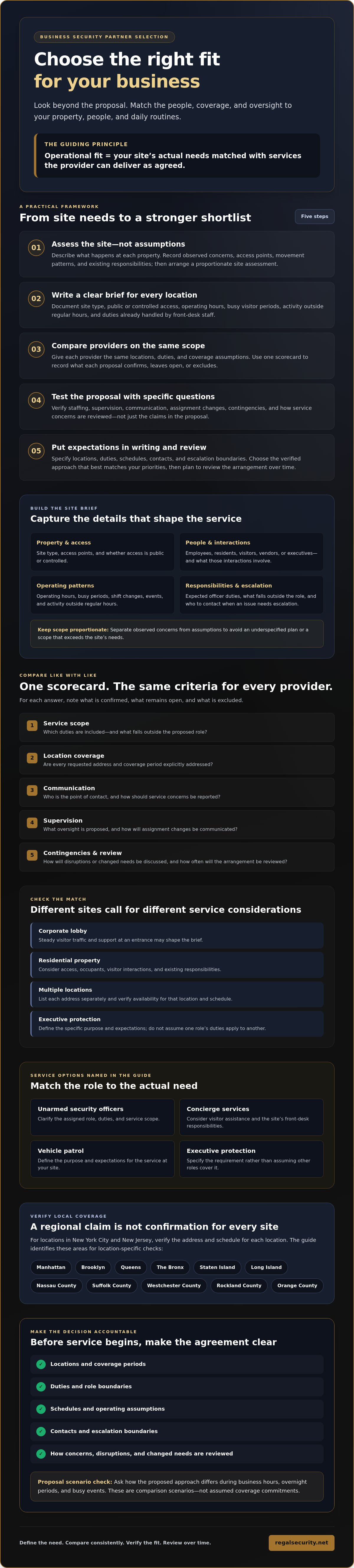
Prepare a brief for each location that lists access points, operating hours, busy visitor periods, and the duties you expect an officer to perform. Operational fit is the match between a site’s actual needs and the services a provider can deliver as agreed. Use that principle to guide your decisions when choosing a security partner for your business.
Which business and property details should you document first?
Describe the site type, whether access is public or controlled, busy periods, activity outside regular business hours, and what front-desk staff already handle. Identify who officers may interact with, such as employees, residents, visitors, vendors, or executives, and note what those interactions involve.
For locations in New York City and New Jersey, list each address separately and state the coverage expectations for that site. A provider’s regional coverage statement doesn’t confirm that a particular location or schedule is available, so verify the details for every address. This is especially useful for organizations with sites across Manhattan, Brooklyn, Queens, the Bronx, Staten Island, Long Island, Nassau County, Suffolk County, Westchester County, Rockland County, or Orange County.
What should a security partner be expected to do?
Define the purpose of the service: a visible presence for deterrence, support at an entrance, visitor assistance, vehicle patrol, or executive protection. These needs are distinct, and you shouldn’t assume that duties assigned to one officer role apply to another. Specify what officers are expected to handle, what falls outside their role, and whom they should contact when an issue needs escalation.
Consider how physical security measures work together at your site, then identify where an on-site service may contribute. For an overview of unarmed officer roles and service scope, consult Regal’s guide to professional unarmed security officers. Use these distinctions to make your request specific instead of expecting every provider to interpret a general description the same way.
How to Compare Security Partners on Service Fit and Local Coverage
Once your needs are documented, ask providers to respond to the same brief. Proposals may look comparable while covering different locations, duties, or schedules, which makes a direct comparison unreliable. Comparable proposals require the same duties, locations, and coverage assumptions. Use one scorecard for every provider and note what each answer confirms, leaves open, or excludes.
Assess each proposal against the same criteria:
Service scope: Which duties are included, and what falls outside the proposed role?
Location coverage: Are all requested addresses and coverage periods addressed explicitly?
Communication: Who is the point of contact, and how should service concerns be reported?
Supervision: What oversight is proposed, and how will assignment changes be communicated?
Contingencies and review: How will the provider discuss disruptions or changed needs, and how often will the arrangement be reviewed?
Ask each provider to explain how its proposed approach would differ during business hours, overnight periods, and busy events. These are comparison scenarios, not assumed coverage commitments. A plan for a steady weekday lobby may not address visitor flow at a special event or overnight expectations at a particular location. For each scenario, ask what changes in the proposed duties, staffing arrangement, communication, and oversight. Have the provider identify any assumptions that still need confirmation.
Which questions reveal whether a provider can support your locations?
For every site in New York City, New Jersey, or nearby counties, ask the provider to confirm coverage for the specific address and requested schedule. Request the proposed point of contact and the process for raising and tracking service concerns. Separately, verify applicable licensing and other requirements for each jurisdiction through authoritative sources. Don’t rely on a proposal alone to establish compliance.
How should you compare different security service models?
Match the service model to the need rather than treating every option as interchangeable. On-site unarmed officers may suit a defined presence or access-support role. Concierge services may fit an assignment that includes visitor assistance, while vehicle patrol may suit a site with documented patrol needs. If the front-of-house role must combine a welcoming visitor experience with security responsibilities, ask providers how they define and balance those duties.
Regal Security offers unarmed security officers, concierge services, and vehicle patrol among its service options. Compare those services with your requirements, and confirm current coverage for each location rather than assuming that regional service statements apply to every address. For more perspective on comparing staffing approaches, see the security staffing services guide. Regal’s security services overview describes options you can assess using the same scorecard as other providers.
How to Vet a Security Partner Beyond the Proposal
A polished proposal describes an intended service, but it doesn’t establish how consistently that service will be delivered. Before choosing a security partner for your business, verify the details that shape day-to-day performance. Separate documented commitments from general assurances.
Use the same process for each finalist:
1. Confirm the scope. Ask the provider to restate the locations, duties, schedules, and boundaries in the proposal. Clarify vague phrases such as “monitor the entrance” by asking what the assigned role specifically includes.
2. Clarify staffing. Ask how proposed personnel will be matched to the assignment, how changes are communicated, and what process applies if an assigned person is unavailable. Treat these as questions to verify, not assumptions about a provider’s practices.
3. Understand supervision. Ask who oversees the service, how often oversight occurs, and how operational concerns reach that person.
4. Examine communication. Establish who receives a concern, how it is recorded, and how the client learns what follow-up occurred.
5. Review service evidence. Ask what written records or scheduled reviews are available to assess whether the agreed scope remains appropriate and is being delivered.
Ask for examples of operating procedures and reporting formats with confidential or identifying information removed. The aim isn’t to require a particular platform or document style. It’s to determine whether the provider can explain a clear, usable process. Compare proposals only after confirming that duties, locations, coverage assumptions, and oversight are equivalent. A lower price may reflect a narrower scope, so evaluate the service being proposed rather than the number alone.
What evidence and references should a business request?
Where available and permitted, ask for references from clients whose site type and service scope resemble yours. Confirm what a reference can speak to, such as communication or consistency, rather than treating a general endorsement as proof of every capability. Request sample reports or escalation procedures with sensitive details removed. Verify insurance, licensing, and other compliance claims directly, and confirm jurisdiction-specific requirements with authoritative sources before relying on them.
How can you assess communication and accountability?
Ask who receives service concerns, how they’re documented, and how follow-up is shared. Set a review schedule and agree what each review will examine, including service fit, recurring issues, and changes at the site. If a provider cites response times or performance standards, ask what the statement means, how it is measured, and whether it can be documented. Don’t treat an informal assurance as a firm commitment unless the provider can substantiate it and both parties agree on its terms.
What to Put in a Security Services Agreement and Review Plan
A written agreement turns the selected service approach into shared expectations. It should identify the covered locations, assigned duties, scheduled coverage, and the right contact for each party. Clear terms help prevent a gap between what a business believes it requested and what the provider understands it will deliver.
As part of choosing a security partner for your business, confirm that the agreement reflects the final proposal and any clarifications made during evaluation. Spell out exclusions as well as included responsibilities. For example, if a role includes visitor assistance and access support, describe those duties and identify which decisions or incidents must be referred to a designated contact. Avoid broad descriptions that leave essential responsibilities open to interpretation.
Which service details should be explicit in writing?
Review the agreement for each site, scheduled coverage, assigned responsibilities, and service exclusions. It should also identify client and provider contacts, explain how assignment changes will be communicated, and set out how concerns are raised, acknowledged, reviewed, and escalated. Define reporting expectations, including what information is recorded and how it is shared, without assuming a specific reporting system.
Compare commercial terms only across proposals with equivalent locations, duties, coverage assumptions, and oversight. If contractual language is unclear or you need help interpreting its legal effect, ask qualified counsel to review it before signing.
How can you maintain a useful provider relationship?
Agree on named contacts and a check-in schedule that reflects the confirmed service arrangement. Use reviews to discuss documented observations, recurring operational needs, changes to site activity, and proposed adjustments to duties or coverage. Records can support a useful conversation, but they don’t by themselves establish that every concern was resolved or that a service achieved a particular outcome.
When operations change, such as when a location alters its hours or visitor process, agree how the parties will assess whether the current scope remains suitable and document any approved changes. This keeps the review plan connected to the work instead of turning it into a routine meeting without a clear purpose.
Use Regal Security’s service information to understand which options you may want to assess against your requirements and evaluation criteria.
Selecting a Security Partner for Your Business: From Shortlist to Start
The final decision should rest on demonstrated fit, not the polish of a proposal or the length of a service list. A disciplined shortlist makes choosing a security partner for your business more straightforward: confirm the need, compare equivalent scopes, verify claims, agree on responsibilities, and set a review plan.
Confirm the need. Return to your site brief and identify the priorities the service must address.
Compare equivalent scopes. Check that each finalist has responded to the same locations, duties, and coverage assumptions.
Verify claims. Resolve open questions about location-specific coverage, staffing, oversight, communication, and applicable requirements.
Agree responsibilities. Make sure the service scope, exclusions, contacts, reporting expectations, and escalation routes are clear in writing.
Schedule review. Decide when and how the parties will assess whether the agreed approach still fits the site.
Choose the provider whose verified service approach best meets your priorities and whose responsibilities are clear enough to assess over time. For a multi-site organization, evaluate each New York or New Jersey location separately. Differences in access, operating patterns, and local coverage expectations mean one site’s proposed arrangement shouldn’t be assumed to apply uniformly elsewhere.
What should happen before the service begins?
Before service starts, confirm operational contacts, site information, agreed duties, communication routes, and any orientation the parties have agreed is required. Document how changes to site conditions or requests to adjust coverage will be raised, reviewed, and recorded. Confirm practical arrangements directly with the selected provider rather than assuming a particular start date, staffing level, or readiness process.
When may Regal Security be worth considering?
Regal Security may be an option to assess if its unarmed security officers, concierge services, vehicle patrol, or executive protection align with your documented requirements. Its stated coverage includes New York City, New Jersey, and surrounding counties. Confirm current availability and the proposed scope for each specific location before deciding.
If vehicle patrol suits the site’s needs, consult the vehicle patrol security services guide as part of your evaluation. As with any provider, compare confirmed service details against your shortlist criteria and proceed only when responsibilities, coverage, and review arrangements are clear.
Choose a Partner That Fits the Way Your Business Operates
Choosing a security partner for your business is ultimately a decision about fit and accountability. Start with your site’s actual needs, compare providers against the same scope, and verify how responsibilities, communication, and service reviews will work in practice. A clear written agreement carries those expectations from selection into the ongoing relationship.
The right provider isn’t necessarily the one with the broadest proposal. It’s the one whose confirmed services and approach align with your property, people, and priorities. Regal Security offers unarmed security officers, concierge services, vehicle patrol, and executive protection, with an approach it describes as grounded in integrity, precision, and reliable on-site presence. Compare these options with your requirements, and confirm the proposed scope and location coverage directly.
To discuss your requirements and assess whether Regal Security’s service options fit your business, contact Regal Security.
Frequently Asked Questions
What should a business look for when choosing a security partner?
Look for a provider whose confirmed services, coverage, and oversight match your site’s documented needs. Compare proposals using the same locations, duties, schedules, and assumptions, then verify how staffing, communication, and concerns will be handled. For example, a busy lobby may call for a different service model from a site seeking vehicle patrol. A clear written scope and review plan help set practical expectations from the outset.
How can I tell if a security company is reliable?
Assess reliability through evidence and clear processes, not promises alone. Ask for relevant references where available and permitted, sample reports with confidential details removed, and explanations of supervision and communication procedures. Confirm who receives concerns, how they’re documented, and how follow-up is shared. Ask what the provider can substantiate about performance statements, then include any agreed expectations in the written service scope.
Should I choose the lowest-priced security provider?
Not until you’ve confirmed that the proposals cover equivalent services. A lower bid may reflect differences in duties, locations, schedules, or oversight, so compare the scope and terms line by line before weighing price. Ask providers to clarify exclusions and assumptions, then consider which proposal best fits your operational priorities. Evaluate comparable service arrangements rather than treating price alone as evidence of value.
What questions should I ask a security company before signing?
Ask which duties are included, which locations and schedules are covered, and what falls outside the service. Clarify who will oversee the assignment, how staffing changes are communicated, and who receives and documents concerns. Request examples of operating procedures or reporting formats with sensitive information removed. Ask how service reviews will work and what claims about response or performance the provider can substantiate in writing.
Do New York and New Jersey businesses need to check different security requirements?
Requirements may depend on the jurisdiction and the service involved, so confirming one location doesn’t establish compliance for another. Businesses operating in New York City and New Jersey should verify applicable licensing and other requirements with authoritative sources for each relevant jurisdiction. If your sites span Manhattan, Brooklyn, Queens, the Bronx, Staten Island, or New Jersey, document locations separately and confirm which requirements apply to each.
What should a security services agreement include?
A security services agreement should identify covered sites, scheduled coverage, assigned duties, exclusions, and client and provider contacts. It should also describe how concerns are raised, acknowledged, reviewed, and escalated, along with reporting expectations and how assignment changes are communicated. Set a review process so the parties can revisit service fit as operations change. Consult qualified counsel if you need legal interpretation of contractual language.
Can one security partner serve multiple business locations?
Possibly, but confirm coverage and the proposed service scope for every address rather than assuming one arrangement applies everywhere. Businesses with sites across New York City, Manhattan, Brooklyn, Queens, the Bronx, Staten Island, Long Island, Nassau County, Suffolk County, Westchester County, Rockland County, Orange County, or New Jersey should assess each location’s needs and requirements individually. Regal Security states coverage across these areas, but verify current availability and details for each specific site.