Discreet Personal Security and Travel Protection in New York
The most visible security presence is not always the right one. In New York City, some government offices, educational institutions, and public transit systems restrict armed security, even when personnel hold valid permits. Choosing discreet personal security in NYC starts with understanding your itinerary, exposure, and the level of visibility each setting calls for.
It is reasonable to expect protection that supports your plans without drawing unnecessary attention. The right executive protection company tailors its approach to your circumstances, including your public profile, travel arrangements, destinations, and expected crowds. This guide explains how risk assessment informs a protection plan, what to consider when arranging security for a New York visit, and how armed and unarmed personnel differ across settings.
Table of Contents
How can I find the right executive protection company in New York?
For families, executives, and high-profile visitors, discreet protection may involve planned close accompaniment and advance venue review. Choose a provider that starts with your itinerary and risk assessment, rather than applying the same arrangement to every New York visit.
Customized Executive and VIP Plans
A useful protection plan reflects the person’s public profile, schedule, and destinations. Executives attending meetings across Manhattan, for example, may need a different approach from a dignitary attending a public event. Discuss recognition, planned venues, travel movements, and the level of visibility that feels appropriate. These details help tailor executive protection services to the assignment instead of relying on a generic package.
Look for a clear planning process. A professional security agency considers the itinerary and conditions at each destination as part of its risk assessment. For an extended assignment, discuss whether personnel with medical skills or a team working shifts is appropriate. The plan should also explain how officers coordinate movements and adapt when schedules or venue arrangements change.
Discreet Security Options
Discreet protection can involve close accompaniment without unnecessary attention, rather than a conspicuous formation. For a family visiting New York, the plan might account for hotel departures, shared outings, and separate activities. For executives, it may prioritize movement between meetings. For celebrities, public recognition and event exposure can influence how officers position themselves and provide accompaniment.
Ask how the provider balances visibility with practical coverage. Reviewing a venue in advance can help personnel understand arrival points and the surrounding environment before the client arrives. Share destinations and event details during planning so the team can account for crowds and movement between locations. A sound plan should fit the client’s day, not disrupt it with unnecessary procedures.
Close Protection for Executives and Dignitaries
Close protection involves accompanying a person through planned activities while remaining aware of changing conditions. For an executive attending an event, this can mean coordinating arrival, movement through the venue, and departure. For a visiting dignitary, public recognition and scheduled appearances should inform the plan. These details help determine how closely officers accompany the person.
When comparing executive protection companies, ask how they assess risk, prepare for each location, and coordinate with the client’s schedule. A useful discussion covers destinations, venues, crowd conditions, and requirements for an extended assignment. It should also clarify how changes are handled and how the approach remains proportionate to the visit. In New York, these planning details are more informative than a broad promise of coverage.
Threat assessment and security planning
Effective planning begins with a risk assessment that connects identified concerns to the itinerary. In New York City, party size, destinations, transportation, and assignment length all shape the plan.
Secure Routes and Emergency Planning
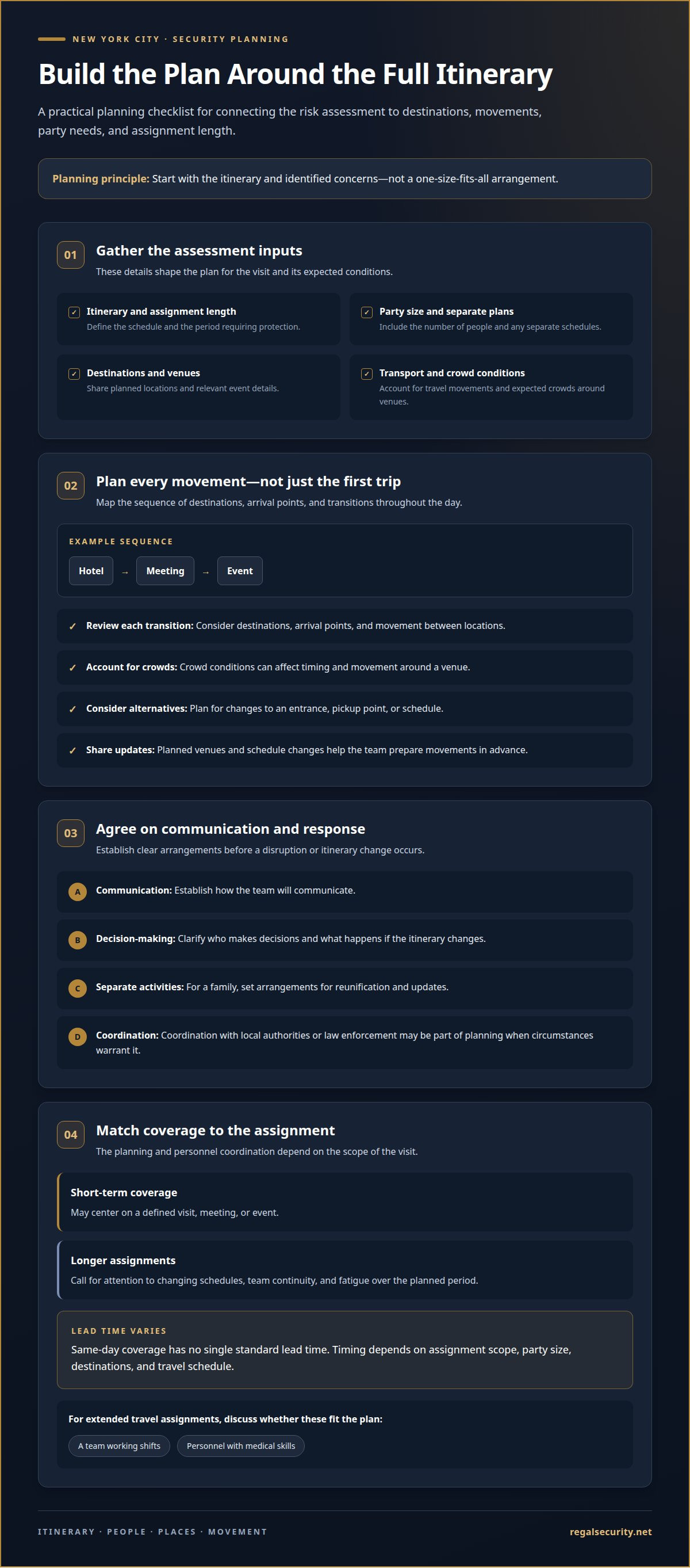
Route planning should account for each destination, arrival point, and transition throughout the day. A visitor traveling from a hotel to a meeting and then to an event needs a plan for the full sequence, not just the first trip. Sharing venues and schedule changes helps protection professionals plan movements in advance.
Crowd conditions can affect timing and movement around a venue. The plan should consider alternatives if an entrance, pickup point, or schedule changes. For extended travel assignments, discuss whether a team working shifts or personnel with medical skills is appropriate. Coordination with local authorities or law enforcement may also be part of planning when circumstances warrant it.
Emergency planning should establish how the team communicates, who makes decisions, and what happens if the itinerary changes. For example, a family with separate activities may need clear arrangements for reunification and updates. These measures make it easier to coordinate a response without relying on assumptions during a disruption.
Arranging Security Coverage
Same-day coverage has no single standard lead time. Practical timing depends on the assignment’s scope, party size, destinations, and travel schedule. A focused meeting itinerary differs from a day involving several venues, a large group, or a public appearance. Those details determine the planning and personnel coordination required.
To arrange coverage, define the period requiring protection and share planned destinations, venues, and transport movements. Include the number of people in the party, any separate schedules, and anticipated changes. This gives the security team a basis for assessing risks, identifying priorities, and shaping personal protection services around the actual movement plan.
Short-term coverage may center on a defined visit, meeting, or event. Longer assignments call for attention to changing schedules, team continuity, and fatigue over the planned period. Either way, clarify the client’s priorities and the decisions that may be needed if circumstances change. A defined plan helps officers respond consistently rather than improvise with incomplete information.
For help structuring the assignment, planning personal security coverage can begin with the itinerary, party size, and travel needs.
A professional security agency begins personal protection planning with a thorough risk assessment, using the itinerary as a structured starting point. For a New York assignment, crowd conditions are one factor in planning movements. Sharing planned destinations and venues allows protection professionals to prepare in advance. This connects the assessment to expected locations and conditions, rather than treating each movement as an isolated detail.
Personal protection for high-profile NYC visitors
Yes. Protection can be planned for travel, events, and selected daily routines in New York City. The approach should reflect each visitor’s public profile, destinations, transportation, and privacy priorities.
Protection for People Facing Threats
When someone faces a threat, start by understanding its nature and how it may affect planned activities. Relevant details include the person’s schedule, known concerns, public appearances, and regular destinations. For example, a visitor with a meeting and a public event needs a plan that accounts for both settings.
Private security should fit the circumstances, rather than assuming every concern calls for the same visible response. An officer may accompany a person during specific movements while the broader plan accounts for destinations and transitions. Clear communication about changed plans helps the protection team adapt to the person’s actual routine.
Discreet Protection and Privacy
For a high-profile visitor, discretion means coordinating protection without making every interaction feel like a public display. The visitor’s profile, preferred level of visibility, and planned activities guide how officers provide accompaniment. An international executive, for instance, may prefer a composed presence during hotel departures and private meetings.
Privacy also depends on careful handling of itinerary details. Share destinations and schedule information with those responsible for planning, and keep updates focused on operational needs. A tailored approach can account for a family outing or an executive’s separate appointments while limiting unnecessary disruption to everyday activities.
Protection at Meetings and Events
A meeting and a public event create different demands. For a private meeting, planning may focus on arrival, access, and departure. At a public event, the guest’s profile and expected crowd conditions also matter. Protection personnel can review a location before the visitor arrives and remain attentive to safety during the visit.
For example, a celebrity attending a reception may need coordinated movement from transportation to the venue and onward to the next destination. Discussing the event schedule and public recognition helps shape the level of accompaniment. These practical details allow protection services to support attendance while preserving the event’s purpose.
Coverage During Travel and Daily Routines
Coverage can extend beyond a single appearance when an itinerary includes travel and routine activities. A visitor might need support between a hotel, business appointments, and a planned dinner. Sharing the sequence helps personnel understand where transitions occur and how the day’s arrangements connect.
For daily routines, identify which activities require accompaniment and which should remain private. Transportation plans, recurring destinations, and schedule changes can inform that decision. Discreet personal protection in NYC should support the visitor’s movements without treating every part of the day as an event. That distinction keeps the arrangement aligned with the person’s priorities.
Secure transportation and travel security
Travel security connects the passenger, itinerary, vehicle, and destinations in a coordinated plan. For a New York City visit, begin by assessing each movement, from airport arrival to hotel transfer and scheduled appointments. Identify who is traveling, what each person needs, and where changes could affect timing. This gives security personnel a practical basis for coordinating ground transportation and protection.
For chauffeured transportation, agree on pickup points, destinations, passenger arrangements, and how schedule updates will be shared. A traveler going from an airport to a hotel and then to a meeting benefits from treating each leg as part of the same itinerary. Security personnel can coordinate their presence around those movements. Unarmed officers can provide an appropriate on-site security presence without taking on a transportation role.
Air and ground travel involve different transitions. An itinerary that includes a flight, a vehicle transfer, and a public event should account for arrival and departure points at each stage. Share changes promptly with those coordinating the plan. For international visitors, aligning the travel schedule with New York appointments helps reduce uncertainty around connections and handoffs.
High-value assets, such as jewelry, need thoughtful handling during travel. Include the item’s planned movements and destinations in the assessment, especially if it will be worn at a meeting or event. Keep its transport arrangements separate from the passenger’s protection plan. A personal security assignment is not a specialized valuables-carriage service, so clarify how the asset fits into the overall itinerary.
Route planning should also account for crowd conditions and venue access. For example, a vehicle drop-off near a busy event may require coordination around the arrival point and the passenger’s next movement. Build flexibility into the schedule so changes can be communicated and considered. Coordination with local authorities or law enforcement may form part of protective planning when appropriate.
Before travel begins, confirm the sequence of destinations, the party’s transport needs, and how updates will be communicated. For a family, this may include coordinating separate arrivals or activities; for an executive, it may involve aligning vehicle movements with meetings. A carefully planned arrangement helps everyone understand their roles and keeps transportation logistics aligned with the visit.
Armed and unarmed security personnel
Armed and unarmed personnel serve different roles, so the appropriate choice depends on the setting, assignment, and access requirements. In New York City, some government offices, educational institutions, and public transit systems restrict armed security, even when personnel hold valid permits. For corporate visits or event security, consider whether an armed presence suits the venue and the client’s priorities.
What qualifications and licenses should NYC personal security professionals have? Look for role-relevant training, sound judgment, clear communication, and experience suited to the assignment. For example, personnel supporting a corporate meeting need to coordinate discreetly with attendees and venue staff, while event security may involve managing movement around a crowd.
What are New York State laws on armed security guards and concealed carry for bodyguards? A permit alone may not ensure access to every location on an itinerary.
An unarmed presence can be appropriate when a calm, service-oriented approach matters. At a corporate reception, for instance, unarmed officers can support orderly access and provide an on-site security presence without introducing a visibly armed element. The assignment should still reflect the venue, expected attendance, and each officer’s responsibilities.
For armed or unarmed coverage, assess the full route and every location, not just the main event. A visitor may travel from a hotel to a meeting, then use public transit or enter an institutional building. These transitions can affect what a venue permits. Security professionals should account for restrictions before deciding on staffing, rather than assuming one arrangement will fit every stop.
When evaluating security services, discuss the team’s role, relevant preparation, and coordination with the venue. Ask how personnel will support arrival, access, and departures, and how their approach will differ between a private meeting and a public event. These practical questions help determine whether the proposed personnel fit the assignment’s on-the-ground demands.
For settings where an unarmed presence is appropriate, discuss unarmed security coverage suited to the venue and assignment.
In New York City, some government offices, educational institutions, and public transit systems restrict armed security even when personnel hold valid permits. A permit alone may not mean a bodyguard can carry a concealed firearm at every stop on an itinerary, so check the restrictions that apply to each location.
Regal Security
Regal Security provides protection for corporate, residential, and executive needs, with services tailored to different settings and assignments. Its offerings include Executive Protection, Unarmed Security Officers, Concierge Services, and Vehicle Patrol. These services can support personal protection, an on-site security presence, or mobile patrol, depending on the assignment.
For discreet personal security in New York City, turn to Regal Security for professional support tailored to your people, property, or planned movements. The right service depends on the setting and protection required, rather than a one-size-fits-all approach. Contact Regal Security to discuss your security needs.
Put a considered protection plan into motion
Start by turning your priorities into a practical brief: who needs protection, which movements matter, and how discreet the presence should be. A discreet personal security plan in NYC should fit the people and places involved while allowing for changes to the schedule. Sharing those priorities with a security team gives the planning conversation a clear starting point.
Regal Security offers Unarmed Security Officers, Concierge Services, and Vehicle Patrol to address different security needs. The right fit depends on the setting and role required, whether you are planning personal protection, an on-site presence, or mobile patrol.
For a considered discussion of your requirements, contact Regal Security about protection. A clear first conversation can help you define the next step with confidence.
Frequently Asked Questions
What should I consider before hiring bodyguard services in New York?
Start by defining the protection need, the people involved, and the officer’s expected duties. A corporate appearance differs from support throughout a family’s visit or an executive’s regular schedule. Clarify how the security presence should fit into public interactions, who will coordinate schedule changes, and which locations are involved. These details help align the assignment with your priorities before coverage begins.
What discreet personal security services are available in New York City?
Regal Security offers Executive Protection, Unarmed Security Officers, Concierge Services, and Vehicle Patrol. These services address different needs, from personal protection to an on-site presence or mobile patrol. The company’s local focus includes New York City, Manhattan, Brooklyn, Queens, the Bronx, Staten Island, Long Island, Nassau County, Suffolk County, Westchester County, Rockland County, Orange County, and New Jersey. The appropriate service depends on the setting and assignment.
How do I choose between armed and unarmed personal security in New York City?
Consider the assignment’s setting and access requirements before choosing an approach. Some New York City government offices, educational institutions, and public transit systems restrict armed security, even when personnel hold valid permits. An unarmed presence may suit a corporate reception or residential setting where service and access coordination matter. Regal Security provides Unarmed Security Officers, and the plan should account for location-specific restrictions and assigned duties.
How can I verify a NYC personal security company’s license, insurance, and references?
Request current documentation relevant to the company and assigned personnel, then confirm that names and details match the proposed arrangement. Ask for evidence of insurance and clarify what the policy covers. For references, request contacts familiar with comparable corporate or residential security assignments, and ask about communication and reliability. Review the information against the actual scope, locations, and responsibilities in your agreement.
How do NYC personal security firms protect client privacy and handle confidentiality?
Discuss privacy expectations before sharing sensitive itinerary details. Agree on who needs access to schedules, how updates will be communicated, and what information should be limited to those coordinating the assignment. For example, a family may prefer not to discuss routine movements broadly with venue staff. Set expectations clearly and keep operational communications focused on the protection plan.
What should I expect during a personal security risk assessment in New York City?
Expect a focused discussion of the concern, the people affected, and the practical details of the assignment. A visitor attending a corporate meeting, for example, can outline arrival plans, destinations, public appearances, and anticipated schedule changes. The assessment helps identify priorities and shape a plan for communication and coordination. It should also allow new information to be incorporated as circumstances or plans change.