Security for corporate retreats in the Hudson Valley
Retreat security works best when it is planned alongside the itinerary, not added at the last minute. Security for corporate retreats in the Hudson Valley should account for the venue, guest arrivals, transportation, and the pace of the program. A thoughtful plan supports a welcoming experience while addressing the practical needs of the gathering.
Planning protection for an off-site retreat involves more than deciding whether personnel should be present. Arrival points, access to meeting and lodging areas, travel between locations, and evening activities all shape the arrangements. Seasonal conditions and busy retreat periods in the region can also affect timing and logistics.
This guide explains when to begin planning, what to coordinate with the venue and event schedule, and how seasonal timing can influence arrangements. It also covers how Unarmed Security Officers, Concierge Services, Vehicle Patrol, and Executive Protection can fit different retreat needs, helping you make clear, informed decisions.
Table of Contents
Planning timelines and logistics
Plan security around the retreat itinerary, using arrival times, venue layout, and activities to define coverage. Hudson Valley travel and seasonal demand can shape when personnel are needed.
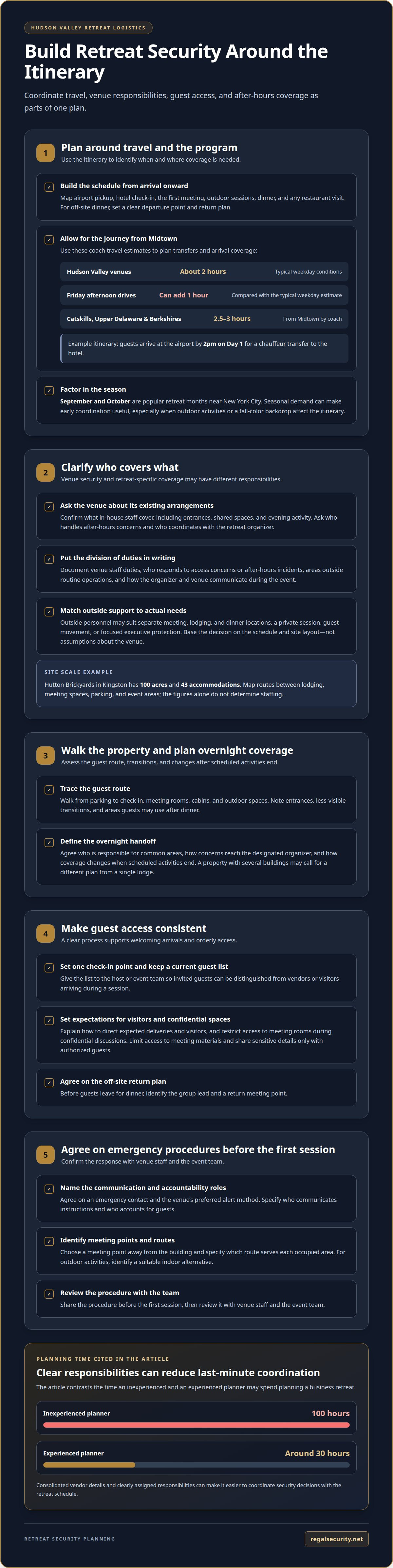
Build the schedule around arrival, transfers, meetings, and evening events. Some retreat itineraries ask guests to arrive at the airport by 2pm on Day 1 for a chauffeur transfer to the hotel. Midtown Manhattan to Hudson Valley venues takes about 2 hours by coach under typical weekday conditions, while Friday afternoon drives can add an hour. The Catskills, Upper Delaware, and Berkshires typically take 2.5 to 3 hours from Midtown by coach.
Map each movement: airport pickup, hotel check-in, the first meeting, an outdoor session, dinner, and any restaurant visit. For example, a group leaving a hotel for dinner needs a clear departure point and return plan. September and October are popular retreat months near New York City, with fall color and mild days. Seasonal demand can make early coordination useful, especially when a creative session or outdoor backdrop affects the itinerary.
Security Staffing and Vendor Selection
Ask the venue’s event contact what in-house security covers, including entrances, shared spaces, and evening activity. Outside personnel may suit a schedule with separate meeting, lodging, and dinner locations, or a smaller group requiring focused executive protection. Local security firms can serve retreats in Dutchess, Ulster, Orange, and Columbia counties; match coverage to the venue address and schedule. Protect confidential company information by limiting access to meeting materials and sharing sensitive details only with authorized guests.
Venue Risk and Overnight Measures
Assess the property by walking the guest route from parking to check-in, meeting rooms, cabins, and outdoor spaces. Note entrances, less visible transitions, and areas guests may use after dinner. For overnight stays, establish who is responsible for common areas, how concerns reach the designated organizer, and how coverage changes after scheduled activities end. A venue with several buildings may need a different plan from a single lodge.
Access Control and Guest Screening
Set one check-in point and give the host or event team a current guest list. A consistent process helps distinguish invited guests from vendors or visitors arriving during a session. Explain how to direct expected deliveries and visitors, and restrict access to meeting rooms during confidential discussions. For off-site dinners, identify the group lead and a return meeting point before guests leave.
Emergency Response and Evacuation Planning
Agree on an emergency contact, the venue’s preferred alert method, and a meeting point away from the building. The plan should specify who communicates instructions, who accounts for guests, and which route serves each occupied area. For outdoor activities, identify a suitable indoor alternative. Share the procedure before the first session, then review it with venue staff and the event team.
An inexperienced planner may spend 100 hours planning a business retreat, compared with around 30 hours for an experienced planner. Clear responsibilities and consolidated vendor details can make it easier to coordinate security decisions with the retreat schedule and avoid unnecessary last-minute changes.
Hudson Valley Retreat Security: In-house or Outside?
Hudson Valley retreat venues do not all follow the same security arrangements. Some include security in their operations; others rely on event staff or expect organizers to arrange separate coverage. The distinction matters: venue personnel may focus on property operations, while retreat security can be planned around guest movement, private meetings, and executive needs. Establish responsibilities in writing before finalizing the event schedule.
Use the venue agreement and an operations discussion to clarify the practical scope. Identify whether staff are present at the entrance, how they handle after-hours concerns, and who coordinates with the retreat organizer. For example, a hotel team may manage guest check-in without providing dedicated coverage for a confidential meeting in a separate building. A clear division of duties helps prevent gaps and duplicated responsibilities.
Property size and layout help determine whether existing arrangements fit the retreat. Hutton Brickyards in Kingston has 100 acres and 43 accommodations, so organizers should map the route between lodging, meeting spaces, parking, and event areas. These figures do not determine staffing by themselves; they show why a single entrance or reception desk may not cover every part of a program. Smaller properties may need a different arrangement, especially when a retreat uses off-site venues.
Compare the venue’s arrangements with the event’s actual movements. A daytime meeting with guests staying onsite may need different coverage from a retreat with separate evening events or executive travel. Before deciding on outside support, document:
Which venue staff duties apply to retreat guests and event spaces.
Who responds to an access concern or an after-hours incident.
Which areas are outside the venue’s routine operations.
How the organizer and venue staff communicate during the event.
Outside coverage can be appropriate when the venue’s staff responsibilities do not extend to the retreat’s specific needs. It can provide a defined presence for an executive, a private session, or movement between locations. Base the decision on the schedule and site layout, not assumptions about the venue’s name, size, or setting. A written plan can assign each responsibility to a person or team.
For additional on-site coverage, retreat security planning can help align staffing with the venue, guest schedule, and event priorities. Discuss the scope in relation to the locations and activities requiring attention, then coordinate responsibilities with the venue’s event contact. This keeps the arrangement focused on the retreat rather than duplicating services the venue already provides.
How do you assess security risks at a corporate retreat venue?
Assess the property against the retreat’s schedule, spaces, and guest movements. A wooded resort, historic inn, and conference venue each present different considerations. Mohonk Mountain House, for example, has 85 miles of trails on the Shawangunk Ridge. That setting makes it important to identify which areas are part of planned activities and how guests return from them. A venue review is a practical starting point for security for corporate retreats in the Hudson Valley.
Begin with a site review, then connect observations to the event plan. Walk the route guests will use from arrival through departure. Include meeting rooms, lodging, dining spaces, parking, outdoor activity areas, and buildings used separately. Wildflower Farms in Gardiner spans 140 acres, so the selected event locations matter more than acreage alone. Focus on the specific spaces participants will enter and the routes connecting them.
Map the guest journey. Trace arrivals, check-in, sessions, meals, and evening activities. Mark transitions between buildings or outdoor areas.
Review access points. Identify public entrances, staff entrances, delivery areas, and doors connecting event spaces. Note who manages each point.
Consider visibility. Review reception areas, corridors, parking, and paths between locations. Record places where guests may become separated from the group.
Match coverage to the schedule. Compare busy periods with quieter intervals, including session starts and finishes. Consider how excursions change the group’s location.
Assign clear responsibilities. Establish who receives concerns, communicates with venue staff, and coordinates responses. Ensure event staff understand the agreed process.
Consider how each activity changes the site’s use. A meeting in one building followed by dinner elsewhere creates different movements from a single-location agenda. A trail walk, outdoor reception, or private executive session may need distinct arrangements. Assess each activity’s location, participant access, and route back to shared spaces. This makes the review specific to the actual program.
Include confidentiality in the assessment. Identify where sensitive discussions will take place, who should enter, and how materials will be handled between sessions. For a leadership meeting in a shared hotel, establish a discreet way to redirect visitors. Executive Protection may suit a retreat involving a senior leader whose movements or privacy need particular attention.
Record findings in a concise site plan covering relevant spaces, expected movements, assigned contacts, and response procedures. Review it with the venue’s event representative before the retreat, then update it if the itinerary or locations change. This tailored approach to security for corporate retreats in the Hudson Valley keeps the plan aligned with the property and program.
What security measures are recommended for overnight corporate retreats?
Overnight coverage should reflect the shift from scheduled programming to guest rest. Define the evening handoff: who remains responsible after the final session, how concerns reach that person, and how venue staff are contacted. For example, an organizer can share one contact method with guests and designate an event lead to coordinate with the venue.
Set clear boundaries between private lodging and shared retreat spaces. Confirm which corridors, lounges, and meeting rooms guests may use after dinner. Close confidential work areas when sessions end, and store presentation materials in an agreed secure location. If participants stay in separate cabins, identify the route between accommodations and common areas, then tell guests where to seek assistance.
Agree on a discreet process for unexpected visitors and late arrivals. The venue’s front desk or event contact should know who is expected and how to direct anyone arriving for the retreat. For example, a visitor seeking a team member should be referred through the event lead rather than sent directly to a guest room. Keep the process welcoming while protecting guests’ privacy.
Set an evening handoff. Record who receives concerns after the program ends and how that person contacts venue staff.
Define shared-space access. Identify which meeting rooms and lounges remain available after scheduled sessions.
Protect private information. Put confidential documents away and restrict access to rooms used for closed discussions.
Clarify guest assistance. Tell participants where to go and whom to contact if they need help.
Coordinate overnight personnel. If on-site coverage is part of the plan, establish the assigned areas and communication route.
Vehicle arrangements also matter during overnight stays. Identify where retreat transportation is parked, who is authorized to use it, and how guests can request a ride between event spaces. For an off-site dinner, establish a departure point and return procedure before the group leaves. This reduces confusion without requiring guests to share sensitive travel details broadly.
Prepare a concise overnight briefing for the event team and venue contact. Include the guest assistance process, relevant access boundaries, communication responsibilities, and schedule changes. Limit the information to people who need it. A focused briefing helps the evening team respond consistently while allowing guests to move between rest and retreat activities with minimal disruption.
How should retreats handle access control, guest check-in, and visitor screening
Begin with one designated check-in point, such as the venue’s main reception desk. Give its staff a current attendee list and the event lead’s name. For a retreat using separate meeting and lodging buildings, clarify which entrance serves each activity. This helps guests, vendors, and visitors avoid conflicting directions.
Use a consistent check-in process that welcomes guests and protects their privacy. The host can greet each guest, confirm their name against the attendee list, and explain where the first session meets. Do not display a full guest list where other visitors can read it. If participants arrive at different times, ensure the event lead knows how late arrivals will be directed.
Separate expected visitors from unplanned arrivals with a simple referral procedure. A caterer, speaker, or delivery driver should have a named event contact and a clear destination. For example, reception can notify the event lead before directing a delivery to a meeting area. Visitors seeking an attendee can be asked to wait while the host confirms the request.
Define entry points. Identify the entrance for guests, vendors, and scheduled deliveries.
Assign check-in responsibility. Name the person who manages the list and directs arrivals.
Set a visitor process. Decide how reception contacts the event lead before granting access to retreat spaces.
Limit information sharing. Provide staff only the details needed for their assigned role.
Plan for schedule changes. Tell the check-in contact when a session or dinner location changes.
Manage access according to the event’s different spaces, not just the property’s front door. A shared dining room may welcome other hotel guests, while a leadership meeting needs a more private arrival process. Identify which areas are open, which are reserved, and who can redirect someone who enters the wrong space. Give clear directions at transitions between reception, meeting rooms, and lodging.
For confidential sessions, keep attendance details and room locations within the event team. Give participants relevant directions directly rather than announcing sensitive meeting details in a public lobby. If an executive has a private schedule, route requests through the designated host. These practices help preserve discretion without making ordinary guest arrivals feel restrictive.
Before guests arrive, brief reception and the event lead on the attendee list, visitor procedure, and escalation contact. During the retreat, update those details when the schedule or assigned staff changes. A coordinated access plan can support a composed arrival and orderly movement through the venue. Arrange retreat access coverage to align on-site presence with check-in and guest movement.
Venue scale can help determine how much arrival coordination is needed. Historic Hudson Valley educates and entertains more than 300,000 visitors a year, while Eastwind Oliverea Valley in Big Indian, New York, hosts groups of 6-26 guests. Hotel Lilien in Tannersville, New York, accommodates 22-44 guests depending on room configuration. These different capacities call for check-in arrangements matched to the group and the property’s other activity.
The Edgewood Mansion at Hutton Brickyards has 12 guest rooms, while The Mansion at Glen Cove has 187 guest rooms and suites. Armon Stamford Hotel has more than 450 guestrooms. Confirm with the venue how reception can distinguish retreat arrivals from other guests, and ensure the event contact can be reached if someone arrives without a clear destination.
Regal Security
Regal Security helps align retreat security with the venue, guest schedule, and priorities identified during planning. Unarmed Security Officers and Concierge Services provide an on-site presence and guest-facing coordination. Vehicle Patrol can support arrangements involving parking areas or movement around the property, while Executive Protection addresses leadership needs. The right approach depends on the locations used, the event schedule, and the responsibilities handled by venue staff. Bringing these details together creates a clear plan without disrupting the retreat’s hospitality or business objectives. Contact Regal Security to plan security for your corporate retreat.
Set Your Retreat Plan in Motion
Turn your retreat’s security considerations into a practical plan that supports the event without overshadowing it. Bring together the itinerary, venue arrangements, guest needs, and privacy priorities, then assign clear responsibilities for each part of the gathering. A defined plan gives organizers and venue staff a shared understanding of how the retreat should run.
Security for corporate retreats in the Hudson Valley should reflect the specific event, not a generic checklist. As your schedule takes shape, consider where professional support could complement the venue’s arrangements and help maintain an orderly, welcoming experience. Regal Security can discuss how its services fit your retreat’s setting and priorities.
Contact Regal Security to discuss your retreat and take the next step toward a considered plan. With clear coordination in place, your team can focus on the purpose of its time together.
Frequently Asked Questions
What security services are available for corporate retreats in the Hudson Valley?
Available options include Unarmed Security Officers, Concierge Services, Vehicle Patrol, and Executive Protection. The right combination depends on the retreat’s needs, such as a guest-facing presence, coverage around vehicles, or discreet support for an executive. Organizations coordinating from New York City, Manhattan, Brooklyn, Queens, the Bronx, Staten Island, Long Island, Nassau County, Suffolk County, New Jersey, Westchester County, Rockland County, or Orange County can factor those locations into retreat logistics.