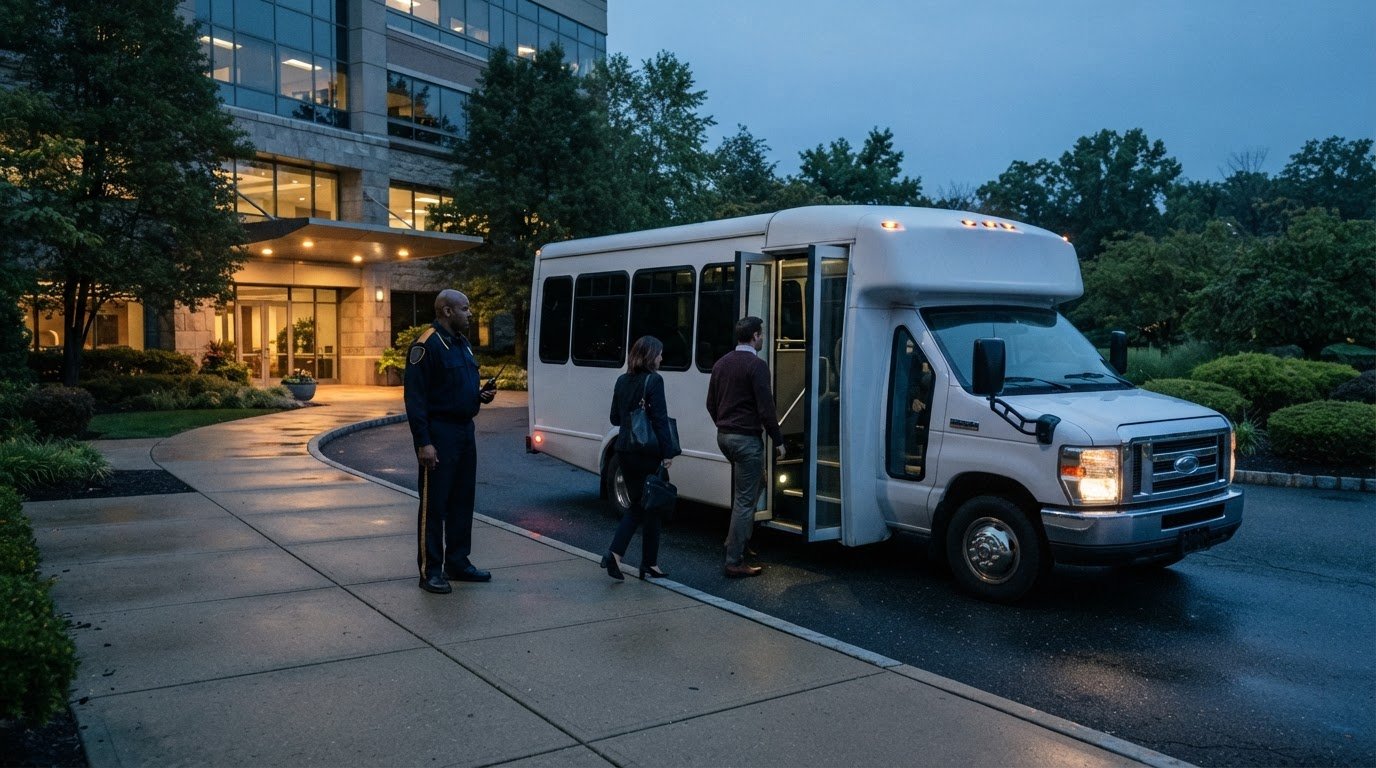
Executive Transport Security in Teterboro for Meeting Travel
For an executive arriving at Teterboro, a secure journey requires coordinated planning for the airport handoff and the onward trip. Teterboro Airport serves general aviation only and has no airline service, and it is about 12 miles northwest of Midtown Manhattan, according to the Port Authority of New York and New Jersey. A plan for executive transport security in Teterboro should account for where the passenger is met, how the transition to ground travel is handled, and what happens if plans change.
It’s reasonable to expect an airport pickup to be as well coordinated as the meeting itself. A vehicle reservation alone does not manage the handoff between the arrival point, the passenger, and the destination.
This guide explains how executive protection and advance planning can support meeting travel, what to consider when arranging ground transportation, and how security personnel can contribute to a composed, discreet journey. You’ll also learn how to assess a trip’s needs and determine where professional protection fits into the plan.
Table of Contents
Executive protection and advance work
A sound executive transport security plan in Teterboro begins before the aircraft lands. Teterboro Airport is about 12 miles northwest of Midtown Manhattan, according to the Port Authority of New York and New Jersey. That distance makes the meeting address, arrival time, passenger needs, and onward itinerary essential planning details. Advance work brings those details together so the airport handoff and meeting schedule form one coordinated plan.
Start by establishing the itinerary’s purpose and constraints. A board meeting may call for a direct transfer, while a day of appointments may involve several stops. The advance plan should identify the arrival point, destination, schedule priorities, passenger preferences, and who can approve changes. Clear decisions help the protection detail coordinate discreetly and avoid last-minute assumptions.
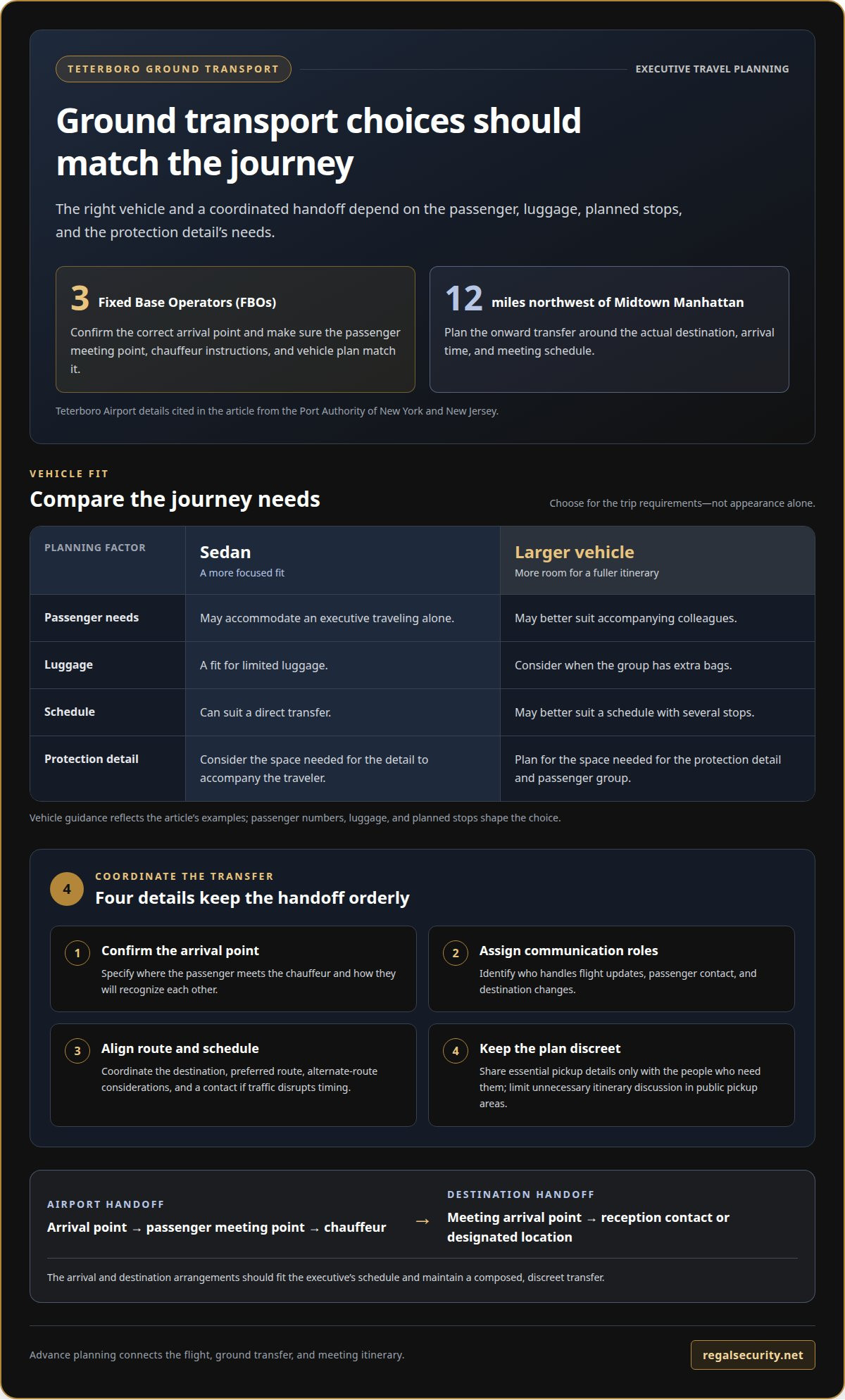
Airport arrangements deserve particular attention. The Port Authority of New York and New Jersey states that Teterboro Airport has three Fixed Base Operators (FBOs). Because an FBO is a separate arrival and departure point, the handoff plan should specify the correct location and the person coordinating it. The chauffeur’s instructions, passenger contact method, and vehicle staging plan should all match that arrival point.
Aircraft limitations also belong in the advance picture. The Port Authority of New York and New Jersey states that Teterboro Airport prohibits operations by aircraft with actual operating weights in excess of 100,000 pounds. This is an airport operating restriction, not a passenger-security procedure. Including relevant flight and arrival details in the itinerary helps the team coordinate the ground plan around the actual journey.
Confirm the itinerary: Record the meeting address, timing, planned stops, and authorized schedule contacts.
Coordinate the handoff: Align the arrival location, passenger meeting point, chauffeur instructions, and vehicle plan.
Set change procedures: Establish who communicates delays or itinerary changes and who approves adjustments.
Match transport to the trip: Consider whether a discreet sedan, luxury vehicle, or sprinter suits passenger numbers, luggage, and planned stops.
Advance planning also considers how the protection detail can accompany the executive without disrupting the meeting. A direct transfer may suit a straightforward arrival, while an Executive Protection detail can support a more involved itinerary. Vehicle Patrol may be relevant when the plan calls for attention to vehicle movement around a location. Each measure should fit the trip rather than add unnecessary complexity.
Before departure, reconcile the arrival plan with the meeting schedule and designated contacts. If an appointment location changes, for example, the updated address should reach the people coordinating the transfer and protection. Clear roles, accurate instructions, and a defined communication path make the plan easier to adapt while keeping travel orderly and discreet.
Security details accompanying ground transportation
A secure ground transfer involves more than a vehicle and a destination. For an executive arriving through private aviation, the pickup should connect the flight, meeting schedule, and people responsible for coordination. Clear roles help prevent confusion at the airport and keep the passenger’s movements discreet.
Begin with the arrival handoff. The person coordinating the flight should share the expected arrival point with the chauffeur and protection detail. Specify where the passenger will meet the chauffeur, how they will recognize each other, and who will communicate changes. For example, a designated coordinator can relay a revised arrival time without sharing sensitive itinerary details with a broad group.
Choose a vehicle to suit the journey, not its appearance. A sedan may accommodate an executive traveling alone with limited luggage. A larger vehicle may better suit accompanying colleagues, extra bags, or a schedule with several stops. Consider passenger comfort, discreet entry and exit, and the space needed for the protection detail to accompany the traveler.
Route planning should reflect the actual destination and meeting schedule. A transfer to Manhattan may call for a different approach than travel to a nearby corporate campus. The chauffeur and security coordinator should align on the destination, preferred route, alternate-route considerations, and point of contact if traffic disrupts the schedule. This keeps decisions organized instead of improvised during travel.
Coordinate roles: Identify who handles flight updates, passenger contact, and changes to the destination.
Keep instructions concise: Share essential pickup details with the people who need them.
Prepare for schedule changes: Establish how the chauffeur receives revised timing or meeting information.
Preserve discretion: Limit unnecessary discussion of the executive’s itinerary in public pickup areas.
Plan the arrival at the destination with equal care. A corporate lobby may call for a direct handoff to a reception contact, while a private office may have a different arrival point. Concierge Services can support orderly, guest-facing coordination, while Unarmed Security Officers can provide an on-site presence where appropriate. The arrangements should complement the executive’s schedule without drawing undue attention.
Communication during executive travel should be calm and specific. If a meeting time changes, the coordinator can relay only the updated timing and destination details needed for the transfer. This reduces conflicting instructions and helps the driver focus on safe, composed travel.
Organizations planning a discreet arrival can consider ground-transport security planning as part of the wider meeting itinerary. A well-defined handoff, suitable vehicle, and clear communication plan give each participant a practical role in the journey.
Executive ground transportation
At Teterboro, ground transportation planning starts by identifying the correct Fixed Base Operator (FBO). The airport uses private FBO terminals rather than one central passenger terminal, so the chauffeur needs to know the arrival FBO before positioning the vehicle. It determines where the passenger exits and where the pickup can be coordinated. Confirming the location before the aircraft lands helps prevent a mismatch between the arrival point and the ground plan.
Access has defined limits. Chauffeurs cannot access the runway, and vehicle access to the ramp depends on permission from the FBO and airport. Pickups are coordinated from FBO lobbies or other terminal pickup areas. Distinguish the passenger meeting point from any vehicle staging location. FBO-approved staging is used only when permitted, so the plan must account for local access conditions.
Arrival times can change, so flight updates matter to pickup coordination. A coordinated transportation service tracks the arriving flight and adjusts pickup arrangements when its schedule changes. The chauffeur should receive the revised timing and meeting location through a clear communication channel. This helps prevent an early vehicle arrival from turning into a confusing lobby wait, while keeping the onward schedule in view.
For a Teterboro Airport transfer to Manhattan Midtown, the listed drive time is 25-45 minutes. The listed route uses NJ-17 and the Lincoln Tunnel. That estimate is useful for planning, but a corporate itinerary should leave room for the difference between planned departure and actual arrival. Landing, passenger exit, luggage, and the meeting’s start time all affect when the executive reaches the destination.
Booking lead time depends on the arrangement. Routine airport transfers should be booked 24 hours ahead. Sprinter Van, group, and other specially coordinated trips should be booked 48-72 hours ahead. Peak New York City demand calls for booking 1-4 weeks ahead. These windows give coordinators time to align vehicle capacity, pickup instructions, and meeting requirements.
Before the flight: Confirm the arrival FBO and passenger meeting point.
Before vehicle positioning: Establish where pickup is permitted and whether staging is approved.
As timing changes: Relay updated flight timing and pickup instructions to the chauffeur.
For the onward trip: Allow for the stated drive estimate and the passenger’s meeting schedule.
Vehicle capacity should reflect who is traveling and what the group carries. A listed Mercedes-Benz S580 accommodates 3 passengers, while a Cadillac Escalade accommodates 6 passengers. A Mercedes-Benz Sprinter accommodates 14 passengers. Matching capacity to the party avoids treating a corporate group transfer like a single-executive journey. The right vehicle, confirmed FBO, permitted pickup point, and coordinated timing make the ground portion a planned continuation of the flight.
What risks or safety considerations apply to executive ground transport around Teterboro?
Executive ground travel around Teterboro involves coordination risks as well as personal-security considerations. A missed handoff, conflicting destination, or uncommunicated schedule change can disrupt the transfer. If a meeting moves from a Manhattan office to a corporate campus, for example, the chauffeur and itinerary coordinator need the same updated destination. A clear communication lead helps prevent competing instructions and unnecessary sharing of travel details.
Protect the passenger’s itinerary by sharing information selectively. Give the chauffeur essential pickup and destination details, while limiting broader circulation of the full schedule. For a day with several meetings, communicate each change to the people responsible for that part of the journey. Avoid discussing sensitive timing or destinations in public pickup areas, where other travelers may overhear.
Vehicle suitability is another practical consideration. A sedan carrying one executive and a small bag has different loading needs from a group traveling with colleagues and luggage. Before departure, confirm passenger count, luggage, accessibility needs, and planned stops. This helps avoid a rushed vehicle change or a difficult transfer between locations. Keep loading orderly, with one coordinator directing movement and confirming that the passenger is ready.
Schedule changes can create pressure to make hurried decisions. A revised landing time or delayed meeting may affect pickup coordination and the onward schedule. Establish who receives updates, who passes them to the chauffeur, and who may approve a route or destination change. If an instruction comes from an unfamiliar contact, route it through the designated coordinator rather than acting on conflicting messages.
Before travel: Confirm passenger names, destination details, luggage, and the designated communication lead.
At pickup: Use an agreed recognition method and keep passenger identification discreet.
During a change: Share revised instructions through one established contact path.
At arrival: Coordinate the handoff with the meeting contact before the vehicle departs.
Give arrival at the meeting site its own attention. A corporate lobby, private office entrance, and event venue may each have different reception arrangements. Identify the intended drop-off point and the person receiving the executive before the vehicle sets out. If the next appointment changes, communicate the new destination directly to the responsible coordinator and chauffeur. Avoid asking the passenger to resolve conflicting instructions while entering or leaving the vehicle.
An executive protection plan should be proportionate to the itinerary and passenger’s needs. A direct airport-to-office journey may call for a simpler arrangement than a day involving several stops and public-facing meetings. Clear roles, discreet communication, suitable vehicle capacity, and deliberate handoffs address common points of friction without making unsupported promises about results.
Quotes, booking terms, and possible additional charges
A useful Teterboro transportation quote starts with a defined itinerary, not just an airport and destination. Include the arrival FBO, passenger count, luggage, destination, planned stops, and meeting timing. Each detail can affect vehicle selection and coordination. A direct transfer for one executive, for example, differs from a group journey with several corporate stops.
Ask for the quote to distinguish the transportation arrangement from other costs. Teterboro Airport landing fees are billed by the Port Authority of New York and New Jersey and are separate from FBO charges. Both are distinct from ground transportation costs. Keeping these categories clear helps the travel coordinator understand which charges relate to airport operations, FBO services, and the vehicle transfer.
The cost of an executive security arrangement depends on the case and is provided after a quote request. Relevant factors include itinerary scope, service duration, staffing, and coordination needs. Describe the travel plan and support required rather than assuming every journey needs the same arrangement. A single airport-to-office transfer and a full day with several appointments call for different planning.
Booking terms should clearly state the agreed schedule and trip details. Specify the pickup location, destination, passenger count, luggage, planned stops, and the contact responsible for changes. If flight timing shifts, the coordinator should communicate the update through the agreed channel. This keeps the chauffeur’s instructions aligned with the current itinerary, not an earlier version.
Lead time varies with the type of trip. Routine Teterboro Airport transfers should be booked 24 hours ahead. Sprinter Van, group, and other specially coordinated trips should be booked 48-72 hours ahead. During peak New York City demand, bookings should be made 1-4 weeks ahead. These intervals help organize vehicle capacity and trip coordination; they are not substitutes for setting out the exact service terms.
Define the route: Give the departure point, destination, stops, and meeting schedule.
Describe the party: State passenger and luggage requirements to guide vehicle selection.
Separate charge types: Distinguish transportation arrangements from airport landing fees and FBO charges.
Record change procedures: Identify who communicates updates and how revised instructions reach the chauffeur.
Before accepting a quote, compare its stated itinerary with the requested trip. A mismatch in the FBO, destination, passenger count, or planned stops can change the arrangement. For a journey that also requires protective planning, request a tailored security quote based on the itinerary and its coordination needs.
Regal Security: Executive Protection
Regal Security provides Executive Protection for executives whose meeting travel calls for a considered security presence. This service can suit itineraries involving an airport arrival, corporate appointments, or several transitions that require coordinated attention. Unarmed Security Officers, Concierge Services, and Vehicle Patrol can support related security needs in appropriate settings. The right arrangement depends on the travel plan, locations, and support required. Share the itinerary’s key details and priorities so the discussion can focus on the journey and its practical requirements. For executive protection support related to meeting travel, contact Regal Security.
Prepare Your Next Meeting Journey
Treat the next meeting itinerary as an operational document, not a fixed calendar entry. Assign one person to approve changes, keep the traveler’s priorities clear, and ensure current instructions reach everyone coordinating movement. This discipline helps keep executive transport security in Teterboro aligned with the trip’s purpose, even as schedules evolve.
Before each journey, define the priorities: a discreet arrival, coordinated transitions, or maintaining a demanding meeting schedule. Clear priorities let protective planning support business objectives rather than compete with them. They also give the coordination team a sound basis for decisions when timing or meeting arrangements change.
Regal Security can discuss how its security services may support the itinerary’s needs. For a conversation focused on your travel requirements, contact Regal Security to discuss executive travel. Bring the trip’s purpose and priorities to that discussion; a considered plan can help your team approach the next meeting with greater clarity.
Frequently Asked Questions
What executive transportation and security services are available at Teterboro Airport?
Regal Security provides Executive Protection, Unarmed Security Officers, Concierge Services, and Vehicle Patrol for security needs related to executive travel. These services can complement an airport transfer arranged separately; Regal Security provides security services, not chauffeur or vehicle bookings. For a meeting itinerary involving Teterboro and destinations in New York City or New Jersey, clarify whether the priority is personal protection, an on-site presence, or support at a guest-facing location.
Which Teterboro-area companies provide secure executive ground transportation?
Regal Security provides executive security services for travel plans involving Teterboro, New York City, and New Jersey. Executive Protection addresses personal security, while Unarmed Security Officers, Concierge Services, and Vehicle Patrol support other relevant security needs. Ground transportation is arranged separately. For example, an executive can coordinate a vehicle transfer independently and engage Regal Security for protection needs connected with the itinerary.
What vehicles and protective services can be booked for Teterboro transfers?
Sedans, SUVs, and sprinter vans are transportation choices, while Regal Security provides protective services rather than vehicle bookings. Executive Protection can support an individual’s travel, while Unarmed Security Officers, Concierge Services, and Vehicle Patrol address related security requirements. An executive traveling with colleagues can arrange a suitable vehicle separately and plan security support around the meeting locations and responsibilities at each stop.
How do I arrange executive transportation and security at Teterboro Airport?
Arrange the vehicle transfer and security support as coordinated but distinct parts of the trip. Give the travel coordinator the passenger’s itinerary, meeting locations, relevant security priorities, and a designated contact for changes. Then discuss with Regal Security whether Executive Protection, an on-site officer, Concierge Services, or Vehicle Patrol best suits the requirements. This approach is useful for schedules connecting Teterboro with Manhattan, Brooklyn, or other New York and New Jersey destinations.
How far in advance should I book secure transportation at Teterboro?
Book routine Teterboro transfers 24 hours ahead; specially coordinated group or Sprinter Van trips should be booked 48-72 hours ahead. For peak New York City demand, arrange transportation 1-4 weeks ahead. These booking windows apply to transportation planning. For a trip that also involves security support, include the itinerary and meeting requirements in the planning conversation so the proposed arrangements can reflect the journey’s needs.