Security Guard Service Level Agreements: Coverage and Metrics
A security arrangement needs more than a post assignment. Both parties need a shared understanding of what the service includes and how it will be assessed. A security guard service level agreement (SLA) formalizes expectations between a customer and a security provider, defining the scope of protection, responsibilities, communication, and performance standards. It can also clarify how staffing, supervision, reporting, and escalation fit together.
That clarity matters because security coverage depends on people and decisions, not just contract language. The customer sets site priorities and shares relevant requirements, while the provider defines how the agreed services are staffed, overseen, and documented. Clear measures make it easier for both sides to review whether the arrangement is meeting its purpose.
This article explains what an SLA can cover, how post coverage and staffing requirements are expressed, and which metrics make performance measurable. It also describes how supervision and incident escalation work, and why identifying the parties and their responsibilities is central to an effective agreement.
Table of Contents
What Is A Security Service Level Agreement (SLA)?
A security service level agreement records what protection a provider will deliver, how performance will be assessed, and how the client and provider communicate. Its scope can cover posts, staffing, incident response, reporting, and responsibilities.
Service Scope and Responsibilities
The service scope defines the agreed security tasks and assigns responsibility for each. For the client, this clarifies which activities belong to the provider and which depend on site information or decisions.
Terms should identify coverage areas, operating hours, post duties, reporting expectations, and communication procedures. For example, an agreement can distinguish guarding an entrance from patrolling elsewhere on the property.
What terms should a security guard SLA include? It should describe services, staffing expectations, performance measures, reporting, escalation, and review procedures. A security guard service level agreement should also explain how changes to the site or service scope are documented.
Legal Compliance and Client Duties
Compliance and client duties describe how the agreement addresses applicable requirements and the information each party must provide. Clear assignments help prevent gaps between the written scope and site operations.
The provider and client should discuss expectations before setting service commitments, and the provider should assess its capacity before agreeing to deliver them. The agreement can record site rules, access procedures, known risks, and the client contact responsible for operational decisions.
In the United States, the enforceability of penalties, credits, and termination clauses can vary by jurisdiction and contract law. Formal documentation can set out review procedures, while legal counsel can help assess contract language for the relevant jurisdiction.
Alarm and Duress Response Times
Alarm and duress response terms define what happens after an alert, including who acknowledges it, who is dispatched, and what happens next. Separating these stages gives the client a clearer way to assess response performance.
A sample SLA requires responses to security events within five minutes and security phones to be answered within four rings. These are sample commitments, not universal standards. An agreement should set targets suited to its defined coverage and operating conditions.
Define the starting point and endpoint for each response-time measure. Acknowledgment measures when an alert is received or recognized, while arrival measures when personnel reach the specified location. Dispatch time can separately describe mobilizing the nearest available team after an initial call or alarm.
Insurance, Indemnity, and Liability Terms
Insurance, indemnity, and liability terms explain how the parties address coverage, claims, and responsibility for losses. Their wording matters because it clarifies how contractual risk is allocated when an incident leads to a dispute.
What insurance, indemnity, and liability clauses should a security guard SLA include? The agreement should define required insurance documentation, the events covered by indemnity, and the process for notifying and handling claims. It should also state any liability limits or exclusions the parties accept.
These terms should align with the service scope and the parties’ assigned duties. For example, a claim involving a missed report may raise different questions from one involving an incident response. Clear definitions and legal review help keep responsibilities and remedies coherent.
Post coverage and staffing requirements
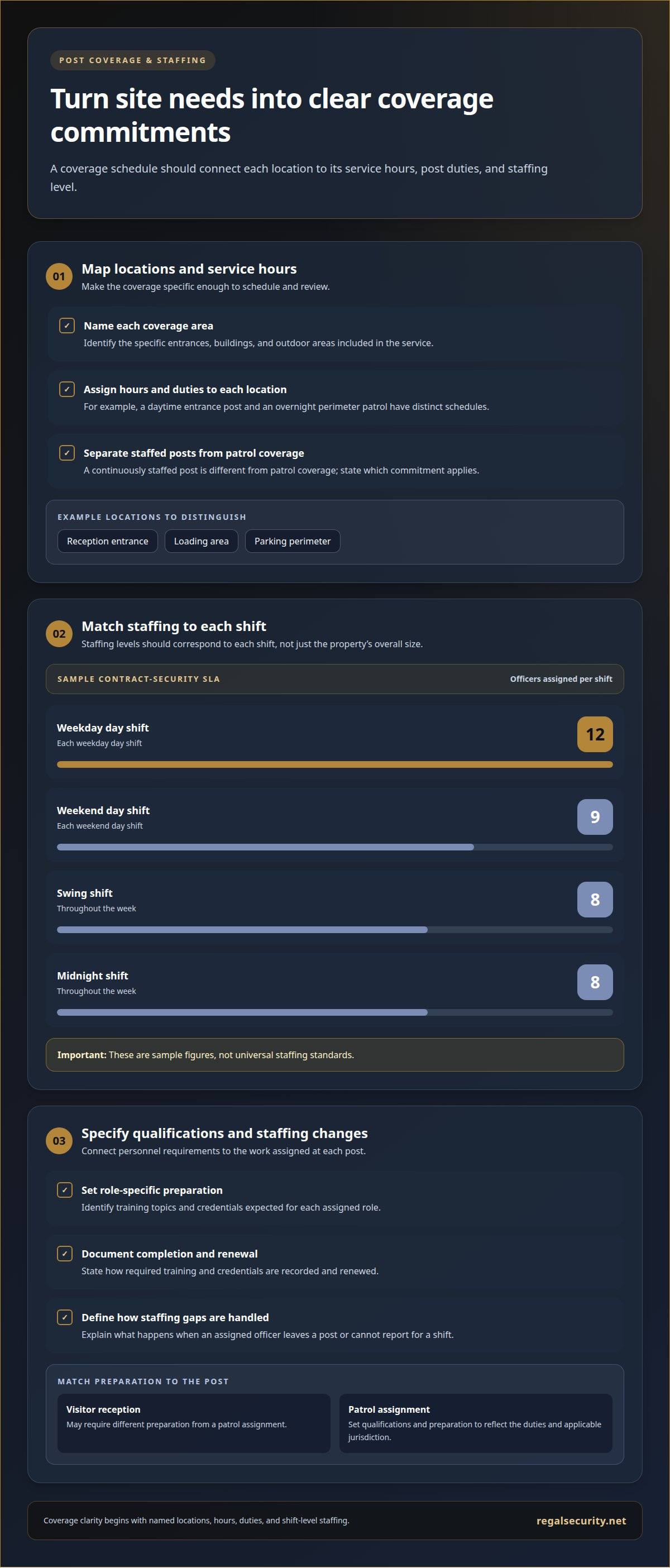
A coverage schedule translates site needs into named locations, service hours, post duties, and staffing levels. A clear contract distinguishes a continuously staffed post from patrol coverage, so each commitment can be scheduled and reviewed.
Locations and Service Hours
Locations and service hours identify where security coverage applies and when each assignment operates. This detail helps the client understand which entrances, buildings, and outdoor areas fall within the agreed service.
For example, a site plan can distinguish a reception entrance from a loading area and a parking perimeter. The contract should connect each location with its assigned hours and duties, rather than relying on broad phrases such as “site coverage.”
Operating hours can also differ by location. A daytime entrance post and an overnight perimeter patrol have distinct schedules, so recording them separately clarifies the expected coverage in each period.
Training and Licensing Requirements
Training and licensing terms describe the qualifications and preparation expected for each assigned role. Including them helps the client understand how personnel are matched to post duties and how relevant qualifications are documented.
The SLA can identify role-specific training topics, required credentials, and the process for documenting completion or renewal. For example, a post involving visitor reception may require different preparation from a patrol assignment.
Requirements should reflect the duties and applicable jurisdiction. The agreement can also state how staffing changes are handled when an assigned officer leaves a post or cannot report for a shift.
Staffing levels should correspond to each shift, not merely to the property’s overall size. A sample contract-security SLA sets twelve officers for each weekday day shift, nine officers for each weekend day shift, and eight officers for each swing and midnight shift throughout the week. These are sample figures, not universal staffing standards.
Post descriptions make staffing levels meaningful. For each assignment, the agreement can state the location, primary duties, shift, reporting line, and required documentation. A lobby post, for example, may focus on observing access activity, while a patrol assignment covers designated internal or external areas.
Patrol frequency can be written as an observable commitment. One sample SLA calls for internal patrols every two hours and external patrols every four hours. The agreement should connect each interval to its patrol area and activity log, so reviews can distinguish completed rounds from missed or delayed coverage.
Staffing continuity also needs clear terms. A security SLA can require the provider to backfill a call-off within a specified window, with that window recorded in the contract. It can define how a temporary gap is reported, who receives notice, and what record captures the replacement’s arrival.
For each post, the agreement can make these elements explicit:
Assigned location and service hours
Required staffing level for each shift
Post duties and patrol frequency
Training or credential documentation relevant to the role
Call-off reporting and backfill expectations
SLA metrics, thresholds, and measurement sources
Metrics turn service expectations into evidence the client and provider can review. A useful measure names the expected result, the responsible role, and the record used to assess performance.
To compare security service agreements, use the same criteria for each: defined responsibilities, measurable thresholds, reliable records, and a recurring review schedule. This shows whether each agreement makes performance observable and assigns accountability.
Performance Metrics and Thresholds
Performance metrics are defined indicators, while thresholds set the level required to meet an agreement’s standard. They matter because a specific target lets the client assess performance against agreed duties rather than rely on broad descriptions such as “prompt” or “thorough.”
Key performance indicators can address cost, responsiveness, and quantity. For example, an agreement can measure whether scheduled duties were completed, how quickly a defined response occurred, or whether activity stayed within an agreed cost measure.
Each indicator should be specific, measurable, and tied to an assigned responsibility. A threshold also needs a measurement period and a clear counting method, so both parties interpret the results consistently.
Security service levels can be reviewed monthly or quarterly. Recurring reviews help identify patterns, such as repeated incomplete records, and give the parties a structured basis for refining service expectations.
Measurement Sources and Reporting
Measurement sources are the records used to establish whether a service met its agreed standard. Naming these sources lets the client and provider review evidence instead of relying only on recollection.
Routine records can include patrol logs, access control records, and observation notes. A daily activity report can show completed duties, while an incident report can document a specific event within the reporting window set by the agreement.
How are security guard service levels measured and reported? The parties compare recorded results against each metric’s threshold, then summarize findings in the agreed format. Performance summaries can help track compliance, identify patterns, and refine risk planning over time.
For consistent reviews, an SLA can state who prepares each report, which records support it, and when the client receives it. A same-day daily activity report, for instance, sets a clear reporting expectation. Incident reports can follow a separately defined window.
A practical review can group evidence by responsibility:
Completion records for scheduled duties
Response records tied to defined service thresholds
Reports showing observations and activity
Recurring summaries of compliance and patterns
When a result falls short, the documented measure and source help identify the issue. The parties can then distinguish a missed duty from incomplete documentation and address the right performance gap.
Supervision, monitoring, and incident escalation
Supervision establishes who reviews security activity, while escalation defines how concerns reach decision-makers. In a security agreement, these procedures connect routine oversight with a documented response when incident conditions change.
Supervision and Service Monitoring
Supervision and monitoring describe how a provider reviews assigned duties and service records. This helps the client see who is accountable for oversight and how follow-up is documented.
A sample contract-security SLA calls for one supervisory visit per daytime shift. The agreement can define the visit’s purpose, such as reviewing post readiness, discussing observations, and recording issues that require follow-up.
Monitoring can also draw on routine records, including patrol logs, access control records, and observation notes. For example, a supervisor reviewing a patrol log can compare recorded activity with the duties assigned to that post.
The agreement should identify the supervisor responsible for receiving concerns and the process for documenting them. If a review identifies an incomplete record, the provider can note the discrepancy, assign follow-up, and include the outcome in the next service review.
Incident Escalation Procedures
Incident escalation procedures set out who must be notified as conditions change, how updates are delivered, and how decisions are recorded. Defined steps help the client and provider respond consistently instead of relying on improvised communication.
The agreement can assign notification roles to officers, supervisors, managers, and external partners. It can also distinguish routine observations from incidents requiring immediate management attention, with the applicable priority guiding notifications and resources.
A clear escalation sequence can specify:
Who receives the initial incident notice
Which supervisor or manager is contacted if conditions change
How the client receives updates and through which channel
Where actions, decisions, and outcomes are documented
For example, an officer can report an incident to the designated supervisor, who then informs the named client contact. If the situation changes, the procedure can identify the next manager or external partner to notify, leaving no uncertainty about who makes decisions.
Each update should capture the event status, action taken, person notified, and any decision made. An incident report can preserve that sequence for later review, while the escalation procedure explains who owns each communication step.
Reviewing escalation records alongside supervisory notes can reveal whether notifications followed the agreed chain. The agreement can establish how unresolved issues are escalated and how follow-up is assigned, giving both parties a consistent basis for reviewing the response.
Parties to a security guard services agreement
A security services agreement works only when each signatory and operational contact has a defined role. The central parties are the customer receiving coverage and the security provider responsible for delivering the agreed service.
The customer is usually the organization responsible for the protected property or site. Its role includes setting priorities, identifying relevant site requirements, and assigning an authorized representative for decisions. For example, a property manager may coordinate routine service matters, while a designated executive approves contract changes.
The security provider accepts responsibility for the services set out in the agreement. Its representative should have authority to discuss staffing, service records, and operational concerns. Naming a provider contact gives the customer a clear route for raising service issues without confusing operational communication with contract changes.
The people performing the work are operationally important, but they are not necessarily signatories. The agreement should distinguish the provider’s contractual obligations from officers’ assigned duties and supervision. For example, an officer may record an observation, while the provider’s supervisor handles follow-up and reports it to the customer’s authorized contact.
Other parties may affect communication without becoming parties to the agreement. A building manager, tenant representative, or emergency contact may receive information or coordinate access. The agreement should define their role and the limits of their authority. Someone who receives an incident update, for instance, should not be assumed to have authority to change the contracted scope.
Clear assignments prevent common points of confusion. If a site has separate property and operations teams, the agreement can name which representative approves schedule changes and which receives routine reports. If the provider needs access instructions, it can identify the customer contact responsible for supplying them. These assignments make decisions traceable.
Before execution, the parties can map each responsibility to a named role:
The customer’s authorized signatory approves contractual terms.
The customer’s designated contact handles operational communication.
The provider’s authorized representative addresses service delivery.
The provider’s supervisor oversees assigned personnel and follow-up.
Any additional site contact receives only the information assigned to that role.
This distinction also supports orderly contract changes. The agreement can state that requests from site personnel go to the designated representative, who routes proposed changes through the agreed approval process. A verbal request at a post, for example, need not become an undocumented change to coverage.
To discuss how defined on-site responsibilities can support your security coverage, start a conversation about site security needs.
Regal Security: Concierge Services
Regal Security provides Concierge Services for properties seeking a professional, security-minded presence at visitor-facing locations. This service can suit organizations that want reception and security needs considered together as they define coverage, responsibilities, and reporting expectations.
Where a site requires a dedicated security presence beyond concierge responsibilities, Unarmed Security Officers may be relevant. The right arrangement depends on the property’s priorities and the duties the agreement needs to define.
For support aligning on-site service with your security requirements, contact Regal Security to discuss your needs.
Make the agreement work on site
A well-crafted security guard service level agreement should remain useful after signing. Its terms need to guide everyday coordination, support consistent service reviews, and adapt when site priorities change. Treat the agreement as an operating framework, not merely a record of initial expectations.
As you consider the next step, connect the service model to the experience your property requires. Regal Security offers Unarmed Security Officers, Concierge Services, and Vehicle Patrol, which can suit different coverage needs. The right arrangement depends on the duties and setting you want addressed.
For a conversation about aligning security services with your site’s priorities, discuss security services with Regal Security. A clear starting point can help turn operational needs into a considered plan.
Frequently Asked Questions
What is a security guard service level agreement (SLA)?
A security guard service level agreement is a written arrangement that clarifies the customer’s expectations and the provider’s commitments. Beyond describing coverage, it can establish how amendments are approved, how service concerns are raised, and how unresolved issues proceed. For example, if a tenant’s access needs change, the agreement’s change process helps authorized representatives decide whether duties or schedules should be revised.
How should security guard response times and patrol frequency be defined in an SLA?
Define each response target by its trigger, starting point, endpoint, and completion record. Keep alert acknowledgment distinct from dispatch and arrival, since each measures a different stage. Patrol terms should identify the assigned route or area, what counts as a completed round, and how exceptions are recorded. This lets a review distinguish a missed patrol from a completed patrol with an incomplete log.
What remedies, service credits, or penalties can an SLA set for missed security service levels?
An SLA can set out remedies such as a corrective-action plan, a service credit, or a right to exit after repeated breaches. It should define what counts as a breach, how it is documented, and the process for notifying the other party and resolving disputes. In the United States, enforcement of credits, penalties, and termination clauses can vary by jurisdiction and contract law, so clear drafting matters.
How should a security guard SLA address emergencies, incident reporting, and escalation?
The agreement should link emergency actions to designated contacts, approved communication channels, and required incident records. For example, after a disruption at a building entrance, the officer can record the location, observed conditions, actions taken, and notifications made. The agreement should also clarify how updates are handled if circumstances change and how the final report is submitted. Consistent records help the parties review what occurred and address follow-up.
What state and local laws affect security guard service agreements in the United States?
Applicable requirements depend on where services are delivered, and contract enforcement can also vary. Agreements covering New York City, Manhattan, Brooklyn, Queens, the Bronx, Staten Island, Long Island, Nassau or Suffolk County, Westchester, Rockland, Orange County, or New Jersey should be considered in light of relevant state and local rules. Legal review can help assess the agreement’s obligations, remedies, and termination terms for each location.